

These are weird times.
The economic environment feels unsettled. Costs remain high. Public needs are becoming more complex. Governments are reassessing priorities. Funding streams and engagement opportunities that organizations may have come to understand, rely on, or plan around do not always feel as predictable as they once did.
For nonprofits, charities, and mission-driven organizations, that uncertainty is not abstract.
It shows up in rising demand. It shows up in stretched teams. It shows up in tighter budgets, more complicated funding environments, and more pressure from the communities they serve. It shows up in board conversations, strategic planning sessions, and quiet questions about what comes next.
At the same time, the people and communities nonprofits serve are also living through uncertainty. Public opinion research has increasingly described a shift from scarcity to precarity: not only concern about today’s costs, but anxiety about whether the systems people rely on will hold up in the future.
That matters for nonprofits because they often sit closest to the pressure.
They see early signs of housing instability, food insecurity, mental health strain, caregiver burnout, employment barriers, family stress, and people falling through the cracks between systems.
The question is what organizations do with that knowledge.
In uncertain times, it can be tempting to pull back. To focus only on immediate service delivery. To wait until the funding picture becomes clearer. To assume government is too distracted, too constrained, or too cautious to engage.
That instinct is understandable.
But it is also risky.
When the path ahead is uncertain, nonprofits should not move further away from government.
They should move closer.
The Old Assumptions Are Shifting
For many organizations, the past few years have changed what government engagement feels like.
Funding opportunities may not look the same. Program renewals may feel less predictable. Consultation processes may shift. Political priorities may evolve quickly. Governments may be more focused on affordability, fiscal discipline, productivity, system pressure, and visible outcomes.
That does not mean opportunity has disappeared.
It means opportunity may be harder to see.
In more stable times, organizations may be able to plan around familiar windows: annual budget submissions, regular program intakes, predictable consultations, known funding streams, or established relationships with officials.
In more uncertain times, those pathways can become less clear. Programs may be redesigned. New priorities may emerge quickly. Funding may be tied to different outcomes. Government may look for partners who can help solve immediate problems, reduce system pressure, or demonstrate measurable public value.
That is exactly why engagement matters.
Government relations is not only about asking for something. It is also about understanding what is changing, where decisions are moving, and how your organization’s work fits into the moment.
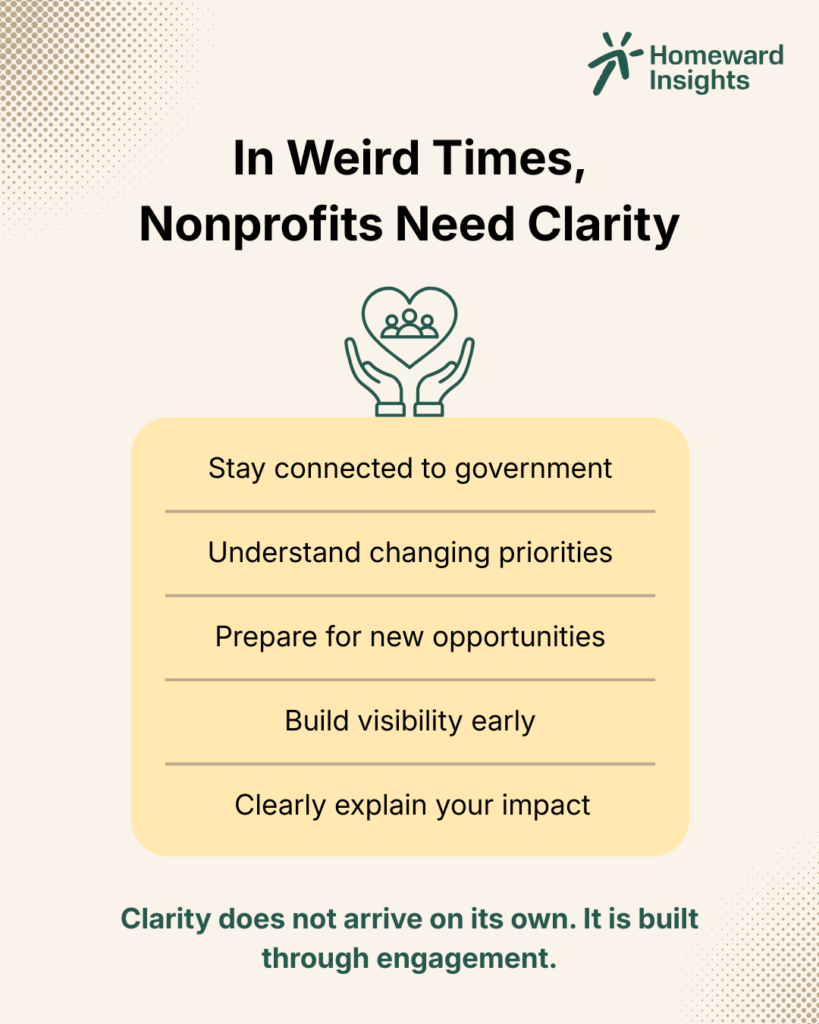
When the environment is unclear, engagement is how organizations create clarity.
Clarity Comes From Being in the Conversation
Many nonprofits wait to engage government until they have a fully formed ask.
That can make sense. Government should not be approached casually or without preparation.
But in uncertain times, waiting for perfect certainty can mean waiting too long.
Sometimes the purpose of engagement is not to arrive with a final answer. Sometimes the purpose is to test the landscape, understand the direction of travel, hear what government is trying to solve, and begin positioning your organization as part of the solution.
A good conversation with government can help clarify whether an issue is timely. It can reveal which ministry, office, program, or process matters most. It can help an organization understand what evidence is needed, which partners would strengthen the case, and whether the current framing is likely to land.
That kind of clarity is valuable.
It can help organizations avoid wasted effort, prevent them from chasing the wrong opportunity and can help them prepare before a funding window opens. It can also signal to an organization when the immediate path is not ready, but a future one may be.
In other words, engagement is not only about influence.
It is also about learning.
Visibility Matters Before the Opportunity Appears
In uncertain times, government still makes choices.
Programs are still designed. Budgets are still developed. Pilots are still launched. Consultations still happen. Implementation tables are still formed. New funding streams still emerge. Existing programs are still reviewed, renewed, narrowed, or expanded.
The question is whether your organization is visible when those choices are being made.
You do not want government learning who you are for the first time when a funding window opens. You do not want to be introducing your model after program design is already mostly complete. You do not want to be explaining your sector for the first time when decisions have already narrowed.
You want to be known before the opportunity appears.
That does not mean being loud for the sake of being loud. It does not mean chasing every announcement, sending constant emails, or trying to meet everyone.
It means being legible.
Government should understand what your organization does, what public problem you help solve, what communities you serve, what pressures you are seeing, and what role you could play when an opportunity emerges.
That is how inbound calls happen.
Not by accident and not because government knows every strong organization automatically. But because a relationship, a briefing, a meeting, a submission, or a prior conversation helped make the organization visible and credible before the moment arrived.
In uncertain times, visibility becomes strategy.
Advocacy Is Not Only About Asking for Money
When the economic environment is difficult, government relations is sometimes reduced to funding.
Funding matters. For many nonprofits, it is essential.
But advocacy is broader than asking for money.
Advocacy can be about helping government understand an emerging pressure before it becomes a crisis or can be about protecting an effective program from being redesigned in a way that weakens delivery. It can also be about improving eligibility rules, reducing administrative burden, aligning capital and operating funding, fixing a procurement issue, or showing why a community-based model delivers better outcomes than a more expensive institutional response.
Sometimes the most important advocacy is not a new request.
It is making sure government understands the consequences of its choices.
A nonprofit may be holding pressure that would otherwise show up in hospitals, shelters, schools, police services, long-term care, corrections, or crisis response systems. But government may not see that connection unless the organization explains it clearly.
That is especially important when governments are making harder choices.
If decision-makers are focused on value, risk, outcomes, and fiscal discipline, nonprofits need to be able to explain not only what they do, but what their work prevents.
What Nonprofits Should Be Asking Now
For organizations trying to navigate uncertain times, the lesson is not to panic.
It is to get more deliberate.
A few questions are worth asking now:
- Where does government already affect our work?
- What public problems are we helping solve?
- What pressures are we seeing before they become visible elsewhere?
- Which funding streams, programs, policies, or decisions could affect us in the next year?
- Who in government understands our role?
- Who should understand it but does not yet?
- What would we want government to know before the next opportunity appears?
These questions help organizations move from uncertainty to strategy.
They also help reframe government relations as something more useful than a last-minute push for funding. Done well, government relations helps organizations understand the landscape, build relationships, sharpen their public value, and prepare for moments that may not yet be visible.
How Homeward Helps
At Homeward, we work with nonprofits, charities, Indigenous communities, social enterprises, and mission-driven organizations navigating exactly this kind of uncertainty.
We help organizations understand where government matters to their work, how decisions are being made, who needs to hear their story, and how to turn operational reality into a clear public policy case.
In weird times, that work becomes more important.
The goal is not to manufacture certainty where none exists. The goal is to create enough clarity that organizations can see where they fit, where risks may be emerging, and where opportunity may appear.
A strong government relations strategy can help an organization become more visible, more legible, and more prepared. It can help ensure that when government is looking for partners, evidence, delivery models, or practical solutions, your organization is already part of the conversation.
For organizations that are not sure where to begin, Homeward Talks is a practical starting point. It is a low-barrier way to speak with an expert, take stock of the current environment, and begin thinking through whether government relations should be part of your strategy.
Book a Homeward Talk Today: https://homewardpa.ca/talks/
A Final Thought
These are uncertain times.
That is exactly why engagement matters.
Nonprofits cannot control every economic trend, funding decision, or political shift. But they can control whether they are visible, whether their work is understood, and whether they are prepared when new opportunities emerge.
When the path ahead is unclear, the answer is not to wait for certainty.
The answer is to get closer to the people, processes, and decisions that will shape what comes next.
Because in uncertain times, clarity does not arrive on its own.
It is built through engagement.