

Many organizations come to government with a funding need.
That is understandable.
A program is oversubscribed. A capital project needs support. A service model is working but cannot scale. A funding agreement is ending. A community need is growing faster than the organization’s resources. A project is ready, or almost ready, but the final dollars required to make it happen are not yet in place.
In those moments, it is natural to say: “We need funding.”
But a funding need is not the same thing as a government relations strategy.
It may be the reason you need to engage government. It may be the pressure point that has forced the conversation. It may even be the ultimate outcome you are trying to secure.
But on its own, “we need funding” is not enough.
Government needs to understand not only what your organization needs, but why supporting your organization helps solve a public problem.
That is where the strategy begins.
Government Does Not Fund Need Alone
Need matters.
The human stakes matter. Community demand matters. Service gaps matter. Organizational sustainability matters.
But governments make decisions in a crowded environment. They are weighing competing priorities, limited fiscal room, political commitments, delivery capacity, public expectations, risk, and timing.
That means an ask has to do more than describe an organizational challenge.
It has to become a public policy case.
A strong ask helps government understand the problem, the opportunity, the role your organization can play, and the decision required. It connects your work to something government already needs to solve.
That might be housing affordability, health system pressure, food insecurity, workforce participation, mental health, economic resilience, public safety, Indigenous economic development, climate adaptation, community infrastructure, or another public priority.
The point is not to distort your mission to fit government’s language.
The point is to translate your mission into terms government can understand, assess, defend, and act on.
A Strong Ask Answers Five Questions
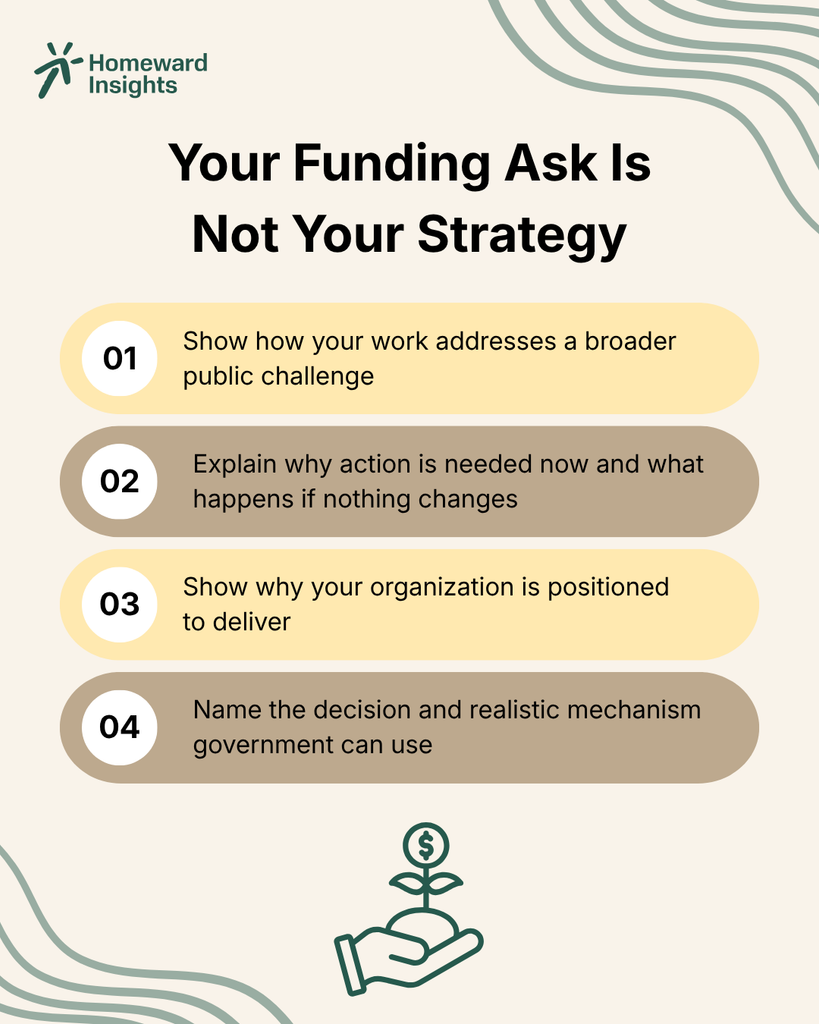
The strongest government asks usually answer five basic questions.
First: what is the public problem?
This is different from the organizational problem. “Our program needs funding” may be true, but government also needs to understand the broader issue. What gap does the program address? What population does it serve? What system pressure does it reduce? What gets worse if the work cannot continue?
Second: why now?
Timing matters. Is there a budget window? A program review? A mandate commitment? A crisis? A cost pressure? A new policy direction? A community need that has become more urgent?
Government is more likely to act when an issue is connected to a live decision point or a current priority.
Third: why you?
Organizations often assume their credibility is obvious. It usually is not.
Government needs to know why your organization is well positioned to deliver. That might include your track record, relationships, community trust, operational expertise, scale, data, partnerships, readiness, or ability to reach people government struggles to reach directly.
Fourth: what should government do?
This is where many asks become too vague.
“Support our work” is not specific enough. Does that mean capital funding? Operating funding? A pilot? A policy change? A regulatory amendment? A procurement adjustment? A program eligibility fix? A letter of support? Inclusion in a consultation? A meeting with officials? A partnership pathway?
The clearer the action, the easier it is for government to understand what is being asked.
Fifth: what happens if nothing changes?
This is not about fearmongering. It is about consequences.
What is the cost of inaction? Will people fall into crisis? Will another part of the public system absorb higher costs? Will housing be lost? Will a community need deepen? Will a promising model fail to scale? Will government miss an opportunity to act before the problem becomes more expensive?
A strong ask makes the consequence of inaction visible.
The Ask Has to Fit the Mechanism
Not every problem is solved through a budget line.
Sometimes the right path is a new funding commitment. Sometimes it is a change to program criteria. Sometimes it is regulatory flexibility. Sometimes it is a pilot project. Sometimes it is procurement reform, tax treatment, land access, operating alignment, implementation guidance, or inclusion in a formal advisory process.
This matters because organizations can sometimes arrive at government with the right problem but the wrong mechanism.
A department may agree that the issue is real, but not have a program that fits. A political office may be sympathetic, but not know what decision is required. Officials may understand the barrier, but need a different kind of evidence or process to act.
A good government relations strategy does not only ask, “What do we want?”
It asks, “What is the pathway by which government could realistically do this?”
That distinction is critical.
An ask that is technically impossible, poorly timed, or disconnected from the right decision-making process may not move, even if the underlying idea is strong.
A strong ask is not necessarily smaller.
It is clearer.
The Ask Has to Be Politically Realistic
Ambition matters. Organizations should not be afraid to bring forward serious ideas, especially when the need is real and the public value is clear.
But ambition without political realism can create problems.
An ask may be too broad. Too expensive. Too vague. Too disconnected from the government’s current priorities. Too late for the relevant fiscal window. Too early for the evidence available. Or too dependent on a part of government that does not actually control the outcome.
That does not mean the organization should give up.
It means the strategy needs to be sharpened.
Sometimes the right move is to break a large objective into stages. Sometimes the first win is not the final funding commitment, but getting the issue into a briefing note, consultation process, program review, or senior-level conversation. Sometimes the best path is to build credibility with officials before asking for political intervention. Sometimes the strategy is to secure a pilot before seeking a permanent program.
Political realism is not about lowering expectations.
It is about understanding how change actually happens.
A Strong Ask Is Human and Usable
At Homeward, we often describe our approach as policy advocacy, made human.
That matters when building an ask.
The human story is essential. Government needs to understand who is affected, what is at stake, and why the issue matters in real life. A purely technical ask can miss the emotional and public purpose behind the work.
But humanity alone is not enough.
Government also needs something usable. It needs clear recommendations. It needs evidence. It needs implementation logic. It needs to understand cost, timing, authority, risk, and expected outcomes.
The strongest asks bring those elements together.
They are rooted in real people and real community need, but structured in a way government can act on.
That is what makes advocacy effective.
Not just passion. Not just policy.
Both.
What This Means for Organizations Like Yours
For organizations considering government engagement, the starting point should not be a 40-page deck or a long list of everything you need.
It should be clarity.
- What public problem are you helping solve?
- Why does it matter now?
- Why is your organization credible?
- What specific action are you asking government to take?
- What happens if nothing changes?
These questions can feel simple, but they are often the difference between an ask that gets heard politely and an ask that starts to move.
They also help organizations use their time and resources more effectively.
A clear ask makes meetings better. It makes briefing notes stronger. It makes follow-up more useful. It helps boards understand the strategy. It helps staff stay aligned. It helps government know what to do with the information being provided.
Without that clarity, even good advocacy can become scattered.
With it, an organization has a much better chance of turning need into public value, and public value into action.
How Homeward Helps
Homeward helps mission-driven organizations move from “we need support” to a clear government strategy.
That means helping clients define the public problem, sharpen the ask, identify the right mechanism, understand the political and fiscal timing, and position their work in a way government can understand and act on.
Sometimes that leads to a funding strategy. Sometimes it leads to a policy proposal, a regulatory fix, a program design conversation, a partnership pathway, or a longer-term relationship-building effort.
The right path depends on the objective.
But the first step is almost always the same: making the ask clear, credible, timely, and actionable.
For organizations that know government support may matter but are not sure what the ask should be, Homeward Talks is a practical place to start. It is a low-pressure way to speak with an expert, clarify the opportunity, and begin thinking about what a real government relations strategy could look like.
Book a Homeward Talks session!: https://homewardpa.ca/talks/booking/
A Final Thought
A funding need can be urgent.
It can be legitimate.
It can be deeply important.
But it is not, by itself, a strategy.
The strategy is the work of turning that need into a public policy case government can understand, trust, and act on.
Because government does not only need to know what your organization needs.
It needs to know why acting on that need helps solve something bigger.