


When times are difficult, organizations scrutinize every expense.
That is especially true for nonprofits, charities, social enterprises, Indigenous communities, associations, and mission-driven organizations that are already being asked to do more with less.
Costs are rising. Demand is growing. Funding feels less predictable. Boards are asking harder questions. Staff teams are stretched. Communities are under pressure. The broader economic environment feels unsettled, and leaders are understandably cautious about taking on anything that feels optional.
In that kind of environment, government relations can be misunderstood as a luxury.
Something to invest in when things are stable. Something to consider when there is extra capacity. Something useful, perhaps, but not essential.
We think that gets the moment exactly backwards.
When the path ahead is uncertain, government relations becomes more important — not less.
Because serious government relations is not about activity for its own sake. It is not about collecting meetings, sending letters, or appearing busy. It is about creating clarity, protecting what matters, and making sure your organization is visible and understood when decisions are being made.
In uncertain times, that is not a luxury.
It is part of how organizations stay ready.
The Moment Feels Uncertain Because It Is
Many leaders are feeling a tension that is hard to name.
On one hand, government is still moving. Budgets are still being developed. Programs are still being redesigned. Consultations are still happening. New priorities are still emerging. Opportunities still exist.
On the other hand, the old assumptions do not feel as reliable as they once did.
Funding streams that organizations understood may be shifting. Engagement pathways may feel less predictable. Governments may be more focused on affordability, fiscal discipline, productivity, delivery, and visible outcomes. Public expectations are changing. Boards and executives may be more cautious about spending, even when they know strategic engagement matters.
Public opinion research helps explain part of this. Canadians may be less panicked than they were at the height of recent disruptions, but they are not broadly confident. Cost of living, housing, healthcare, and the economy continue to dominate public concern. People are looking for stability, reassurance, and proof that institutions can deliver.
That same psychology affects organizational decision-making.
Many leaders are not asking, “Could advocacy help us?”
They are asking, “Can I defend this investment right now?”
That is a fair question.
And it deserves a serious answer.
Government Relations Is About Protection, Positioning, and Clarity
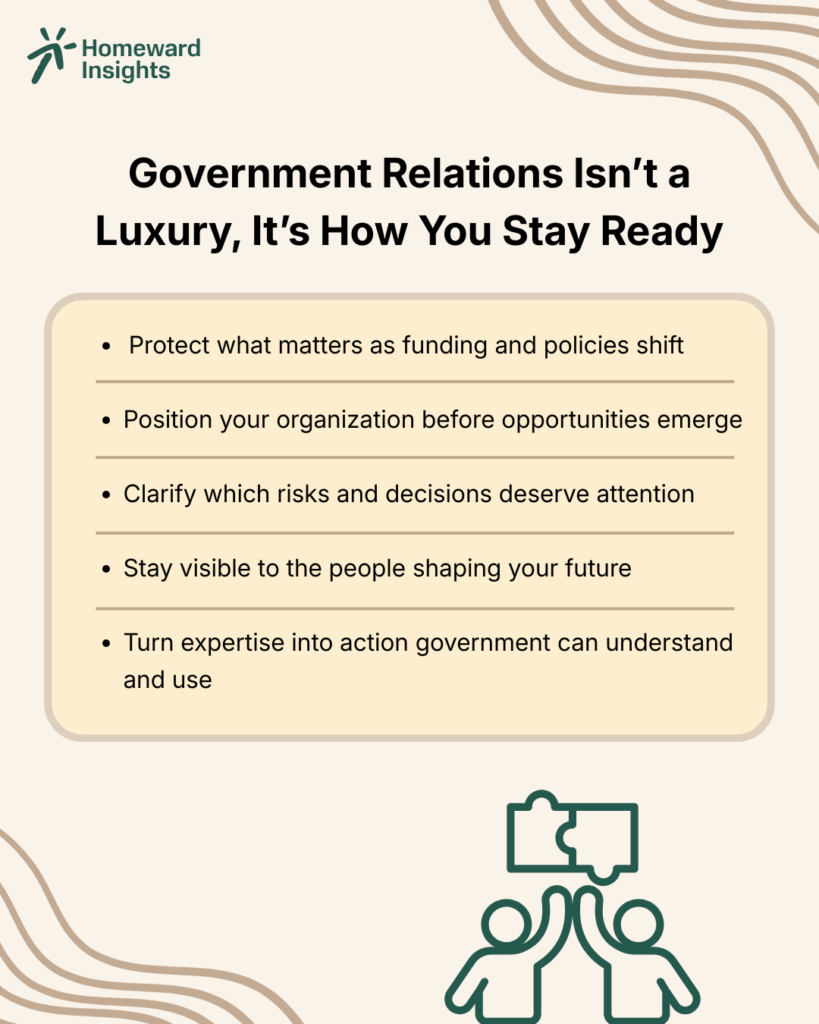
Government relations is often discussed as though it is only about winning something new.
A funding commitment. A policy change. A regulatory fix. A program expansion. A meeting with a minister. A new opportunity.
Those outcomes matter. We have helped clients secure major government investment, build access and credibility, shape policy and program conversations, and become better understood by the offices and officials that matter.
But government relations is not only about pursuing new wins.
It is also about protection.
It can help an organization understand whether a funding stream is at risk, whether a policy shift may affect its work, whether a program redesign could create unintended consequences, or whether government is moving in a direction that creates future opportunity or future vulnerability.
It is also about positioning.
You do not want government learning who you are for the first time when a funding window opens. You do not want to introduce your model after program design is mostly complete. You do not want your organization to be invisible when government is looking for partners, evidence, delivery capacity, or practical solutions.
And it is about clarity.
In uncertain times, leaders need to know where to spend attention. Not every government announcement matters. Not every meeting is worth taking. Not every opportunity is real. Not every rumour deserves a response.
Good government relations helps organizations sort signal from noise.
The Work Is Not Just Access
Access matters.
Relationships matter.
Knowing who to call, who to brief, who to listen to, and who actually influences a decision can make a real difference.
But access alone is not enough.
A meeting without a clear purpose does not create much value. A strong relationship without a clear ask may not move a file. A good idea that is not connected to government’s priorities, pressures, timelines, or decision-making processes can still fail to land.
That is why the real work is deeper.
Government relations is the work of making your organization’s expertise legible, timely, and actionable inside government.
Legible means government understands what you do, why it matters, and how it connects to a public problem.
Timely means your message reaches the right people when there is a real decision, process, risk, or opportunity in front of them.
Actionable means government can see what could be done next: a policy adjustment, funding pathway, consultation, pilot, partnership, regulatory fix, procurement change, or implementation solution.
That is the difference between being heard and being useful.
And in government, being useful matters.
Policy Advocacy, Made Human
At Homeward, we often describe our approach as policy advocacy, made human.
That does not mean making the work less substantive.
It means remembering what the substance is for.
Policy is not just machinery. It affects people’s homes, health, income, safety, dignity, communities, and opportunities. The organizations we work with usually understand those human realities deeply. They see where systems are working, where they are failing, and where small changes could make an enormous difference.
But government also needs discipline.
It needs clear arguments, practical recommendations, credible evidence, political awareness, and implementation realism. It needs to understand not only why something matters, but why it matters now and what can actually be done about it.
Our work is to bring those things together.
Humanity without strategy can become an appeal that does not move. Strategy without humanity can become sterile and disconnected from the people the policy is meant to serve.
The strongest advocacy holds both.
It is empathetic and rigorous. Practical and principled. Ambitious and realistic. Clear about the human stakes, but also clear about the path to action.
That is the kind of advocacy this moment requires.
Why It Matters More When Resources Are Tight
When resources are constrained, organizations may feel pressure to focus only on immediate delivery.
That is understandable. Frontline work matters. Payroll matters. Programs matter. Keeping the lights on matters.
But uncertainty does not pause government decision-making.
Governments will still choose which problems to prioritize. They will still redesign programs. They will still decide what to fund, what to delay, what to scale, and what to stop. They will still look for partners who can help them deliver outcomes in a difficult environment.
If your organization is not part of those conversations, decisions may still be made that affect you.
They may just be made without you.
That is the risk.
Government relations helps ensure that your organization’s work is visible before decisions are finalized. It helps make sure government understands what would happen if a program is changed, a funding stream disappears, or a promising model is overlooked. It helps connect your operational reality to the choices government is actually making.
In good times, advocacy can help organizations grow.
In difficult times, it can help organizations avoid being left behind.
What Organizations Should Be Asking
For leaders wondering whether government relations is worth prioritizing, the question should not be, “Can we afford advocacy?”
The better question is:
“What decisions could affect us, and are we visible to the people making them?”
From there, a few practical questions follow.
- Where does government already affect our work?
- What public problems are we helping solve?
- What pressures are we seeing before they become visible elsewhere?
- Which funding streams, policies, regulations, or programs could change in the next year?
- Who in government understands our role?
- Who should understand it, but does not yet?
- What would we want government to know before the next opportunity appears?
Those questions do not require panic.
They require discipline.
They help organizations move from uncertainty to strategy.
How Homeward Helps
Homeward works with mission-driven organizations that need to navigate government with more clarity, confidence, and purpose.
We help organizations understand where government matters to their work, who needs to understand their story, what decisions may affect them, and how to position their expertise in a way government can use.
Sometimes that means helping secure major public investment. Sometimes it means shaping a policy conversation before a decision is made. Sometimes it means preparing a client for a budget window, a program redesign, a senior meeting, a consultation, or a regulatory shift. Sometimes it means helping an organization understand that the smartest move is not immediate advocacy, but preparation.
The point is not to create noise.
The point is to build visibility, credibility, and momentum.
In uncertain times, that work becomes more important because organizations need to know not only what they want from government, but where they fit in a changing public policy environment.
A Practical On-Ramp
We know that not every organization is ready for a full government relations campaign.
We also know that many leaders are trying to figure out whether advocacy is something they should be taking more seriously.
That is why we created Homeward Talks.
Homeward Talks is an easy, low-pressure on-ramp for organizations that want to explore how to move forward. It is a way to speak with an expert, ask questions, understand where government may matter to your work, and begin identifying whether there is a risk, opportunity, or pathway worth paying attention to.
For some organizations, that conversation may confirm that a larger strategy is needed.
For others, it may simply create clarity.
Either outcome has value.
Book a Homeward Talks session to start making sense of where your organization fits in the current environment.
A Final Thought
Government relations is not a luxury.
Not when funding is shifting. Not when public need is rising. Not when governments are making difficult decisions. Not when the organizations closest to the ground have insight that decision-makers need to hear.
In uncertain times, the answer is not to disappear from government.
The answer is to become clearer, more visible, and more useful.
Because when the next opportunity appears, you want government to know who you are, what you do, why it matters, and how to call you.