

What the 2026 Fall Economic Statement means for nonprofits, municipalities, First Nations and other organizations seeking government support.
Ontario’s Fall Economic Statement, released today, paints a challenging picture of the province’s finances.
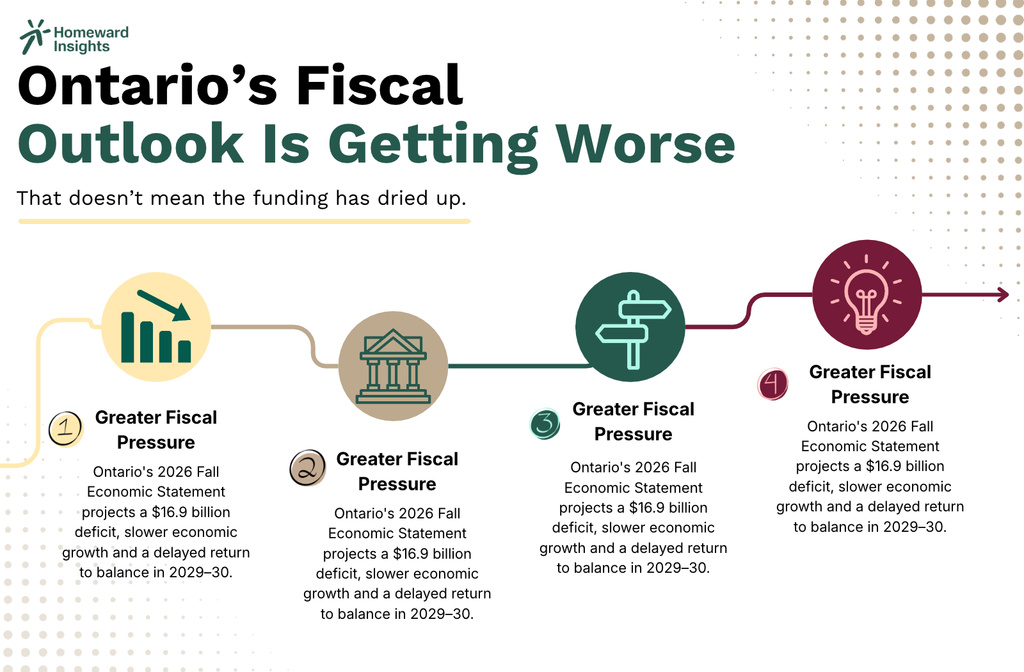
The projected deficit has grown to $16.9 billion, economic growth has slowed considerably, and the government’s anticipated return to a balanced budget has been pushed back to 2029–30.
By 2028–29, the province expects to collect $4.9 billion less in annual revenue than it forecast just seven months ago.
For organizations already struggling to secure government funding, these numbers might be discouraging.
But I think there’s a much more important story here.
Understanding what the government is trying to accomplish
Ontario is navigating an extraordinarily turbulent economic environment.
American tariffs, trade disruptions, geopolitical uncertainty and slower growth are creating significant challenges for the province’s economy. These aren’t abstract concerns. Ontario’s manufacturing industries, supply chains, workers and communities are particularly exposed to developments south of the border.
The government’s response has been to concentrate considerable resources on making Ontario’s economy more competitive, resilient and self-reliant.
We’re seeing that reflected in its continued $210 billion infrastructure plan, substantial business-investment tax incentives, and emphasis on energy, critical minerals, housing construction, workforce development and industrial competitiveness.
The underlying objective is relatively clear: protect Ontario’s existing economic foundations while building the capacity to withstand future disruptions.
There are perfectly legitimate debates to be had about these choices, particularly when many essential public services are experiencing significant pressures.
But understanding the government’s priorities isn’t the same as endorsing them.
And for organizations seeking government support, understanding the problems decision-makers are trying to solve is critically important.
A constrained budget doesn’t mean the government has stopped investing
One of the biggest misconceptions I encounter in public affairs is that a difficult fiscal environment means governments simply aren’t prepared to spend money.
That’s rarely the full picture.
Even governments facing significant deficits continue making substantial investments. What changes is how those investments are prioritized, justified and delivered.
Ontario’s Fall Economic Statement illustrates this particularly well.
While the province is maintaining major commitments to infrastructure, economic development and health care, projected spending growth in areas like community and social services is much more limited.
That creates real challenges for organizations delivering essential services.
It also means that traditional approaches to seeking government funding may be less effective.
Simply demonstrating that a problem exists, or that an organization does excellent work addressing it, may not be enough.
Organizations increasingly need to demonstrate how addressing their priorities can also help government achieve its own objectives.
And sometimes, that requires looking beyond the ministry or funding program they would traditionally approach.
Housing and healthcare: a particularly important example
Consider the relationship between non-market housing and health care.
For organizations delivering supportive housing, the two are often inseparable.
Stable housing, combined with appropriate supports, can improve health outcomes, reduce reliance on emergency services, support hospital discharge and help people manage complex physical and mental health needs.
Yet housing and health care are often approached through different programs, ministries and funding structures.
This creates an important opportunity.
Ontario continues to make substantial investments in health care, particularly in improving access, managing hospital pressures and ensuring patients receive care in appropriate settings.
For supportive housing providers, the question shouldn’t simply be whether there is a dedicated housing program capable of funding their project.
It should also be whether their work can help address pressures elsewhere in the healthcare system.
Could an investment in supportive housing reduce avoidable hospital utilization? Could it help patients transition out of acute care? Could it improve the delivery of community-based mental health services?
Where the evidence supports these connections, they can fundamentally change how a project is understood.
A housing proposal can also be a healthcare solution.
Importantly, this isn’t about finding clever language to make a funding application sound more attractive. It’s about recognizing that government responsibilities are interconnected, even when budgets and ministries are not.
And it’s about building a credible, evidence-based case that reflects those connections.
The opportunities extend well beyond housing
Similar thinking applies across other sectors.
For First Nations pursuing economic-development initiatives, Ontario’s emphasis on energy infrastructure, Indigenous equity participation and major projects creates opportunities to explore financing partnerships, loan guarantees and other mechanisms beyond traditional grant funding.
For municipalities, investments in infrastructure, housing construction and economic competitiveness may create opportunities to advance local projects through broader provincial priorities.
For nonprofits delivering social services, there may be connections to health-system capacity, workforce participation, prevention or other public outcomes that deserve greater attention.
None of this means every organization should suddenly rebrand its work as economic development.
Nor does it mean every worthwhile initiative will neatly align with the government’s current priorities. Sometimes advocacy requires making the case for changing those priorities.
But understanding where government is concentrating its attention provides a much stronger starting point.
So, how should organizations respond?
I would encourage organizations to consider four questions before developing their next major government funding or advocacy proposal.
1. What is government actually trying to accomplish?
Look beyond individual funding announcements. Understand the broader economic, political and fiscal pressures influencing decisions.
2. How does your work contribute to those objectives?
Identify genuine connections between your mission and the government’s priorities. Quantify the benefits wherever possible, including avoided costs, improved outcomes and long-term public value.
3. Who needs to be involved?
The ministry traditionally responsible for your sector may not be the only one with an interest in your proposal. Effective solutions often require cooperation across government, and sometimes with municipalities, Indigenous governments, private investors or other partners.
4. Are you pursuing the right kind of support?
A conventional grant may not be the only option. Depending on the project, capital financing, partnerships, loan guarantees, procurement opportunities or changes to existing policy may offer more appropriate pathways.
Understanding these distinctions can make an enormous difference.
The bottom line
Ontario’s fiscal challenges are real, and organizations shouldn’t underestimate the consequences of constrained public spending.
But the Fall Economic Statement doesn’t suggest that government has stopped investing. It tells us a great deal about where those investments are being directed and what the province is trying to accomplish.
For organizations seeking to advance important social, economic and community priorities, the lesson is not to abandon their ambitions.
It’s to become more sophisticated about how they pursue them.
At Homeward Public Affairs, we spend a great deal of time helping nonprofits, First Nations, municipalities and social-purpose organizations navigate precisely these kinds of challenges. It’s also one of the reasons we created Homeward Talks: to make practical insights into government decision-making and effective advocacy more accessible.
Because knowing what government has announced is useful.
Understanding why those decisions are being made, how the system works, and where your organization fits into that picture is what can help turn an important idea into meaningful progress.