

When government starts moving, organizations can feel immediate pressure to respond.
A new fund is announced. A minister gives a major speech. A consultation opens. A program is redesigned. A new office is created. A budget commitment starts turning into implementation. A policy priority that once felt abstract suddenly appears to have machinery behind it.
For mission-driven organizations, that movement can create excitement.
It can also create anxiety.
Boards may ask whether the organization should be pursuing a new opportunity. Staff may wonder whether a recent announcement affects existing work. Leaders may feel pressure to request meetings, prepare submissions, join coalitions, or move quickly before a window closes.
Sometimes that urgency is justified.
Sometimes it is not.
A government announcement is not automatically a strategy. A policy signal is not automatically an opportunity. A funding envelope is not automatically a fit.
The work is to translate signal into strategy.
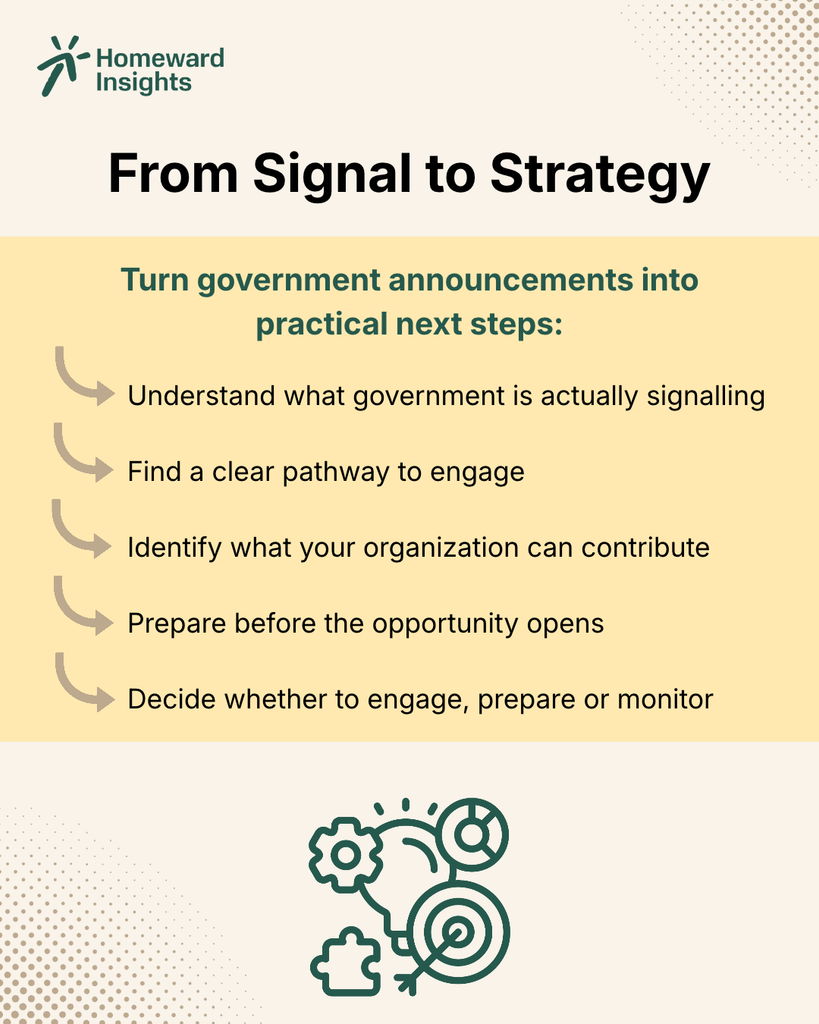
That means understanding what government is actually doing, whether it matters to your organization, what pathway may exist, and whether the right move is to engage now, prepare quietly, monitor closely, or ignore the noise.
In a fast-moving policy environment, that discipline matters.
Start With the Signal
The first question is not, “How do we respond?”
The first question is, “What kind of signal is this?”
Some announcements are immediate opportunities. A fund opens. Eligibility criteria are published. An intake period begins. A consultation deadline is set. Government is asking for proposals, evidence, partners, or feedback within a defined timeline.
Those moments may require quick assessment and action.
Other announcements are policy signals. Government may be showing where it wants to go, but not yet providing a direct path for organizations to engage. A speech, mandate priority, budget theme, or new institutional structure may not create an immediate application window, but it can still matter. It may tell you where political attention, public service work, and future program design are heading.
Some signals are implementation openings. Government may not be asking your organization for anything directly, but the success of its agenda may depend on the kind of work you do. Housing, infrastructure, workforce, major projects, public health, economic development, Indigenous partnership, community services, and social infrastructure often intersect in ways that are not obvious from the first announcement.
Some signals are long-term positioning opportunities. They may not produce a near-term ask, but they reveal where government attention is likely to grow over time.
And some signals are simply noise.
That is important too.
Good government relations does not treat every announcement as urgent. It helps organizations distinguish between what matters now, what may matter later, and what does not matter enough to justify attention.
Do Not Chase the Headline. Find the Pathway.
Headlines can be misleading.
An announcement may sound relevant because it uses familiar language: housing, affordability, community, resilience, workforce, innovation, infrastructure, health, productivity, reconciliation, or economic growth.
But the real question is not whether the language sounds aligned.
The real question is whether there is a pathway.
Is there a fund? A program? A consultation? A procurement process? A legislative or regulatory change? A budget window? A departmental review? A federal-provincial negotiation? An implementation table? A local project list? A ministerial priority that needs examples, evidence, or delivery partners?
Different pathways require different strategies.
- A funding intake requires readiness, eligibility assessment, partners, budgets, and a strong application or proposal.
- A consultation requires evidence, recommendations, and a clear explanation of how the issue lands on the ground.
- A program design process requires early engagement, technical feedback, and a credible understanding of implementation.
- A legislative or regulatory process requires precision, timing, and often a different set of decision-makers.
- A broad political signal may require relationship-building and positioning rather than an immediate ask.
Without a pathway, organizations can spend time reacting to announcements that cannot yet produce a result.
With a pathway, they can make better decisions about how to engage.
Clarify Your Role
Once you understand the signal and the pathway, the next question is simple:
Where do we fit?
That question is often harder than it sounds.
An organization may not be the direct applicant for a fund, but it may be a critical partner. It may not be the project proponent, but it may bring community legitimacy. It may not be designing the program, but it may understand how the program will work in practice. It may not control infrastructure, but it may understand the people and services that infrastructure is meant to support.
Different organizations can play different roles.
- You may be a delivery partner.
- You may be a source of evidence.
- You may be a community validator.
- You may be a coalition member.
- You may be an implementation expert.
- You may be a risk-mitigation partner.
- You may be a potential applicant.
- You may be a connector between government ambition and community reality.
Clarifying that role is essential because it shapes the strategy.
An organization that wants funding needs one kind of approach. An organization trying to shape program design needs another. An organization trying to ensure government understands local impacts needs another. An organization trying to become known before future opportunities emerge needs another still.
Government does not need every organization to say the same thing.
It needs to understand what each organization can contribute.
Prepare Before the Window Opens
Many organizations wait until a formal opportunity appears before they begin preparing.
That can be too late.
By the time eligibility criteria are published, many important choices may already have been made. By the time a consultation opens, government may already have framed the issue. By the time a funding intake is live, organizations may have limited time to build partnerships, gather evidence, align their boards, secure financial information, or develop a credible proposal.
Policy signals matter because they give organizations time to prepare.
- A signal can tell you to start gathering evidence.
- It can tell you to build or repair relationships.
- It can tell you to clarify your ask.
- It can tell you to map decision-makers.
- It can tell you to identify partners.
- It can tell you to prepare your board for a future opportunity.
- It can tell you to become visible before government starts looking for delivery capacity.
The organizations best positioned for government opportunities are rarely the ones that start from scratch when an intake opens.
They are the ones that saw the signal early and used the time well.
Choose the Right Level of Engagement
Not every policy signal requires a full campaign.
- Sometimes the right response is a formal submission.
- Sometimes it is a meeting with officials.
- Sometimes it is a briefing note.
- Sometimes it is quiet outreach to political staff.
- Sometimes it is coalition alignment.
- Sometimes it is preparing evidence for a future window.
- Sometimes it is monitoring.
- Sometimes it is doing nothing yet.
That last option matters.
Organizations have limited time, credibility, and executive capacity. Responding to everything can be just as risky as responding to nothing. It can create internal urgency without external progress. It can pull leaders away from the opportunities that actually matter.
Good strategy is not only about knowing when to move.
It is about knowing how much to move.
A small signal may require a light touch. A live decision may require sustained engagement. A major opportunity may require internal alignment, board involvement, partners, materials, and a structured campaign.
The level of effort should match the reality of the opportunity.

Watch for Implementation Needs
One of the biggest mistakes organizations make is assuming that government opportunities are only found in formal funding streams.
Some of the most important openings come through implementation.
When government announces a major investment agenda, housing strategy, workforce plan, infrastructure fund, or national project pipeline, it creates practical questions.
- Who will deliver?
- Where will workers live?
- Which communities will be affected?
- What services will be needed?
- Who has trust on the ground?
- What barriers will prevent the policy from working?
- Which populations could be missed?
- What evidence does government need before implementation decisions are locked in?
Mission-driven organizations often understand these questions better than anyone.
That is why implementation matters.
A government announcement may not name your organization. It may not create an immediate application. It may not look like a direct opportunity.
But if the success of the policy depends on the kinds of communities, systems, people, or services your organization understands, there may still be a role.
The opportunity is not always in the headline.
Sometimes it is in what the headline will require.
Turn Relevance Into an Ask
Once an organization understands the signal, pathway, role, and timing, it still needs an ask.
That ask may not always be funding.
It could be a meeting, a policy adjustment, a seat at an implementation table, a change to eligibility criteria, a pilot, recognition of a model, inclusion in a consultation, support for a partnership, a regulatory fix, or a request that government consider evidence before finalizing design.
The ask should match the moment.
A vague request for “support” is rarely enough. Government needs to understand what decision is being requested and why that decision matters now.
A strong ask connects three things:
- What government is trying to do.
- What your organization knows or can deliver.
- What action would help improve the outcome.
That is the bridge between signal and strategy.
Make the Human Case Usable
At Homeward, we often describe our approach as policy advocacy, made human.
That matters when responding to government signals.
Policy movement can feel abstract: funds, frameworks, authorities, mandates, timelines, offices, programs, and processes.
But the stakes are human.
Housing policy affects whether people can stay in their communities. Infrastructure affects whether people can access work, school, care, and services. Workforce policy affects whether people can build stable futures. Major projects affect communities, lands, economies, and local systems. Investment strategy affects who benefits from growth and who is left out.
Mission-driven organizations bring those realities into the conversation.
But the human case also needs to be usable.
Government needs clear evidence, practical recommendations, implementation insight, and a realistic understanding of what action is possible.
The strongest advocacy connects lived reality to policy machinery.
It helps government understand not only why something matters, but what to do next.
What Organizations Should Be Asking
When a major government announcement lands, leaders should ask a few disciplined questions before deciding how to respond.
- What is actually being announced?
- Is this an immediate opportunity, a policy signal, an implementation opening, a long-term positioning opportunity, or noise?
- Is there a real decision or process attached to it?
- Who controls the next step?
- Does our organization have a role to play?
- Are we a delivery partner, evidence source, applicant, community validator, implementation expert, or coalition member?
- What would government need to understand from us?
- What evidence, relationships, or materials do we need to prepare?
- Do we have an ask?
- Is this a moment to engage, prepare, monitor, or wait?
These questions do not slow strategy down.
They prevent wasted motion.

How Homeward Helps
Homeward helps mission-driven organizations turn government signals into practical strategy.
We help clients understand whether a policy development is relevant, whether there is a real pathway, who needs to be engaged, what materials are needed, and what level of effort makes sense.
Sometimes the answer is to move quickly.
Sometimes it is to prepare quietly.
Sometimes it is to monitor.
Sometimes it is to ignore the noise.
The value is in the judgment.
In a fast-moving policy environment, organizations do not need to chase every announcement. They need to understand which signals matter, where they fit, and how to act before the window closes.
For organizations trying to make sense of a new government announcement, funding signal, consultation, or policy shift, Homeward Talks is a practical place to start. It is a low-pressure way to speak with an expert, assess whether there is a real opportunity, and understand what a thoughtful next step could look like.
Book a Homeward Talks session to move from signal to strategy.
A Final Thought
Government movement creates possibility.
But possibility is not the same as strategy.
The organizations that benefit from a changing policy environment are not always the ones that react first. They are the ones that understand what government is really signalling, where the pathway may be, what role they can play, and how to prepare before the opportunity becomes obvious to everyone else.
A government announcement can open a door.
But strategy is what helps you know whether to walk through it, wait beside it, or keep moving.