


Every organization wants government to take it seriously.
That is especially true for nonprofits, charities, Indigenous communities, associations, social enterprises, and mission-driven organizations working on complex public problems.
They want decision-makers to understand their work. They want their concerns to be heard. They want their recommendations to be considered. They want government to recognize their expertise, fund their solutions, fix barriers, or invite them into the right conversations.
But government does not treat every organization the same way.
Some organizations become trusted voices. They get called when government is trying to understand an issue. Their materials get circulated. Their concerns are taken seriously. Their advice helps shape policy, programs, funding design, or implementation.
Others struggle to break through.
That difference is not always about size, profile, or proximity to power.
Often, it is about credibility.
Credibility is one of the most important assets an organization can build in government relations. It is also one of the easiest to misunderstand.
Government credibility is not just about having a good reputation.
It is about being useful, reliable, clear, and ready when government needs to make decisions.
Credibility Is Built Before the Ask
Many organizations start thinking about credibility when they need something.
A funding request. A policy change. A meeting. A letter of support. A regulatory fix. A program adjustment. A capital investment.
But by the time the ask is urgent, credibility is already being tested.
Government will want to know whether the organization understands the issue, whether it has done the work, whether it can deliver, whether it is aligned internally, whether its evidence is sound, and whether its proposal is realistic.
That is why credibility has to be built before the moment of need.
It is built through consistent engagement, clear materials, disciplined follow-up, constructive relationships, and a track record of saying things that are useful and true.
An organization does not become credible because it insists that its work matters.
It becomes credible because government can see that it understands the problem, understands the system, and can help move toward a practical solution.
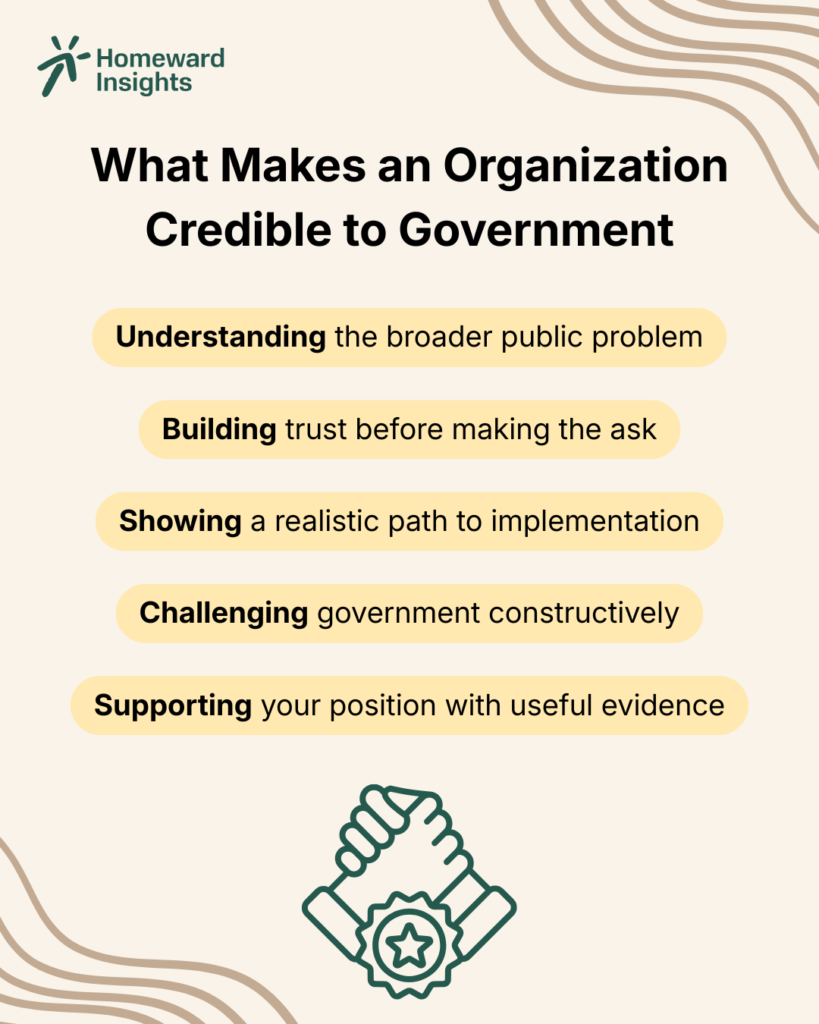
Government Trusts Organizations That Understand the Public Problem
Organizations often begin with their own reality.
That is natural. They know their programs, budgets, staff pressures, clients, communities, and operational challenges. They know where the pain points are.
But credibility grows when an organization can connect its reality to a broader public problem.
Government needs to understand not only what is happening inside the organization, but why it matters beyond the organization.
Is the issue connected to housing stability, health system pressure, affordability, employment, safety, community infrastructure, food security, mental health, economic participation, reconciliation, or another public priority?
What happens if the problem is not addressed?
Who else is affected?
What costs show up elsewhere in the system?
What opportunity is being missed?
When an organization can answer those questions clearly, it shows government that it is not only advocating for itself. It is helping government understand a public challenge.
That makes the organization more credible.
Credibility Requires Evidence
Human stories matter.
They help government understand what is at stake. They show how policy decisions affect real lives. They remind decision-makers that programs, regulations, and funding models are not abstract.
But stories need to be supported by evidence.
That evidence does not always have to be complicated. It may include service data, waitlists, demand trends, financial pressures, outcomes, community feedback, evaluation results, case studies, partner letters, local examples, or comparisons to other jurisdictions.
The point is not to bury government in information.
The point is to support the case.
A credible organization can explain what it is seeing, why it matters, and how it knows.
That last part matters.
Government receives many claims. The organizations that stand out are the ones that can back up what they are saying without overwhelming the people they are trying to persuade.
Clear evidence builds trust.
Credibility Requires Implementation Realism
Government is not only asking whether an idea is good.
It is asking whether the idea can work.
That means organizations need to show that they understand implementation.
What would need to happen next? Who would deliver the work? What partners are involved? What approvals are required? What risks exist? What timelines are realistic? What capacity does the organization already have? What still needs to be built?
This is especially important for organizations seeking funding or policy change.
A proposal that sounds compelling but does not address implementation risk may make government nervous. A proposal that is honest about delivery, trade-offs, readiness, and constraints is often more persuasive.
Credibility does not require pretending everything is easy.
In fact, the opposite is true.
Government is more likely to trust organizations that understand complexity and can still point to a practical path forward.
Credibility Requires Consistency
Organizations can lose credibility when their message changes too often.
That does not mean the strategy should never adapt. Good advocacy learns from feedback. It adjusts to timing, process, evidence, and political context.
But the core message needs discipline.
Government should not hear one version of the ask from the CEO, another from the board chair, another from a coalition partner, and another from a staff member. It should not receive a briefing note that says one thing, a meeting presentation that says another, and a follow-up email that introduces an entirely different priority.
Consistency helps government understand the issue.
It also signals that the organization is aligned internally.
That matters because government is assessing whether the organization can be trusted as a partner. Internal confusion creates external uncertainty. A clear, consistent message creates confidence.
Credibility Requires Judgment
One of the most underrated parts of credibility is judgment.
Government notices how organizations engage.
Do they understand timing? Do they bring forward realistic asks? Do they listen when officials raise concerns? Do they respect process? Do they follow up constructively? Do they know when to push and when to wait? Do they focus on the right audiences? Do they avoid turning every issue into a crisis?
Judgment matters because government has limited time.
Organizations that engage thoughtfully become easier to work with. They do not waste meetings. They do not overstate every claim. They do not send unfocused materials. They do not confuse activity with strategy.
That does not mean being timid.
Credible advocacy can still be ambitious, urgent, and persistent.
But it is disciplined.
It understands that pressure is most effective when paired with clarity, evidence, timing, and respect for how decisions are actually made.
Credibility Requires Humanity
At Homeward, we often describe our work as policy advocacy, made human.
Credibility is a big part of that.
The most effective advocacy does not strip away the human stakes in order to sound serious. It also does not rely on emotion alone and hope that government will figure out the policy path.
It brings both together.
It shows who is affected. It explains what is happening on the ground. It treats people’s experiences with dignity. Then it connects those experiences to a practical policy, funding, or implementation pathway.
That balance is powerful.
Government needs to understand the real-world consequences of its decisions. Mission-driven organizations are often best positioned to explain those consequences. But the explanation has to be clear enough and constructive enough to help government act.
Humanity makes the work matter.
Credibility helps the work move.
Credibility Is Not the Same as Being Agreeable
Being credible does not mean saying yes to government all the time.
It does not mean avoiding hard truths. It does not mean softening every message until it loses meaning. It does not mean pretending a harmful policy is acceptable or that an urgent problem can wait.
Sometimes credibility requires being direct.
But direct advocacy works best when government believes the organization is acting in good faith, knows what it is talking about, and has done the work to propose a practical path forward.
There is a difference between being critical and being constructive.
Credible organizations can identify problems without sounding careless. They can challenge government without burning relationships unnecessarily. They can push for change while still helping decision-makers understand what action is possible.
That is a difficult balance.
It is also one of the places where strong government relations matters most.
What Organizations Should Ask Themselves
Organizations that want to strengthen their credibility with government should ask a few practical questions.
- Do we understand the public problem we are helping solve?
- Can we explain our work in a way that connects to government priorities?
- Do we have evidence that supports our case?
- Are we clear about what we are asking government to do?
- Can we explain why our organization is well positioned to deliver?
- Are our leadership, board, staff, and partners aligned on the message?
- Have we thought through implementation?
- Are we engaging the right people at the right time?
- Are our materials easy to use and easy to share?
- Are we following up in ways that build trust?
These questions are not just communications exercises.
They are credibility tests.
They help determine whether government sees an organization as another voice asking for attention, or as a serious partner that can help solve a problem.
How Homeward Helps
Homeward helps mission-driven organizations build credibility where it matters.
That means helping clients clarify the public problem, sharpen the ask, organize their evidence, prepare usable materials, understand the decision-making environment, and engage government with discipline and humanity.
Sometimes the work is about securing public investment. Sometimes it is about shaping policy, entering a consultation, preparing for a meeting, responding to a risk, or becoming better known to the offices and officials that matter.
Across all of that work, credibility is central.
Government needs to understand the organization, trust the case, and see a realistic path to action.
For organizations that are not sure how government currently sees them, Homeward Talks is a practical place to start. It is a low-pressure way to speak with an expert, assess your positioning, and understand what would help your organization become more visible, useful, and credible to government.
Book a Homeward Talks session to get clearer about how your organization shows up.
A Final Thought
Credibility is not built in one meeting.
It is built through clarity, evidence, consistency, judgment, and follow-through.
It is built when organizations understand not only what they need from government, but what government needs in order to act.
For mission-driven organizations, credibility does not require becoming less human or less bold.
It requires making the human case in a way government can understand, trust, and use.
That is what helps good work become visible.
And it is what helps visible work become actionable.