

Canada needs to build.
That is now one of the clearest themes in federal policy.
The federal government is trying to accelerate major projects, attract investment, diversify trade, strengthen supply chains, expand energy and critical minerals capacity, improve transportation infrastructure, and make Canada more productive and competitive in a difficult global environment.
That ambition matters.
But building big things is hard.
Major projects are not simple files. They touch environmental protection, Indigenous rights, regulatory approvals, provincial and territorial jurisdiction, financing, workforce, housing, community infrastructure, local services, public trust, and long-term economic strategy.
That complexity is real.
The answer cannot be to pretend it does not exist. Environmental protections matter. Impact assessment matters. Indigenous rights and meaningful consultation matter. Communities affected by major projects deserve serious engagement. Canada should not become more productive by becoming careless.
But there is also a real problem when government cannot move.
When departments operate in silos, when reviews are duplicative, when decision-making is fragmented, when no one can see the whole pathway, and when proponents, communities, Indigenous partners, and governments cannot get clarity, projects slow down. Investment becomes harder. Trust erodes. Costs rise. Opportunities are missed.
Canada does not need to choose between rigorous review and functional government.
It needs both.
That is why the Major Projects Office matters.
The Problem Is Not Only “Red Tape”
There is a temptation to describe every delay in major project development as “red tape.”
That phrase can be useful shorthand, but it can also oversimplify the issue.
Some requirements exist for very good reasons. Environmental assessment is not an inconvenience. It is how governments understand and manage potential impacts. Indigenous consultation is not a procedural box to check. It is a constitutional obligation and, more importantly, part of building projects in a way that respects rights, relationships, and long-term partnership. Community engagement is not a distraction. It helps determine whether projects can be built with legitimacy and trust.
The real problem is not that standards exist.
The real problem is when the machinery of government cannot coordinate the standards it has created.
Major projects often cut across multiple departments, agencies, regulators, jurisdictions, and policy objectives. One part of government may be thinking about economic growth. Another may be focused on environmental impact. Another may be responsible for Indigenous consultation. Another may be considering trade corridors, national security, fisheries, species at risk, transportation, or energy systems.
Each piece may matter.
But someone still has to coordinate the whole.
That is where governments often struggle.
Major projects fail, stall, or lose momentum when they are treated only as regulatory files. In reality, they are economic, environmental, Indigenous, community, workforce, housing, infrastructure, and investment files at the same time.
A country that wants to build needs government machinery capable of managing that complexity.
What the Major Projects Office Changes
The Major Projects Office is important because it is an attempt to solve the machinery problem.
From Homeward’s experience engaging with the Major Projects Office, its value is not that it makes serious obligations disappear. Its value is that it helps government work more coherently.
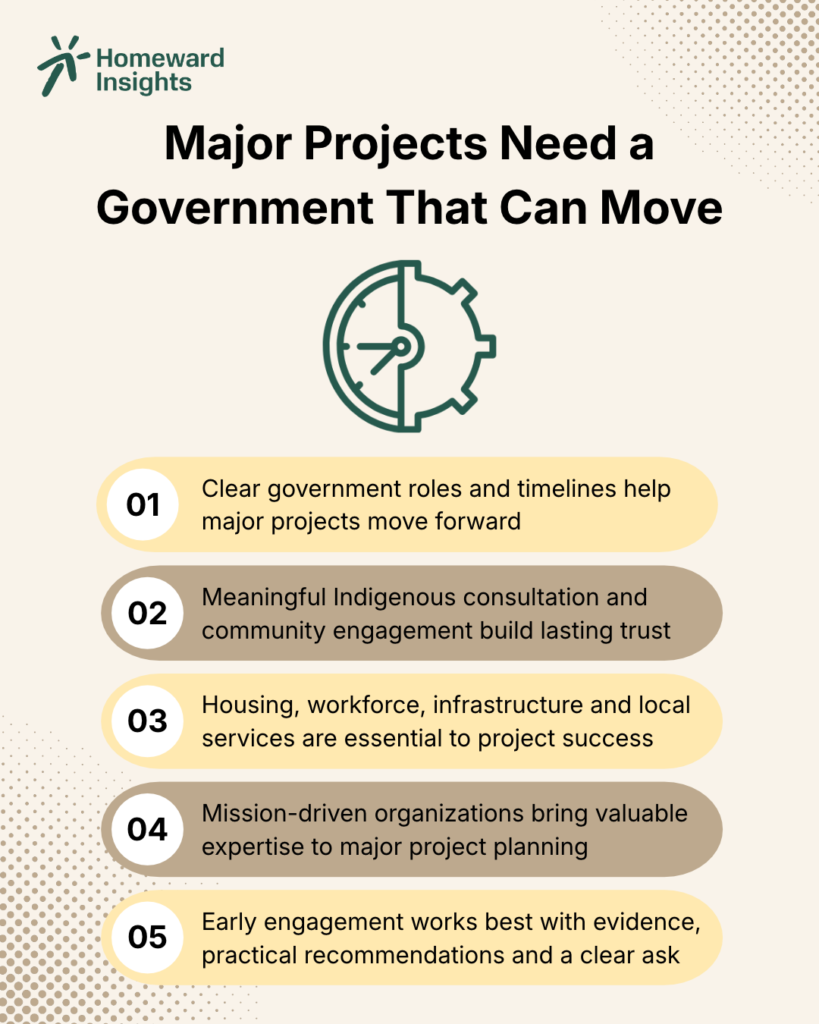
It creates a more central point of coordination. It helps identify bottlenecks. It can bring departments into better alignment. It can make timelines, expectations, and pathways clearer. It can help reduce the traditional silos that have long shaped how government operates.
That matters.
For organizations and project proponents trying to navigate federal systems, one of the most frustrating experiences is not necessarily being told “no.” It is not knowing where a file sits, who owns the next step, which process matters most, or how different parts of government are speaking to each other.
The Major Projects Office cannot solve every issue on its own.
But it can make government more legible and more coordinated.
That is not a small thing.
If Canada wants to be more productive and competitive, government itself has to become more productive and coordinated.

Speed Without Trust Is Fragile
There is a real need for speed.
Canada is competing for capital. Other countries are moving aggressively to attract investment, secure supply chains, build energy systems, develop critical minerals, expand infrastructure, and position themselves for a more uncertain world.
If Canada cannot provide clarity, investors may go elsewhere.
If major projects take too long to navigate, opportunities can disappear.
If government cannot make decisions in a reasonable timeframe, even strong projects can lose momentum.
But speed alone is not enough.
Speed without trust is fragile.
Projects that move quickly but fail to engage Indigenous rights-holders meaningfully can run into deeper problems later. Projects that move quickly but fail to understand environmental impacts can face opposition, litigation, or legitimacy challenges. Projects that move quickly but ignore local housing, workforce, health, transportation, or community-service pressures can create real harm in the places expected to host them.
The goal should not be speed at any cost.
The goal should be timely, rigorous, coordinated decision-making.
That distinction matters.
A strong major projects system should move faster because government is more organized, not because it is less careful.
Major Projects Are Economic Policy
Major projects sit at the centre of the federal government’s economic agenda.
They are about productivity. Investment. Trade diversification. Energy security. Critical minerals. Transportation corridors. Defence capacity. Supply chains. Indigenous economic participation. Regional development. Climate and clean-growth objectives. Workforce. Housing. Infrastructure.
That is why they matter so much.
A major project is not only a single facility, mine, port, railway, transmission line, highway, energy project, or industrial asset. It can reshape a region. It can create demand for housing. It can require new workers. It can affect Indigenous communities, municipalities, ecosystems, transportation systems, local services, and long-term economic planning.
This is why the major projects agenda should not be understood only as a conversation for industry proponents.
It matters for many mission-driven organizations too.
Housing providers may need to understand what major projects will do to local housing demand.
Workforce organizations may need to prepare people for new jobs and training pathways.
Indigenous communities may be considering ownership, partnership, consultation, benefit agreements, environmental stewardship, or governance roles.
Post-secondary institutions may need to align training, research, and regional development.
Community organizations may see pressure on services, affordability, transportation, or health systems.
Environmental organizations may have critical expertise about how projects can be designed, assessed, and monitored responsibly.
Municipalities and regional development organizations may need to connect project growth with local infrastructure and community capacity.
Major projects do not land in a vacuum.
They land in communities.
That is why the social, environmental, Indigenous, and economic dimensions cannot be separated.
Government Coordination Is Also Community Protection
When people hear about faster approvals, they may worry that community interests will be ignored.
That concern should be taken seriously.
But better coordination can actually strengthen community protection when done properly.
A fragmented process can be hard for everyone. Indigenous rights-holders may be asked to engage in multiple disconnected processes. Communities may not know where to raise concerns. Proponents may struggle to understand expectations. Departments may manage narrow mandates without seeing cumulative impacts. Local service providers may be brought in too late, after key decisions have already been made.
A more coordinated process can create clearer points of engagement.
It can help identify issues earlier. It can make sure the right people are at the table sooner. It can connect project planning to housing, workforce, transportation, environmental stewardship, and community infrastructure. It can help prevent governments from discovering avoidable problems only after a project is already politically or financially advanced.
That is the opportunity.
The best version of the Major Projects Office is not a shortcut around complexity.
It is a better way to manage complexity.
Why Mission-Driven Organizations Should Pay Attention
For many nonprofits, Indigenous communities, housing providers, workforce organizations, social enterprises, post-secondary institutions, and community-serving organizations, the major projects agenda may seem distant.
It is not.
If Canada builds the way the federal government says it wants to build, there will be significant downstream needs.
Where will workers live?
Who will train them?
How will Indigenous communities participate as rights-holders, partners, owners, and stewards?
What local services will be needed as populations and economic activity shift?
What transportation and community infrastructure will be required?
How will environmental impacts be monitored and mitigated?
How will benefits be shared?
How will smaller communities absorb growth?
What happens to housing affordability when a major project moves forward in a constrained market?
What organizations already have trust, evidence, relationships, or delivery capacity that government and proponents need?
These are not secondary questions.
They are part of whether major projects can succeed.
Mission-driven organizations should not assume the major projects agenda has nothing to do with them because they are not project proponents. Many of them may be essential to implementation, risk reduction, community benefit, workforce development, housing stability, or public trust.
The question is where they fit.
What Organizations Should Be Asking Now
Organizations trying to understand whether the major projects agenda matters to them should start with a few practical questions.
- Are there major projects or transformative strategies in our region or sector?
- Could those projects create housing, workforce, health, transportation, environmental, community-service, or infrastructure pressures?
- Do we work with communities, populations, workers, tenants, rights-holders, or local systems that may be affected?
- Do we have evidence or expertise that government, proponents, Indigenous partners, or municipalities need?
- Are there opportunities to improve project design, reduce harm, create benefits, or support implementation?
- Who is shaping the project pathway?
- Are the right local and community voices involved early enough?
- Would engagement help us protect our mission, advance community priorities, or position our organization for future opportunities?
Those questions help organizations move beyond reacting to headlines.
They help identify whether there is a real role to play.
How to Engage Constructively
Major project engagement requires judgment.
Some organizations may need to raise concerns. Others may need to identify opportunities. Some may be seeking partnership. Some may want to ensure that community benefits are designed well. Others may be focused on environmental stewardship, Indigenous rights, housing, workforce, or local infrastructure.
The right approach depends on the role.
But constructive engagement usually has a few common features.
It starts early. Waiting until decisions are locked in makes everything harder.
It is specific. General support or opposition may matter politically, but specific evidence, risks, opportunities, and recommendations are more useful.
It is realistic. Major projects involve trade-offs, timelines, jurisdictional complexity, and competing priorities.
It is grounded in community. Organizations closest to local realities often understand things that centralized decision-makers do not.
It is clear about the ask. Are you seeking a meeting, a condition, a partnership, a mitigation measure, a funding pathway, an implementation table, a workforce strategy, a housing plan, or a monitoring role?
And it understands that good advocacy is not only about being heard.
It is about being useful.
At Homeward, we often describe our approach as policy advocacy, made human. This is exactly the kind of file where that matters.
Major projects can sound technical. But their impacts are human. They affect communities, workers, families, Indigenous Peoples, ecosystems, local economies, and future generations.
The strongest advocacy brings those realities into the conversation in a way government can understand and act on.

The Bigger Lesson
The Major Projects Office is part of a larger shift in how the federal government is trying to operate.
The federal government is not only asking what Canada should build.
It is asking whether Canada still has the capacity to build big things at the speed, scale, and quality the moment requires.
That question is about more than permitting.
It is about state capacity.
Can government coordinate across departments?
Can it work with provinces and territories?
Can it engage Indigenous Peoples meaningfully and early?
Can it protect the environment while providing clearer timelines?
Can it attract investment without weakening public trust?
Can it connect major projects to housing, workforce, infrastructure, and community benefits?
Can it move quickly without moving recklessly?
Those are the real tests.
Canada does not need weaker standards.
It needs stronger public capacity to make decisions, coordinate complexity, and deliver.
How Homeward Helps
Homeward helps mission-driven organizations understand where they fit in complex government processes.
That includes organizations trying to engage with major projects, infrastructure, housing, workforce, Indigenous partnership, economic development, and community-impact files.
We help clients understand what government is doing, who is involved, where the decision points are, what risks or opportunities may exist, and how to position their expertise in a way that is clear, credible, and useful.
Sometimes that means helping an organization engage with government. Sometimes it means preparing evidence. Sometimes it means identifying the right partners. Sometimes it means helping a client understand that a policy signal is not yet a real opportunity, but could become one. Sometimes it means helping organizations avoid being brought into a conversation too late.
The Major Projects Office is designed to make government move more coherently.
Organizations that may be affected by major projects should be thinking just as carefully about how they engage.
For organizations trying to understand whether the major projects agenda creates a risk, opportunity, or engagement pathway, Homeward Talks is a practical place to start. It is a low-pressure way to speak with an expert, assess the landscape, and understand what a thoughtful next step could look like.
Book a Homeward Talks session to get clearer about where your organization fits.
A Final Thought
Canada needs to build.
But building well requires more than ambition.
It requires strong environmental protections, meaningful Indigenous consultation, serious community engagement, clear economic strategy, and government machinery that can actually coordinate itself.
The Major Projects Office matters because it is trying to help government move as one system when the issues in front of it cut across many systems at once.
That is not easy work.
But it is necessary work.
Because if Canada wants to be more productive, competitive, resilient, and fair, it needs more than big announcements.
It needs the ability to make complex decisions well — and then deliver.