

Many organizations wait until a problem becomes urgent before they bring evidence to government.
That is understandable.
When frontline teams are stretched, leaders are managing immediate pressures, and communities are already feeling the consequences, advocacy can become most obvious at the point of crisis.
A program is overwhelmed. A waitlist has grown too long. A service gap has become dangerous. A funding issue is about to force cuts. A capital project is stalled. A community need has become impossible to ignore.
By that point, the evidence may be clear.
The need may be urgent.
The consequences may be visible.
But government may already have fewer options.
One of the most important lessons in government relations is that evidence matters most before the crisis peaks.
Not because crisis does not matter.
It does.
But because the earlier government understands what is changing, the more time it has to design, fund, adjust, or prevent.
Government Needs to See the Pattern Early
Mission-driven organizations often see problems before government does.
They see demand rising before it shows up in official systems. They see families struggling before the statistics catch up. They see gaps in service before those gaps become headlines. They see policies failing in practice before anyone has formally reviewed them.
That early knowledge is valuable.
But it only matters if it reaches government in a form government can use.
Anecdotes matter. Staff experience matters. Community stories matter. But government also needs to understand whether those experiences point to a broader pattern.
- Is demand increasing?
- Are client needs becoming more complex?
- Are costs rising faster than funding?
- Are waitlists growing?
- Are outcomes getting harder to sustain?
- Are people being pushed into more expensive or less appropriate public systems?
- Are existing programs unintentionally excluding the people they were meant to serve?
The earlier these patterns are documented and communicated, the more useful they become.
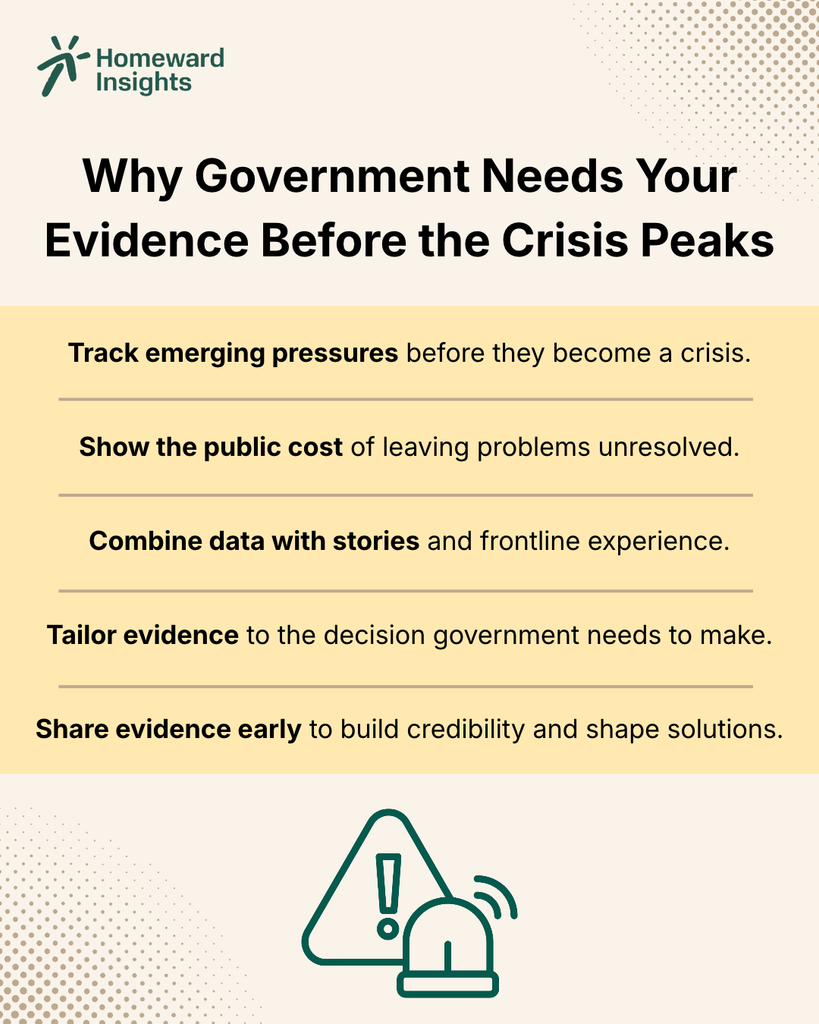
Evidence gives government a reason to pay attention before the issue becomes harder and more expensive to solve.
Crisis Can Create Urgency, But It Can Also Narrow Options
There is a reason many organizations wait for crisis.
Crisis creates urgency. It can attract media attention. It can force decision-makers to respond. It can make a long-standing problem impossible to ignore.
But crisis also comes with risk.
When government is forced to respond quickly, it may choose the fastest available option, not the best one. It may fund a short-term fix rather than a durable solution. It may design a program around the most visible part of the problem while missing the underlying cause. It may move in a way that creates unintended consequences for the organizations expected to deliver.
By the time a crisis peaks, the window for thoughtful design may already be smaller.
Budgets may be set. Programs may already be shaped. Political attention may be intense but short-lived. Decision-makers may be focused on immediate relief rather than long-term prevention.
That does not mean organizations should avoid speaking up during crisis.
It means they should not wait for crisis to begin building the evidence.
Evidence Helps Government Understand the Cost of Inaction
One of the most powerful things evidence can do is make the cost of inaction visible.
Government often knows that a problem exists. What it may not understand is what happens if nothing changes.
A housing gap may lead to greater shelter use, hospital pressure, encampments, family instability, or higher municipal costs.
A mental health service gap may lead to emergency department visits, school disengagement, police involvement, crisis response, or long-term health consequences.
A food security issue may lead to worse health outcomes, increased demand for social services, and deeper household instability.
A workforce barrier may reduce employment, productivity, tax revenue, and economic participation.
A delayed capital project may increase construction costs, reduce service capacity, and leave people stuck in inappropriate settings.
Evidence helps connect the issue to consequences government already cares about.
That is not about fearmongering.
It is about showing the public value of acting early.
Evidence Is Not Just Numbers
When people hear “evidence,” they often think only of data.
Data matters. It helps establish scale, trends, costs, outcomes, and credibility.
But evidence can take many forms.
It can include frontline experience, client stories, waitlist trends, financial pressures, evaluation results, service data, partner letters, case studies, local examples, community feedback, jurisdictional comparisons, implementation lessons, and the lived experiences of people affected by policy choices.
The strongest advocacy often brings these together.
Numbers can show scale.
Stories can show meaning.
Operational experience can show what is actually happening on the ground.
Financial information can show sustainability.
Partner validation can show that the issue is broader than one organization.
Government does not need a mountain of information.
It needs the right evidence, organized in a way that helps decision-makers understand the problem and the path forward.
The Evidence Has to Answer the Right Question
Not all evidence is equally useful.
Organizations sometimes collect evidence that proves their work matters, but does not answer the question government is actually asking.
Government may not be asking, “Is this organization doing good work?”
It may be asking:
- Is this problem growing?
- Who is affected?
- What happens if we do nothing?
- What would it cost to act?
- What would it cost not to act?
- Is there a model that works?
- Can this organization deliver?
- Are there partners aligned?
- Is the solution scalable?
- Is the timing realistic?
- Does this fit an existing priority, program, budget, or mandate?
Evidence should be shaped around the decision government needs to make.
That is a strategic exercise.
A long evaluation report may be useful, but it may not be the right tool for a ministerial office. A powerful client story may be compelling, but it may need to be paired with data. A financial analysis may show need, but it may also need to explain public value.
The question is not only, “What evidence do we have?”
It is, “What evidence will help government understand and act?”
Evidence Builds Credibility Before the Ask
Credibility is built over time.
When organizations share thoughtful evidence before they are in crisis, they become more useful to government.
They help decision-makers understand emerging pressures. They show that their concerns are grounded in reality. They demonstrate that they are watching trends, learning from experience, and thinking beyond their own immediate needs.
That matters.
When the organization later brings forward an ask, it is not appearing out of nowhere. Government has already been introduced to the issue. It has already seen the pattern. It has already had a chance to understand why the problem matters.
This is how evidence supports relationship-building.
Not by overwhelming government with reports, but by steadily helping the right people understand what is happening and why it matters.
Evidence Can Shape the Opportunity Before It Opens
Many organizations think evidence is something they submit after a funding program or consultation is announced.
Sometimes that is true.
But evidence can also shape what opportunities look like before they become public.
Government often designs programs, priorities, and consultation processes before organizations ever see them. Officials may be developing options. Political staff may be testing ideas. Ministers may be looking for practical examples. Departments may be trying to understand whether a problem requires a new approach.
That is when early evidence can matter.
It can influence the framing of a problem. It can help government understand who should be eligible. It can identify implementation risks. It can show where existing programs are failing. It can make the case for a new pathway before the formal window opens.
Once a program is announced, some choices may already be locked in.
That is why the best advocacy does not only respond to public opportunities.
It helps shape them.
Policy Advocacy, Made Human
At Homeward, we often describe our work as policy advocacy, made human.
Evidence is central to that approach.
Good advocacy should never reduce people to numbers. It should also never ask government to act on emotion alone.
The work is to bring human experience, frontline knowledge, and policy discipline together.
That means showing who is affected, what is changing, what the consequences are, and what government can do. It means treating lived experience with dignity while also presenting the practical information decision-makers need.
The most effective evidence does not strip away humanity.
It makes humanity harder to ignore.
What Organizations Should Be Doing Now
Organizations do not need to wait until they have a perfect report to begin building an evidence base.
They can start with practical questions.
- What are we seeing that government may not yet understand?
- What trends are emerging in demand, complexity, cost, waitlists, outcomes, or service gaps?
- What public systems are affected when our work is under-resourced?
- What stories show the human stakes?
- What data supports those stories?
- What partners can validate what we are seeing?
- What would happen if nothing changes?
- What decision or policy pathway could help?
These questions help organizations move from experience to evidence, and from evidence to strategy.
The goal is not to document everything.
The goal is to build enough clarity that when government needs to understand the issue, your organization is ready.
How Homeward Helps
Homeward helps mission-driven organizations turn evidence into advocacy.
That means helping clients identify what government needs to understand, organize their evidence, connect frontline experience to public policy priorities, and present the case in a way that is clear, credible, and actionable.
Sometimes that means preparing for a budget submission. Sometimes it means developing a briefing note, shaping a policy proposal, supporting a funding strategy, preparing for a meeting, or building the foundation for a longer campaign.
The objective is not simply to prove that a problem exists.
The objective is to help government understand what should happen next.
For organizations that are seeing pressure build but are not sure how to communicate it to government, Homeward Talks is a practical place to start. It is a low-pressure way to speak with an expert, clarify what evidence matters, and begin thinking about how to bring the issue forward before the crisis peaks.
Book a Homeward Talks session to get clearer about what government needs to hear.
A Final Thought
Crisis can make problems visible.
But visibility is not the same as readiness.
The organizations best positioned to shape government decisions are often the ones that have already done the work: tracking the pattern, explaining the consequences, building credibility, and helping government understand the issue before it becomes impossible to ignore.
Evidence matters in a crisis.
But it may matter even more before the crisis peaks.
Because that is when government still has the greatest chance to act with foresight, not just urgency.