


Government is always moving.
Budgets are developed. Programs are redesigned. Consultations open. Ministers make announcements. Mandate letters are released. Committees study issues. Funding windows appear. Political priorities shift. Public servants review policies, regulations, and delivery models. New language emerges about what government wants to do next.
For nonprofits, charities, Indigenous communities, social enterprises, associations, and mission-driven organizations, all of this movement can create both opportunity and confusion.
A new announcement may sound relevant. A consultation may seem worth responding to. A meeting may feel important. A funding program may look promising. A political speech may suggest that government is finally paying attention to an issue your organization has been raising for years.
Sometimes, those signals matter.
Sometimes, they do not.
One of the most important parts of government relations is learning the difference.
Because in a constrained environment, organizations cannot afford to chase everything.
Activity Is Not the Same as Strategy
It is easy to confuse activity with momentum.
A busy organization may be writing submissions, requesting meetings, attending consultations, responding to announcements, preparing briefing notes, joining coalitions, sending letters, and tracking every possible government process.
Some of that work may be useful.
But activity alone does not mean a strategy is working.
A strategy is not measured by how many things an organization does. It is measured by whether those actions are connected to a realistic path toward an outcome.
That outcome might be funding. It might be a policy change, a regulatory fix, a program adjustment, a procurement pathway, a relationship with a key office, or recognition of a model government needs to understand.
The form of the outcome can vary.
The discipline is the same.
The goal of government relations is not to be everywhere.
The goal is to be present where your organization’s voice can matter.
Not Every Signal Is an Opening
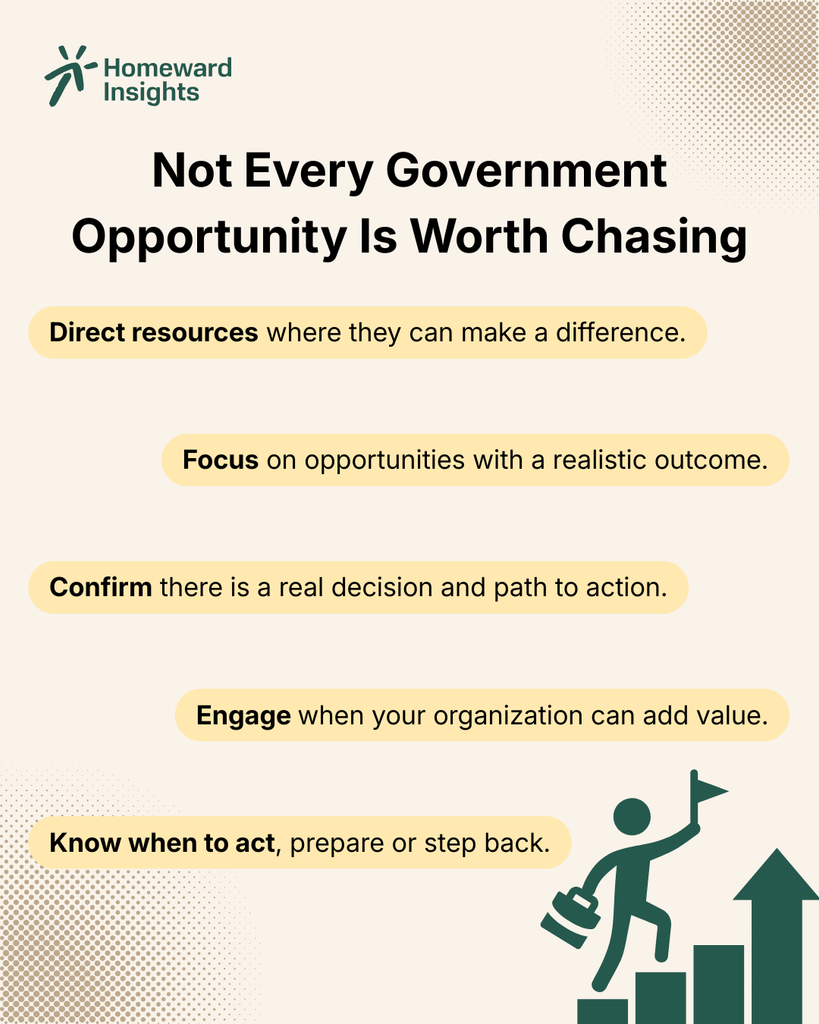
Government announcements can be exciting.
They can also be misleading.
A speech may use language that sounds aligned with your work, but not connect to any immediate decision. A consultation may be broad enough to include your issue, but too early, too vague, or too disconnected from implementation to justify significant effort. A funding program may look relevant on the surface, but not actually fit your organization’s model, timeline, eligibility, geography, or readiness.
That does not mean these signals should be ignored entirely.
It means they need to be assessed.
A government opportunity is more likely to be real when there is a decision being made, a pathway for action, a relevant audience, a plausible timeline, and a clear reason your organization’s perspective would be useful.
Without those elements, organizations can spend a lot of time chasing noise.
And noise is expensive.
It takes executive attention. It consumes staff capacity. It creates urgency that may not be warranted. It can pull an organization away from more important priorities.
In difficult times, that matters.
The Test: Decision, Pathway, Fit
Before pursuing a government opportunity, organizations should ask three basic questions.
First: is there a real decision?
Is government deciding something, or simply talking about an issue? Is there a budget process, program design process, legislative review, procurement opportunity, regulatory change, committee study, mandate commitment, or implementation table that could lead to action?
If there is no decision, the opportunity may still be useful for relationship-building or positioning. But it should not be treated as though an outcome is imminent.
Second: is there a pathway?
Even when government agrees a problem is real, there needs to be some mechanism for action. That might be a funding stream, a policy process, a program authority, a ministerial priority, a departmental review, or a fiscal window.
A strong idea with no pathway can sit in the system indefinitely.
Third: is there a fit?
Does your organization have something meaningful to contribute? Is your work connected to the issue government is considering? Can you provide evidence, delivery insight, community perspective, implementation expertise, or a practical solution?
Relevance matters.
Government is more likely to listen when your organization is not simply interested in an issue, but useful to the decision being made.
When to Engage
Organizations should engage when their perspective can improve the quality of a decision.
That may mean showing government how a program will work on the ground. It may mean identifying a barrier before it becomes a bigger problem. It may mean explaining how a funding design could unintentionally exclude the organizations best positioned to deliver. It may mean sharing evidence from communities that government does not hear from directly. It may mean helping decision-makers understand the human consequences of a policy choice.
Engagement is especially important when your organization can bring something government needs.
That could be credibility with a community, operational experience, data, partnerships, a proven model, or insight into how a policy will land in real life.
In those moments, engagement is not simply about advancing your own interests.
It is about helping government make better decisions.
That is often where mission-driven organizations are strongest.
They understand the human reality behind public policy.
When to Wait
Sometimes the right move is not immediate action.
That can be difficult for organizations that feel pressure to respond quickly. But not every emerging signal is ready for full engagement.
A government priority may be real, but the machinery may not yet exist. A minister may have named an issue, but officials may not yet be designing a program. A funding announcement may be coming, but the criteria may not be clear. A consultation may be too broad to justify a major organizational push.
In those cases, waiting does not mean doing nothing.
It may mean monitoring. Building relationships quietly. Preparing materials. Clarifying the ask. Gathering evidence. Aligning partners. Testing the message. Understanding who will matter once the process becomes more concrete.
Sometimes the smartest strategy is preparation.
The door may not be open yet.
But when it opens, you want to be ready.
When to Ignore the Noise
There are also moments when the best advice is simple: do not chase this.
Not every meeting is worth taking. Not every consultation needs a submission. Not every announcement deserves a response. Not every funding program is worth bending your organization out of shape to pursue.
A political debate may be interesting without being strategically relevant. A program may be attractive but misaligned. A process may be visible but too far removed from the decision-makers who matter. A coalition may be active but unfocused. A meeting may create the appearance of access without advancing a real objective.
This is not cynicism.
It is discipline.
Organizations have limited time, money, credibility, and executive attention. Using those resources well requires judgment.
Sometimes the value of government relations is knowing where to go.
Sometimes it is knowing where not to go.
Why This Matters More in Uncertain Times
When the environment feels stable, organizations may be able to afford some inefficiency.
In uncertain times, they have less room.
Government priorities may shift quickly. Funding may become more competitive. Boards may scrutinize spending more closely. Staff teams may have less capacity. Leaders may need to justify why advocacy work is essential when other pressures feel immediate.
That makes discernment more important.
The question is not, “Should we engage government?”
The question is, “Where will engagement actually matter?”
A good government relations strategy helps organizations avoid two equal and opposite mistakes.
The first is doing too little: staying quiet, waiting for certainty, and becoming invisible when decisions are being made.
The second is doing too much: chasing every signal, spreading attention too thin, and mistaking motion for progress.
The strongest organizations find the middle path.
They stay close enough to government to understand what is changing, but disciplined enough to focus on the opportunities that matter most.
Policy Advocacy, Made Human
At Homeward, we often describe our work as policy advocacy, made human.
That means keeping people at the centre of the work while bringing discipline to how advocacy happens.
The human stakes matter. Government decisions affect homes, health, safety, services, opportunity, dignity, and community well-being. Mission-driven organizations often understand those realities better than anyone.
But those realities still need to be translated into strategy.
Who needs to hear the message? What decision is in front of them? What evidence will matter? What is the right timing? What action is realistic? What should happen after the first meeting?
Human advocacy does not mean unfocused advocacy.
It means being clear enough, practical enough, and credible enough to help government understand what is at stake and what it can do about it.
How Homeward Helps
Homeward helps organizations sort signal from noise.
We help clients understand which government opportunities are real, which are premature, which require preparation, and which are distractions. We help identify where limited executive attention should go, what relationships matter, what processes are worth engaging, and what strategy gives an organization the best chance of moving toward its goals.
Sometimes that means moving quickly.
Sometimes it means slowing down.
Sometimes it means telling a client that the opportunity in front of them is not yet the right one.
That judgment matters.
Because good government relations is not about creating more work. It is about creating more clarity, more focus, and more meaningful progress.
For organizations trying to decide whether a government opportunity is real, Homeward Talks is a practical place to start. It is a low-pressure way to speak with an expert, assess the landscape, and understand whether there is a live pathway, a future opening, or simply noise.
Book a Homeward Talks session to get clearer about where your organization should focus next.
A Final Thought
Government is always moving.
But not every movement is an opportunity.
In uncertain times, organizations need to be visible, engaged, and ready. But they also need to be disciplined.
The work is not to chase everything.
The work is to understand what matters, where your organization can be useful, and when engagement has a real chance of moving something forward.
Because the best government relations strategies do not create activity for its own sake.
They help organizations focus their energy where it can make a difference.