


Coalitions can be one of the most powerful tools in government relations.
When they work, they show government that an issue is bigger than one organization. They bring different voices together. They demonstrate breadth, credibility, and shared urgency. They help decision-makers see that a problem affects a sector, a community, a region, or a system.
For nonprofits, charities, Indigenous communities, associations, social enterprises, and mission-driven organizations, coalitions can also create capacity. They allow organizations to share the work of research, messaging, outreach, public engagement, and follow-up. They can help smaller organizations participate in advocacy they could not carry alone.
At their best, coalitions make a case stronger.
But coalitions can also become mushy.
They can become broad but vague. Busy but unfocused. Inclusive but indecisive. They can gather names, logos, and goodwill without producing a clear ask or a credible path to action.
That is the risk.
A coalition is not automatically a strategy.
It is a structure that can support a strategy — if the purpose is clear.
Government Notices Breadth
Government pays attention when multiple organizations align around a shared issue.
That does not mean government automatically agrees. It does not mean a coalition will win. It does not mean a sign-on letter with dozens of logos is enough to move a decision.
But breadth matters.
A strong coalition can show that an issue is not isolated. It can demonstrate that different parts of a sector are seeing the same problem. It can bring together service providers, community leaders, experts, employers, municipalities, researchers, or people with lived experience in a way that gives government a fuller picture.
It can also create political permission.
Decision-makers may be more willing to act when they see that an issue has support beyond one organization. A minister’s office may feel more confident when a proposal is backed by credible voices. Officials may take an issue more seriously when they see consistency across the sector.
This is why coalitions can be so effective.
They make it harder for government to dismiss an issue as one organization’s problem.
Breadth Without Clarity Is Not Enough
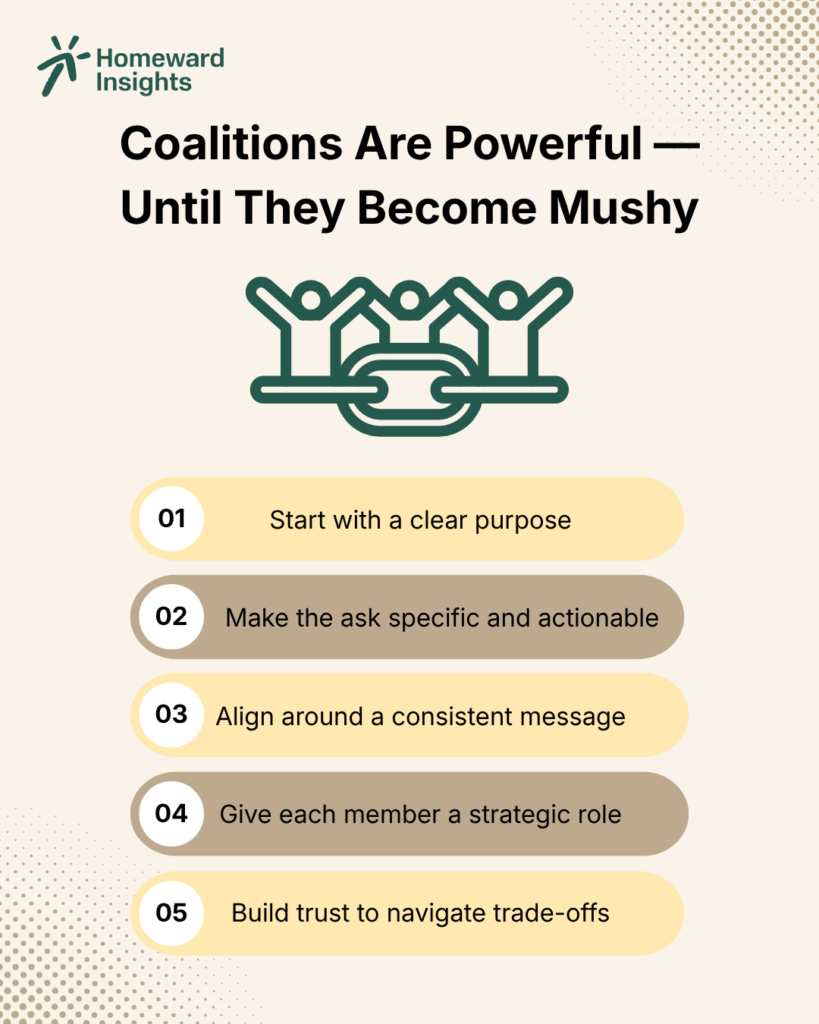
The challenge is that coalitions often become broad by becoming less clear.
To keep everyone at the table, the message gets softened. The ask gets generalized. The language becomes cautious. The recommendations multiply. The coalition avoids hard choices because hard choices might create disagreement.
Eventually, the coalition may have many members but very little strategic force.
Government receives a letter that says the issue is important, urgent, complex, and deserving of attention.
That may all be true.
But what is government supposed to do?
A coalition that cannot answer that question clearly may raise awareness without creating action.
This is the difference between a coalition that demonstrates support and a coalition that moves a file.
Support matters.
But government still needs a decision, a pathway, and a reason to act.
The Strongest Coalitions Know What They Are For
Before building a coalition, organizations should ask a simple question:
What is this coalition meant to achieve?
Is the goal to secure funding? Shape program design? Stop a harmful policy change? Improve legislation? Influence a budget process? Build awareness? Demonstrate sector alignment? Create a shared evidence base? Get invited into implementation discussions?
Different goals require different coalitions.
A coalition designed to influence a budget decision may need a narrow ask, a short timeline, strong political outreach, and disciplined follow-up.
A coalition designed to shape long-term policy may need deeper research, broad engagement, technical expertise, and a longer runway.
A coalition designed to stop a harmful change may need urgency, public pressure, and a clear explanation of consequences.
A coalition designed to build awareness may need storytelling, communications, and visible community support.
The structure should follow the purpose.
When the purpose is unclear, the coalition tends to drift.
A Coalition Needs an Ask
One of the most common weaknesses in coalition advocacy is the absence of a clear ask.
Coalitions often know what they are concerned about. They know what values they share. They know what problem they want government to understand.
But they do not always know what they are asking government to do.
That matters because government cannot act on concern alone.
A strong coalition ask does not have to solve everything. In fact, it often should not try to. The strongest ask may be the first step: a funding envelope, a policy commitment, an advisory process, an eligibility change, a review, a pilot, a legislative amendment, or a commitment to work with the sector on implementation.
The ask should be specific enough to be actionable and broad enough to hold the coalition together.
That balance is not always easy.
But without it, coalition advocacy can become a shared expression of frustration rather than a strategy for change.
Message Discipline Matters
Coalitions are most effective when members can tell the same story in different voices.
That does not mean every organization needs to sound identical. In fact, coalitions are stronger when different members can speak from their own experience: frontline delivery, community impact, research, lived experience, regional realities, operational challenges, or system-level consequences.
But the core message has to be aligned.
Government should hear a consistent explanation of the problem, the ask, the timing, and the public value.
When coalition members say different things, ask for different outcomes, or frame the issue in contradictory ways, government can become confused. Worse, it may use that lack of alignment as a reason to delay.
Message discipline does not mean eliminating nuance.
It means making sure nuance does not become noise.
Not Every Organization Has the Same Role
Good coalitions recognize that not every member needs to do the same thing.
Some organizations may be best positioned to meet with political staff. Others may have stronger relationships with officials. Some may bring data. Others may bring community stories. Some may have local credibility in key ridings. Others may be able to mobilize partners, speak to media, engage members, or validate the implementation case.
A coalition becomes stronger when it uses those differences strategically.
That requires coordination.
Who is the lead spokesperson? Who meets with which offices? Who prepares materials? Who handles follow-up? Who speaks publicly? Who stays behind the scenes? Who can be named? Who needs to remain quieter because of funding relationships or local dynamics?
These questions are not administrative details.
They are strategic choices.
A coalition without role clarity can become chaotic. A coalition with role clarity can move with purpose.
Coalitions Need Trust
Coalitions require trust among members.
That trust does not mean everyone agrees on everything. It means members understand the shared objective, respect the process, and believe the coalition is not being used to advance one organization’s narrow interests at the expense of others.
This is especially important when coalitions include organizations of different sizes, regions, communities, or levels of influence.
Larger organizations need to avoid dominating the conversation. Smaller organizations need to feel their expertise is genuinely valued. Organizations closest to the people affected need to be included in shaping the message, not only endorsing it after the fact.
Trust is also important because advocacy can involve trade-offs.
A coalition may need to decide whether to narrow the ask, move quickly, accept a partial win, escalate pressure, or adjust strategy after government feedback. Those choices are easier when members trust each other.
Without trust, coalitions can fracture at exactly the moment discipline matters most.
Coalitions Can Give Government a Better Answer
At Homeward, we often describe our work as policy advocacy, made human.
Coalitions can be a powerful expression of that idea.
A strong coalition can show government not only that a policy issue matters, but how it affects people, organizations, communities, and systems in different ways. It can bring human stakes and practical expertise together.
That is valuable because government rarely needs only one perspective.
It needs to understand how an issue lands on the ground. It needs to know what different organizations are seeing. It needs to understand whether a proposed solution is workable. It needs to hear where unintended consequences may appear.
A well-organized coalition can help government make better decisions.
But to do that, the coalition has to be useful.
It has to bring clarity, not just volume.
When Coalitions Become a Problem
Coalitions can also slow advocacy down.
They can make it harder to move quickly. They can force everything through too many approvals. They can water down the message. They can create internal politics. They can produce endless meetings and very little action.
Sometimes, an organization should not build a coalition.
Sometimes the issue is too specific. Sometimes the timeline is too short. Sometimes the ask is not yet mature. Sometimes coalition partners are not aligned. Sometimes quiet engagement is more effective than visible collective pressure.
This is not an argument against coalitions.
It is an argument for using them carefully.
A coalition should add power, credibility, reach, or insight that an organization cannot generate alone.
When it does not, it may simply add complexity.
What Organizations Should Ask Before Building One
Before creating or joining a coalition, organizations should ask:
- What are we trying to achieve?
- Is there a real government decision or process we are trying to influence?
- What is the ask?
- Who needs to be involved for the coalition to be credible?
- Who should lead?
- What roles should different members play?
- Can we maintain message discipline?
- What will we do if government responds positively?
- What will we do if government does not respond?
- How will we know whether the coalition is helping?
These questions help prevent coalitions from becoming symbolic rather than strategic.
They also help organizations avoid the trap of treating collaboration itself as the outcome.
Collaboration is valuable.
But in government relations, collaboration should move the work somewhere.
How Homeward Helps
Homeward helps mission-driven organizations decide when coalition advocacy makes sense, how to structure it, and how to keep it focused.
That can include clarifying the shared ask, mapping the right partners, developing common messaging, preparing materials, coordinating outreach, sequencing engagement, and helping members understand their roles.
Sometimes the best strategy is to build a coalition.
Sometimes it is to join one.
Sometimes it is to stay out, build relationships quietly, and wait until there is a clearer pathway.
The right answer depends on the objective, the timing, the decision-maker, and the level of alignment across the sector.
For organizations considering coalition advocacy, Homeward Talks is a practical place to start. It is a low-pressure way to assess whether a coalition could help, what it would need to achieve, and how to avoid creating more activity than progress.
Book a Homeward Talks session to get clearer about whether coalition advocacy is the right path.
A Final Thought
Coalitions can be powerful.
They can show breadth. Build credibility. Create political permission. Bring human experience and technical expertise together. Help government see that an issue matters beyond one organization.
But a coalition is only as strong as its clarity.
Without a purpose, an ask, a pathway, and discipline, coalitions can become mushy.
The goal is not simply to gather voices.
The goal is to help those voices move government toward action.