


One of the most frustrating experiences in government relations is a good meeting that goes nowhere.
The conversation is positive. The officials are engaged. The political staff seem interested. The minister understands the issue. Everyone agrees the organization does important work.
And then nothing happens.
No decision. No funding. No policy change. No follow-up beyond polite words and general encouragement.
For organizations trying to navigate government, this can feel confusing. If the need is real, the work is strong, and the conversation went well, why does the file not move?
The answer is often simple: government may understand the issue, but not yet have what it needs to say yes.
A positive response is not the same thing as a decision.
Government needs more than a compelling story. It needs a clear problem, a practical solution, evidence, timing, internal alignment, implementation confidence, and a reason to act.
That does not mean organizations need to make advocacy more complicated than it already is.
It means they need to understand what government is listening for.
Agreement Is Not Action
Many organizations mistake agreement for momentum.
A decision-maker may agree that a problem exists. They may agree that your organization does good work. They may agree that the current system is imperfect. They may even agree that something should change.
But agreement alone rarely produces action.
Government is full of problems that everyone agrees are real. Housing affordability is real. Food insecurity is real. Health system pressure is real. Youth mental health challenges are real. Infrastructure gaps are real. Workforce shortages are real. Community safety concerns are real.
The question is not only whether government believes the problem exists.
The question is whether government can see a path to doing something about it.
That is the difference between a sympathetic meeting and a moving file.
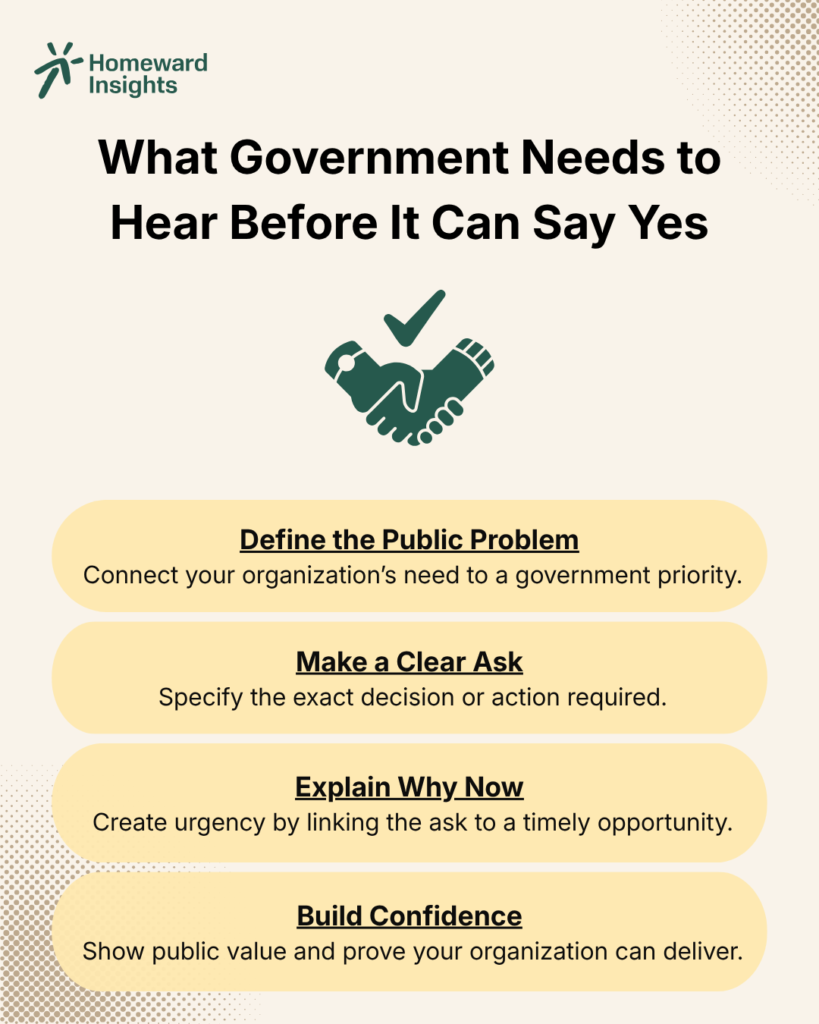
Government Needs a Problem It Can Recognize
Most organizations begin with the problem as they experience it.
That is natural. They see the pressure directly. They know the families, clients, members, residents, staff, and communities affected. They understand the operational burden. They know what will happen if nothing changes.
But government needs the issue translated into a public problem.
That means the problem has to connect to something broader than the organization itself.
A program’s funding gap may be the immediate issue. But the public problem might be increased homelessness, avoidable hospital use, reduced workforce participation, lost affordable housing, worsening mental health outcomes, delayed infrastructure, or higher downstream public costs.
A government audience needs to understand the connection between the organization’s reality and the public outcome.
That translation matters.
“We need support” may be true.
“This support will help solve a problem government is already trying to manage” is more actionable.
Government Needs a Clear Decision
One of the most common barriers to progress is an unclear ask.
Organizations sometimes assume that once government understands the issue, government will know what to do. That is rarely the case.
Decision-makers need to know what decision is being requested.
Is the organization asking for capital funding? Operating funding? A pilot project? A program eligibility change? A regulatory amendment? A procurement adjustment? Inclusion in a consultation? A letter of support? A meeting with officials? A formal partnership? A review of an existing barrier?
Different asks move through different parts of government.
A budget request is not the same as a program design conversation. A regulatory fix is not the same as a capital funding request. A procurement issue is not the same as a policy recognition issue.
When the ask is unclear, government may respond positively but still have nowhere to take it.
A clear decision gives government something to work with.
It also helps the organization understand who matters, what process is relevant, what evidence is needed, and what timeline is realistic.
Government Needs to Understand Why Now
Timing is one of the most underestimated parts of advocacy.
A strong idea can fail because it arrives too late. It can also fail because it arrives too early, before government has a process, mandate, or mechanism to act.
Before government can say yes, it needs a reason to act now.
That reason might be a budget window, a program renewal, a crisis, a mandate commitment, a public pressure point, a legislative review, a funding deadline, a municipal decision, a federal-provincial negotiation, or an emerging policy priority.
Without a timing argument, an issue can drift.
Government may agree the idea has merit, but treat it as something to consider later. Later can mean the next budget. The next mandate. The next program review. The next minister. The next fiscal year. Sometimes, later means never.
A strong strategy explains why the issue matters now.
Not only why it matters in general.
Government Needs Confidence You Can Deliver
Government is not only assessing whether an idea is good.
It is assessing whether it can be implemented.
That is especially true when public dollars, policy change, or new programs are involved. Government needs to know whether the organization has the capacity, credibility, partnerships, governance, financial controls, community trust, and operational readiness to deliver what it is proposing.
This can be uncomfortable for organizations because they often assume their track record speaks for itself.
Sometimes it does.
Often, it needs to be made explicit.
Who have you served? What outcomes have you achieved? What partners are already aligned? What evidence supports the model? What risks have been considered? What approvals are in place? What is ready now? What still needs to happen?
Implementation confidence matters because government carries risk.
If a project fails, a program underdelivers, or a policy change creates unintended consequences, government is accountable. A strong advocacy strategy helps reduce that perceived risk by showing that the organization understands delivery, not just need.
Government Needs the Human Stakes
Government needs evidence, but evidence alone is not enough.
The strongest advocacy keeps the human stakes visible.
Policy affects real people. Funding decisions affect whether services continue. Program rules affect who gets help and who is left out. Capital decisions affect whether people have safe places to live. Regulatory decisions affect whether organizations can deliver effectively.
At Homeward, we often describe our work as policy advocacy, made human.
That means we do not treat lived experience, community reality, or frontline knowledge as an emotional add-on. They are central to the case.
But the human story has to be connected to a practical path forward.
A story without a recommendation may move people emotionally but leave them unsure what to do. A recommendation without a human story may feel technically sound but fail to create urgency.
The strongest advocacy brings both together.
It helps government understand what is at stake, who is affected, and what action could make a meaningful difference.
Government Needs Internal Permission
Even when one person in government wants to help, they may not be able to move the issue alone.
Most decisions require internal permission.
A minister’s office may need officials to validate the proposal. Officials may need political direction. A department may need central agency approval. A program team may need evidence. Finance may need fiscal rationale. Cabinet may need a clear public interest argument. A local MPP or MP may need to understand the community impact.
This is why government relations cannot rely on one conversation.
A file often has to travel.
It may need to move from a political office to a department, from a department to central agencies, from a stakeholder meeting into a briefing note, from a briefing note into an options memo, from an options memo into a budget process, program design process, or cabinet discussion.
That movement does not happen automatically.
Organizations need materials, messages, relationships, and follow-up that help the file travel inside government.
A good meeting opens the door.
A strong strategy helps the issue move through the building.
Government Needs to See Public Value
Every organization believes its work matters.
The strongest organizations can also explain why their work creates public value.
That means showing how the proposed action helps government achieve something that matters beyond the organization itself.
Does it reduce pressure on another public system? Improve outcomes for a vulnerable population? Preserve essential services? Support affordability? Strengthen economic participation? Build housing? Improve health? Reduce long-term costs? Advance reconciliation? Support community resilience? Help government deliver on an existing commitment?
Public value is not a slogan.
It is the bridge between an organization’s mission and government’s responsibility.
When government can see that bridge clearly, the conversation changes.
The ask becomes less about helping one organization and more about solving a shared problem.
What This Means for Organizations
Before asking government to say yes, organizations should test whether they have given government enough to work with.
- Have we defined the public problem clearly?
- Have we explained why now?
- Have we explained why now?
- Have we identified the specific decision we are asking for?
- Have we shown why we are credible?
- Have we made the human stakes visible?
- Have we provided enough evidence?
- Have we considered implementation?
- Have we identified who else inside government needs to understand this?
- Have we made it easy for the issue to move after the meeting?
These questions do not guarantee success.
But they dramatically improve the quality of engagement.
They also help organizations avoid one of the most common advocacy traps: assuming that a positive conversation means government has everything it needs.
Often, the real work begins after the first yes.
The first yes may simply be: yes, this is interesting. Yes, this matters. Yes, we should keep talking.
The strategy is what turns that early interest into a decision.
How Homeward Helps
Homeward helps mission-driven organizations build the case government needs before it can act.
That includes clarifying the public problem, sharpening the ask, identifying the decision-makers, preparing usable materials, sequencing engagement, building credibility, and making sure the human stakes remain at the centre of the work.
Sometimes the goal is major public investment. Sometimes it is policy change, program redesign, regulatory reform, senior-level access, implementation support, or risk reduction.
The objective changes from file to file.
The discipline does not.
Government needs to understand the issue, trust the organization, see the public value, and know what decision is being requested.
For organizations that are not sure whether their ask is ready, Homeward Talks is a practical place to start. It is a low-pressure way to speak with an expert, test your thinking, and understand what government may need to hear before it can say yes.
To learn more about Homeward Talks: https://homewardpa.ca/talks/
A Final Thought
A good idea matters.
A compelling story matters.
A strong organization matters.
But government also needs a path to action.
That is why effective advocacy is not only about being heard. It is about being understood in a way that allows government to move.
Before government can say yes, it needs to know what problem you solve, why it matters now, what decision is required, and why your organization can help deliver the outcome.
The clearer that becomes, the easier it is for government to act.