


The traditional digital funnel is collapsing, and it is happening quietly. For the last two decades, corporate leaders and Government Relations professionals have relied on a predictable, linear path: a stakeholder searches for a topic, they are presented with a page of blue links, they click your meticulously optimized website, and you capture their attention.
That era is over. We have entered the age of the synthesized answer, and if you are not actively adapting to it, your organization is participating in a digital race that has already been rerun on a different track.
Welcome to the era of Generative Engine Optimization (GEO). The landscape is shifting violently in real time, and the organizations that treat this as a mere IT problem, rather than a mandate for high-level creative strategy, are about to find themselves completely invisible to their most critical audiences.
The Death of the Blue Link
To understand the urgency, you must look at consumer and stakeholder behavior. As of early 2026, a staggering large amount of searches are now zero-click. People are no longer browsing pages; they are asking AI assistants like ChatGPT, Perplexity, and Google’s AI Overviews to do the reading for them.
The adoption rate is terrifyingly fast. ChatGPT reached 900 million weekly active users by February 2026. Even more critically for corporate strategy, 44% of AI search users now cite these engines as their primary source for product and brand discovery.
This creates a massive blind spot for leadership teams who are still measuring success through traditional Search Engine Optimization (SEO). You can completely dominate Google’s first page for your core issues and still be entirely absent when a stakeholder asks ChatGPT for an overview of the landscape. In fact, data shows that only 10% of what ChatGPT cites for a given query actually appears in Google’s top 10 organic results.
If your brand, your policy position, or your corporate narrative is not cited in the AI’s generated response, you do not exist in that stakeholder’s journey. You have lost the war for attention before the first click was even a possibility.
Trust and trying to hack it.
The immediate reaction from many boardrooms is to demand that marketing and GR teams “optimize for the AI.” But this is where organizations fall into a dangerous efficiency trap.
We assume that because AI is a machine, we can hack it with machine-like behavior, flooding the zone with synthetic, AI-generated content, stuffing FAQs with keywords, and treating GEO as a purely technical exercise.
This fails because it fundamentally misunderstands what Large Language Models (LLMs) are actually doing. AI engines do not retrieve pages based on keyword density; they evaluate entities, map relationships, and synthesize answers based on consensus and credibility. They act like researchers looking for the most authoritative, trustworthy sources to quote.
When you remove the human strategist and rely on AI to generate your corporate content, you produce what the internet has dubbed “slop”, frictionless, average, sanitized text. AI models are increasingly sophisticated at filtering out semantic noise. If your content lacks original insight, verifiable data, and a distinct point of view, the algorithm will ignore it.
Future-Proofing Your Funnel with Creative Strategy
The tangibles of creative strategy are no longer just nice-to-haves for brand building; they are the literal prerequisites for algorithmic visibility. AI traffic is incredibly valuable, visitors referred by AI answers have been shown to convert at rates 23 times higher than traditional organic search because their intent is so highly qualified.
To capture this, you must build a GEO strategy that marries technical structure with strategic creative. Here is what you need to do right now, and how to execute it.
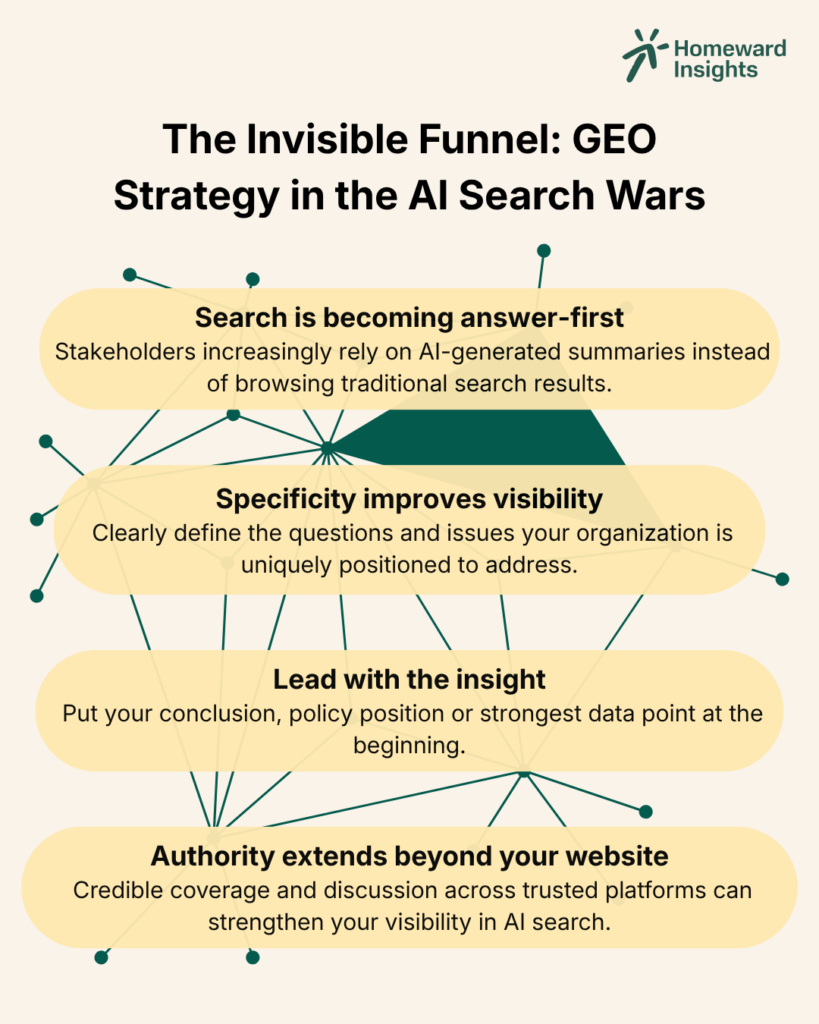
1. Claim the Category Entry Point
- AI engines demand hyper-specificity. If your corporate narrative tries to be all things to all people, the LLM will classify you as ambiguous and exclude you.
- Your creative strategy must define exactly what your brand is the indisputable answer to. Map the specific, high-intent questions your stakeholders are asking, the “sub-queries” that AI breaks larger questions into, and build deep, authoritative content that answers those questions better than anyone else on the internet.
2. Front-Load the Insight.
- AI models evaluate the relevance of your content in real time. If they have to dig through four paragraphs of corporate throat-clearing to find your stance on a regulatory issue, they will move on to a competitor.
- Restructure your communications to be “answer-first.” Lead with the concrete conclusion, the definitive policy stance, or the specific data point. The creative strategist’s job is to make that direct answer compelling and human, wrapping the raw facts in a narrative that resonates once the AI delivers it to the user.
3. Engineer the Influence Graph
- AI rarely cites your self-published press releases in a vacuum. It looks across the web to see if other trusted sources agree with you. This is the new PR.
- You must embed your brand into the broader cultural and industry conversation. This means deploying creative campaigns that generate real human discussion on platforms like LinkedIn, Reddit, and industry forums. When real people and respected publications debate, share, and validate your original research, AI systems capture those trust signals and elevate your authority.
4. Publish with a Soul
- Experience, Expertise, Authoritativeness, and Trustworthiness are the signals AI uses to decide if you are worth citing. Faceless corporate copy fails this test.
- Put your leaders front and center. Attach named, credentialed experts to your content. Publish proprietary data, bold opinions, and nuanced perspectives that only a human could synthesize. The more creativity and humanity you inject into the work, the more the machine will trust it as a primary source.
Aim Higher Than the Prompt
The shift toward AI-synthesized search is the greatest disruption to digital strategy since the invention of the hyperlink. But the solution is not to retreat, nor is it to hand the keys entirely to the algorithm.
At Arqtic, we tell our partners that AI should provide your velocity, but creative strategy must provide your direction. If you want to survive the digital race for attention, you must build a funnel that the machines can easily read, but that humans actually want to engage with. Without a deliberate GEO strategy anchored in real creative nuance, you risk being erased from the conversation.
Put the Strategy into Practice
If your organization is considering how GEO should inform its positioning, public affairs narrative or next campaign, continue the conversation with Jack Shaw through Homeward Talks. As Homeward’s expert in Creative and Campaign Strategy, Jack can help you assess the opportunity, clarify your approach and translate these principles into a practical strategy.
Book a Homeward Talk with Jack: https://homewardpa.ca/talks/expert-jack-shaw/