

Many organizations assume that if their idea is strong enough, government will pay attention.
Sometimes that is true.
A compelling issue matters. Evidence matters. Community need matters. A strong organization matters. But in government relations, strength alone is rarely enough.
Government does not make decisions in a vacuum. It moves through budgets, mandate letters, legislative calendars, committee studies, fiscal updates, program reviews, political transitions, public pressure, and internal decision-making windows.
A good idea brought forward at the wrong time can sit untouched.
A good idea brought forward at the right time, to the right people, in the right form, can become actionable.
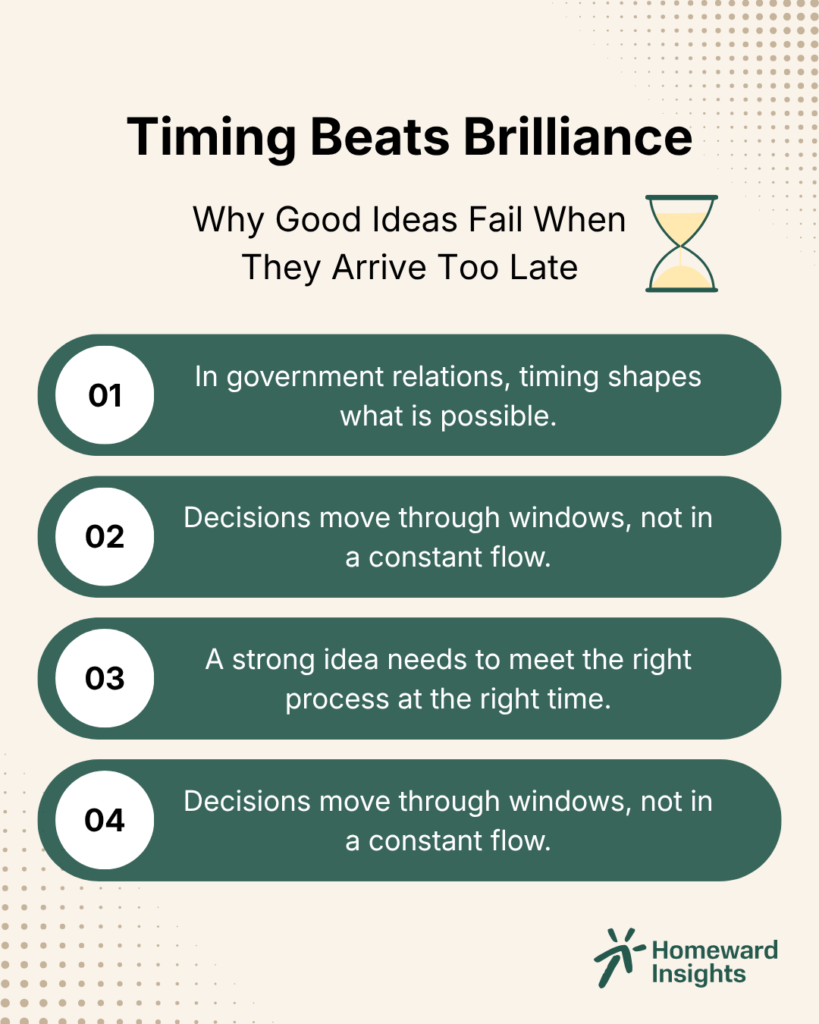
That is why timing often beats brilliance.
Government Moves Through Windows
One of the most important things to understand about government is that decisions do not happen continuously.
They happen through timing windows.
Budgets create fiscal windows. Mandate letters create priority windows. Committee studies create evidence windows. Legislative reviews create amendment windows. Program renewals create design windows. Elections create platform windows. Cabinet shuffles create reset windows. Crises create urgency windows.
For organizations trying to influence government, those windows matter.
A funding ask made while budget decisions are being shaped is very different from the same ask made after decisions have narrowed. A regulatory proposal brought forward during a live review is very different from one raised after drafting is complete. A policy recommendation connected to a committee study has a different pathway than one sent into government with no active process attached to it.
The question is not only whether your idea is good.
The question is whether government currently has a place to put it.
That is where many organizations struggle. They know what they want to say, and they may even have a strong case. However, they are not always clear on when government is most able to hear it, use it, and act on it.
Why Good Ideas Miss
Good ideas fail all the time.
Not because they are bad. Not because the organization behind them lacks credibility. Not because the issue is unimportant.
Often, they fail because they arrive too late, too early, or disconnected from an active decision-making process.
A budget ask made after the fiscal window has closed may still receive a polite meeting. A committee submission on an unrelated study may still be accepted. A regulatory recommendation made after policy design is complete may still be acknowledged. A meeting with a minister’s office may still feel positive.
But none of that means the idea has a real path to action.
Sometimes government does not say no.
Sometimes government simply has no live process through which to say yes.
This is one of the most frustrating realities of advocacy. Organizations may do the work, prepare the materials, meet the right people, and still feel like nothing moves. But the problem may not be the quality of the idea. The problem may be that the moment was wrong.
In government relations, timing is not a scheduling detail.
It is a strategic variable.
The Right Time Is Not Always When You Feel Ready
Organizations often think about timing from the inside out.
They engage government when a project is ready, when a board has approved a direction, when a funding gap becomes urgent, when a program needs renewal, or when a challenge has become too significant to ignore.
Those internal timelines matter. But government works on its own timelines.
Effective government relations is about aligning organizational readiness with government decision points. Sometimes that means moving faster than expected because a window has opened. Sometimes it means holding back because the ask is not ready, the message is not clear, or the relevant decision is still months away.
The right time to engage is not always when your organization feels ready.
It is when government has a reason and a mechanism to act.
That changes the work process. Advocacy cannot begin only when a need becomes urgent. It has to begin early enough to understand the landscape, prepare the case, build relationships, and move when the moment arrives.
The organizations that move best in government are rarely the ones that scramble hardest.
They are the ones that prepare early enough to act with discipline.
Some Windows Are Visible. Others Are Not.
Some political windows are public and easy to identify.
Budgets. Fiscal updates. Committee studies. Public consultations. Elections. Throne speeches. Mandate letters. Legislative reviews.
These are obvious moments for advocacy because government is visibly asking questions, setting priorities, or making decisions.
But some of the most important windows are less visible.
A minister may be setting early priorities. A department may be reviewing a program internally. Political staff may be preparing advice. Officials may be developing implementation details after an announcement. A caucus group may be trying to understand how an issue is landing regionally.
By the time a consultation is public, the conversation may already be well underway inside government.
That does not mean public processes do not matter. They do. Committee submissions, consultation responses, budget briefs, and public engagement can all be valuable.
But they are most valuable when they are connected to a broader strategy.
A strong submission is not just a document. It is part of a sequence. A meeting is not just a conversation. It is part of a pathway. A letter is not just a statement. It is a signal.
And signals matter most when they arrive at the right time.
Different Outcomes Require Different Timing
Not every government relations objective moves through the same kind of window.
A funding ask needs to align with budget and fiscal planning.
A regulatory change needs to align with legislative, regulatory, or administrative review.
A program design ask needs to align with implementation, renewal, or evaluation.
A committee strategy needs to align with a relevant study.
A relationship-building strategy should happen before an urgent ask, not only after a crisis emerges.
This is why government relations cannot be one-size-fits-all.
You do not engage government the same way for every outcome, because government does not make every kind of decision the same way.
The audience, materials, ask or timeline may change depending on the goal. The right first step may be a meeting, a brief, a submission, a local visit, a stakeholder validator, a committee appearance, or quiet engagement with officials.
Ultimately, the strategy has to fit the decision you are trying to influence.
Timing Also Shapes the Message
A good message is not timeless.
It changes with the moment.
Before a budget, the strongest message may focus on fiscal relevance, delivery readiness, cost avoidance, or alignment with government priorities.
During a committee study, the strongest message may focus on evidence, lived experience, implementation barriers, and concrete recommendations.
During a crisis, the strongest message may focus on urgency and immediate problem-solving.
During a mandate reset, the strongest message may focus on how your issue aligns with the government’s stated direction.
During implementation, the strongest message may focus less on principle and more on design: what will work, what will fail, and what needs to be adjusted before the policy hits the ground.
This does not mean organizations should change their values depending on the audience.
It means they should understand what kind of argument the moment requires.
Good timing helps determine not just when to speak, but how to be heard.
What This Means for Organizations Like Yours
For organizations trying to engage government, the lesson is not to panic.
It is to plan.
You do not need to chase every political event or respond to every announcement. You do not need to treat every week as a crisis. And you do not need to be everywhere at once.
You need to understand which windows matter for your objective.
That means asking a few basic questions.
What kind of decision are we trying to influence?
Who actually has influence over that decision?
When will that decision likely be shaped?
What does government need to hear before then?
What materials, relationships, and evidence need to be in place?
What happens if we miss the window?
These questions make advocacy more disciplined. They help organizations avoid wasted effort. They also help distinguish between activity that feels useful and action that actually builds toward a result.
How Homeward Helps
At Homeward, we help organizations understand not only what to say to government, but when it is most likely to matter.
That means reading the political calendar, identifying decision windows, mapping who matters, and helping clients understand where their priorities fit within the real rhythms of government.
Sometimes the work is about moving quickly because a window is open. Sometimes it is about preparing quietly before the window opens. Sometimes it is about recognizing that the timing is wrong and using the moment to build relationships, refine the ask, or prepare for the next opportunity.
Good ideas should not be left to chance.
They should be made legible, timely, and actionable.
For organizations with an issue, project, or policy idea that may need government attention, Homeward Talks is a low-barrier way to begin making sense of the timing. It can help clarify whether there is a window opening, what preparation may be needed, and how to think about the right next step.
Book a Homeward Talk: https://homewardpa.ca/talks/
A Final Thought
A strong idea matters.
But in government relations, strength alone is not always enough.
The idea has to arrive when government can hear it, understand it, use it, and act on it.
That is why timing beats brilliance.
And it is why the organizations that prepare for the right windows often have the best chance of shaping what comes next.