


Canada is entering a new growth moment.
At the federal level, Prime Minister Mark Carney has been clear about the direction of travel: build one Canadian economy, reduce internal trade barriers, accelerate nation-building projects, and create the conditions for significantly more investment across the country. In his mandate letter, he committed to removing barriers to interprovincial trade and expediting projects that can connect and transform the country. Budget 2025 then took that idea further, stating that the government’s broader economic plan is intended to enable $1 trillion in total investment over the next five years.
That is not a small shift.
It signals a Canada that is trying to become more integrated, more investable, and more ambitious in how it approaches growth. It also signals something else: for organizations looking to expand, whether from abroad or from one province into another, this is a moment of real opportunity.
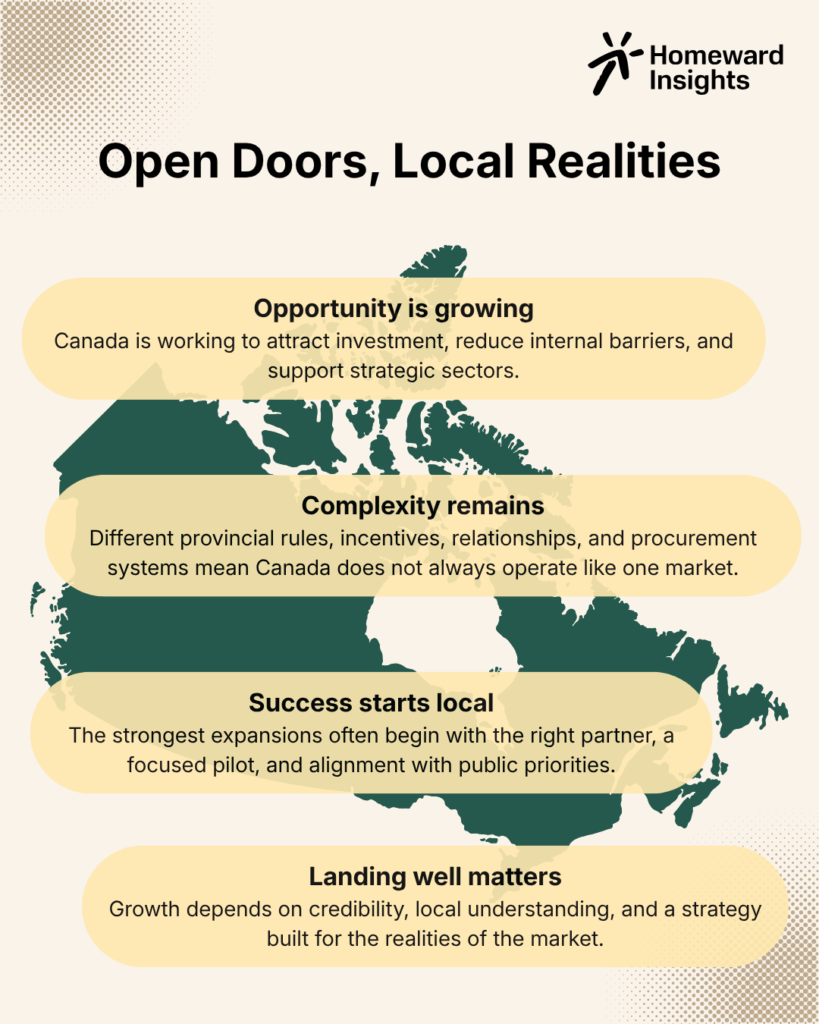
But opportunity does not remove complexity.
Canada may be opening new doors for growth. But expansion still requires careful strategy.
This is not just about foreign direct investment
There is an international version of this story, and there is a domestic one too.
Internationally, Canada is actively trying to attract new capital, new capabilities, and new partnerships in sectors that matter to its future: housing, clean energy, water, health innovation, critical minerals, advanced manufacturing, and infrastructure.
Domestically, Ottawa is also trying to make it easier for Canadian organizations to grow across the country by lowering internal trade and labour barriers that have held back productivity and scale. The federal government has said those barriers have cost Canada as much as $200 billion a year in lost opportunities.
That matters because one of the least appreciated truths about Canada is that expanding from one province into another can sometimes feel like entering an entirely new market.
Different provincial rules. Different incentives. Different policy priorities. Different relationships. Different rhythms of decision-making.
Canada is one country, but it does not always operate like one market.
The current federal push matters because it acknowledges that growth in Canada has too often been slowed not only by international competition, but by our own internal fragmentation.
The opportunity is real. So is the friction.
For organizations looking at Canada from abroad, the opportunity for investment is increasingly compelling.
Our internal research shows that foreign-owned companies establishing Canadian subsidiaries can access substantial public support, especially in strategic sectors. Federal and provincial programs can often provide non-dilutive funding in the $250,000 to $5 million-plus range, and in some cases more, particularly when the project creates jobs, supports innovation, or aligns with environmental and economic goals.
But the same research also points to an important reality: successful entry into Canada is rarely just a commercial exercise.
It usually involves a combination of:
- a credible Canadian footprint,
- local partnerships,
- pilot or demonstration activity,
- alignment with government priorities,
- and a deliberate funding and relationship strategy that reduces risk while building early traction.
That logic applies just as much to a company entering from another country as it does to an organization in one province trying to expand into another.
Because in both cases, the challenge is not simply getting in.
The challenge is landing well.

What successful expansion tends to look like
One of the most useful patterns in our research is that successful market entry in Canada often starts smaller, more strategically, and more collaboratively than people expect.
Many organizations that have scaled successfully here did not begin with a full national rollout. They began with the right local partner, the right pilot project, and a clear fit with a public or market priority.
That pattern shows up again and again.
A Korean ag-tech company, NEXTON, advanced its Alberta entry through an MOU with Invest Alberta and a plan for a local pilot facility, using provincial ecosystem support to establish credibility and connections.
Hydraloop, a Dutch water recycling company, broke into Ontario through a municipal-backed pilot in Waterloo Region, partnering with both the Region and a local developer to demonstrate value in a real-world setting.
Israeli health-tech firms BrainsWay and HeartBeat Technologies used a Canada–Israel innovation pathway and local institutional partners to pilot their technologies in Ontario seniors’ care settings, generating validation and real footholds in the Canadian market.
At the larger end of the spectrum, Volkswagen and Air Products illustrate how strategic alignment with federal and provincial priorities can unlock major public support and create entirely new ecosystems of growth.
These are very different cases. But the underlying lesson is remarkably consistent.
Canada rewards organizations that enter thoughtfully, align with public priorities, and build credibility through real partnerships and real delivery.
Why interprovincial expansion deserves just as much attention
It would be a mistake to think these lessons only matter for international entrants.
For many Canadian organizations, expanding beyond a home province can be every bit as challenging as entering from abroad. Internal trade barriers, labour mobility constraints, procurement differences, and provincial policy silos create real friction. This point has been reflected directly in the federal government’s own messaging on the One Canadian Economy agenda, including its commitment to remove federal barriers and work with provinces and territories toward a more integrated domestic market.
That means organizations in Ontario looking west, Alberta-based firms seeking Quebec partnerships, and Atlantic organizations trying to build a national footprint are all navigating versions of the same challenge:
How do you expand into a market that is legally one country, but operationally still quite fragmented?
The answer is not to assume that a strong offering will simply travel on its own.
Expansion in Canada is rarely plug-and-play.
Success often depends on the ability to translate:
- A value proposition into province-specific realities,
- an offering into trusted local partnerships,
- and ambition into a credible growth plan that aligns with public and market conditions.
What this means now
This is why this moment matters so much.
Canada is trying to reduce the friction that has held growth back. It is trying to become more integrated, more competitive, and more attractive to serious investment. It is building policy, fiscal, and institutional conditions that can support economic expansion.
But that does not mean the work of entry or expansion has suddenly become simple.
It means that organizations that move with care, discipline, and strategic awareness are likely to find a more receptive environment than they would have even a few years ago.
That applies to international companies choosing Canada as a launchpad.
It applies to Canadian organizations deciding now is the time to grow nationally.
And it applies especially to organizations operating in strategic sectors, where public priorities and market demand are increasingly reinforcing one another. Our internal research points to ag-tech, water, clean energy, critical minerals, and health innovation as especially strong examples of sectors where public support, partnerships, and market opportunity can all intersect.
How Homeward fits into this moment
At Homeward, we understand that expansion in Canada is not just about identifying demand.
It is about understanding how government is thinking, where openings are emerging, what kinds of partnerships and pilots build traction, and how to position an organization so that it is not just present in the market, but set up to succeed in it.
That is true whether you are entering Canada from abroad or trying to expand across provincial lines within it.
We help organizations make sense of the opportunity, navigate the complexity, and build the kind of strategy that gives growth a real chance to stick.
A final thought
There is a temptation, when governments start talking about big investment, fewer barriers, and a stronger national economy, to assume that opportunity will naturally become easier to capture.
It rarely works that way.
The opportunity is real. The door is opening.
But the organizations that benefit most will not be the ones that simply show up.
They will be the ones that understand how Canada actually works, where its friction points still are, and how to expand in a way that is deliberate, credible, and aligned with the moment.
Canada is opening new doors for growth. But expansion still requires careful strategy.
And for organizations ready to move, that strategy can make all the difference.