


Many organizations reach a point where they know government matters to their work, but they are not entirely sure what to do about it.
They may have a funding need. A policy problem. A regulatory barrier. A program that should be scaled. A community challenge that government needs to understand better. Or simply a sense that decisions are being made somewhere, by someone, and that their organization should probably be part of the conversation.
That instinct is often right.
But knowing that government matters is not the same thing as knowing how to engage effectively.
That is where government relations comes in.
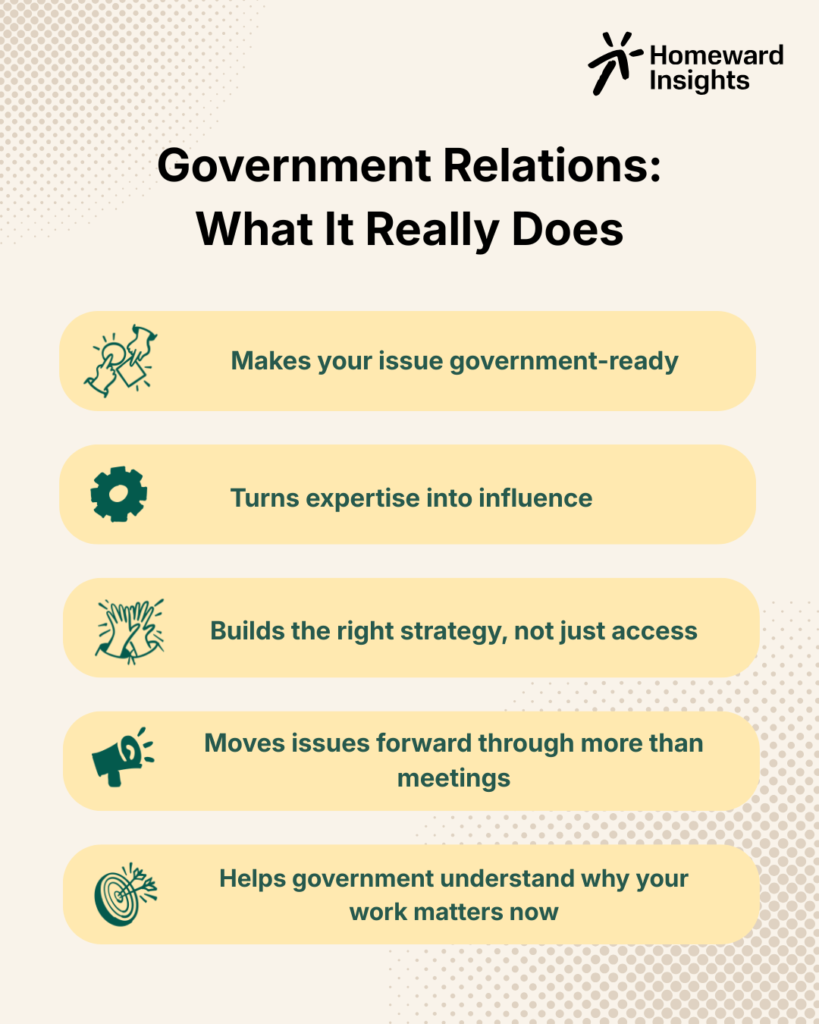
At its best, government relations is the work of turning an organization’s mission, expertise, and priorities into something government can understand, trust, and act on.
It is not only about access. It is not only about meetings. It is not only about funding. And it is certainly not about backroom deals.
It is about strategy, timing, relationships, credibility, and translation.
Government Relations Is Translation
Most organizations know their own work deeply.
They understand the communities they serve, the problems they are trying to solve, the barriers they face, and the opportunities that could help them do more. But government operates according to its own logic. It has its own timelines, pressures, priorities, constraints, and decision-making structures.
A strong government relations strategy helps bridge that gap.
It translates an organization’s expertise into a public policy case. It turns a program need into a government-relevant outcome. It turns lived experience, operational insight, and sector knowledge into something that can inform policy, funding, regulation, procurement, or implementation.
A good government relations firm does not replace your expertise. It helps make that expertise legible, timely, and actionable inside government.
That is one of the most important benefits of the work.
Many organizations do not struggle because their issue is unimportant, they struggle because their issue has not yet been framed in a way that fits how government actually makes decisions.
Government Relations Is Not Magic
There are a lot of misconceptions about government relations.
Some people think it is inherently cynical. Others assume it is about manipulating government, cutting corners, or relying on private relationships instead of strong arguments.
That is not how serious government relations works.
Government relations is not about backroom influence or shortcuts.. It is not magic. It is not a guarantee that government will say yes. And it is not a substitute for having a credible idea, a clear ask, or a strong organization behind it.
But it does involve relationships.
That distinction matters.
A good government relations firm will often have connections across government: in ministers’ offices, political staff networks, public service departments, central agencies, parliamentary offices, caucuses, and stakeholder communities. Those relationships can help open doors, clarify who matters, identify the right timing, and ensure that strong ideas are actually heard by the people who need to hear them.
Access matters. But access is not the strategy.
The real value comes from knowing what to do with that access once you have it.
A meeting with the wrong person, at the wrong time, with the wrong message, rarely changes anything. This is why it is important for organizations to have a meeting with the right person, at the right time, with a clear and politically realistic case so that an interaction with government can become the start of something much more meaningful.
Meetings Are a Tactic, Not the Whole Strategy
For many organizations, government relations begins with the thought: “We need meetings.”
Sometimes that is true.
But meetings are only one tool. Government relations can also include written submissions, policy briefs, advocacy days, committee engagement, budget submissions, community events, media strategy, stakeholder coalitions, public campaigns, and long-term relationship building.
The right approach depends on what you are trying to achieve.
A funding ask may require one strategy. A regulatory change may require another. A policy issue that cuts across multiple departments may require a whole different approach . An organization seeking long-term recognition as a trusted delivery partner may need to focus less on one immediate ask and more on sustained relationship-building over time.
That is why the first question should not be, “Who can we meet?”
The first question should be:
What are we trying to accomplish, and what path gives us the best chance of getting there?
Good Government Relations Starts With the Right Outcome
Not every advocacy effort should begin by aiming for the biggest possible win.
Sometimes the right first outcome is a meeting with a minister’s office or senior political staff. Sometimes it is getting your issue reflected in a briefing note or options memo. Sometimes it is being added to a consultation list, invited into a working group, or recognized by officials as a credible stakeholder.
Those may not sound like major victories from the outside. But in government relations, they matter.
They can build trust. They can create visibility. They can position an organization for future opportunities. They can help an idea move from the margins of a conversation into the machinery of government.
Over time, those smaller wins can contribute to larger shifts: changes to program rules, budget commitments, new pilot projects, regulatory amendments, or permanent funding streams.
Good government relations often builds momentum through smaller wins that create the conditions for bigger ones.
That is why political realism matters.
An unrealistic ask can damage credibility. A poorly timed campaign can miss the window. A message that is too broad, too vague, or too disconnected from government priorities can fail even when the underlying issue is important.
A strong strategy helps organizations aim for outcomes that are ambitious enough to matter and realistic enough to move.
Influence Depends on Power, Timing, and Framing
Government is not one person, one office, or one process.
Different actors matter at different times.
Sometimes the most important person is a minister. Sometimes it is a chief of staff or policy advisor. Sometimes it is a senior public servant who understands the file in detail. Sometimes it is a parliamentary secretary, a committee member, a caucus chair, a central agency official, or a local elected representative who can help build awareness.
Part of effective government relations is knowing the difference between decision-makers, influencers, and noise.
That distinction is not always obvious from the outside.
The most publicly visible person is not always the most important person for your objective. The person most willing to meet is not always the person most able to help. The office that seems closest to the issue may not be where the decision will ultimately be made.
Timing matters just as much.
Budgets, mandate letters, committee studies, legislative reviews, program renewals, cabinet processes, elections, fiscal updates, and public controversies all create windows where certain ideas can move and others cannot.
The right message to the wrong person at the wrong time rarely moves government.
And even when the audience and timing are right, framing still matters.
Some frames survive politics better than others. Affordability, economic prosperity, productivity, safety, fairness, resilience, and delivery often travel better than abstract appeals to “doing the right thing.” That does not mean values do not matter. They do. But values need to be connected to outcomes government can understand, defend, and implement.
Why Organizations Like Yours Work With Government Relations Firms
Many organizations are curious about government relations before they are certain they need it.
That is completely understandable.
You may know enough to recognize that advocacy could matter, but not enough to know where to begin. You may have had meetings before, but no clear result. You may have strong internal expertise, but no clear path into government. You may know your issue is important, but not know how to turn it into a government priority.
That is where the right support can make a meaningful difference.
A government relations firm can help your organization clarify its ask, map the decision-making environment, identify the right targets, choose the right timing, sharpen the message, prepare for meetings, build relationships, and understand what progress actually looks like.
At Homeward, this is at the core of how we work.
We help organizations understand not only what they want from government, but what government needs to hear in order to act. We help turn operational reality into policy language. We help clients avoid wasting energy in the wrong places. And we help them build strategies that reflect the real political, fiscal, and administrative environment they are operating in.
The goal is not to make government relations mysterious. The goal is to make it useful.
Not Sure Where to Begin?
If your organization is starting to wonder whether government relations should be part of your strategy, you do not need to have everything figured out before starting the conversation.
For many organizations, the challenge is not recognizing that government matters. It is understanding where to start, what is realistic, and how to think about the path forward.
That is part of why we created Homeward Talks.
Homeward Talks is a low-barrier way to speak with an expert, clarify what you are trying to accomplish, test assumptions, and begin mapping what a government relations strategy could look like for your organization.
It is designed for organizations that know government may matter to their work, but are still trying to understand the opportunity, the pathway, and the right next step.
Sometimes, the most valuable starting point is simply getting a clearer sense of what is possible.
Book a Homeward Talk: https://homewardpa.ca/talks/
A Final Thought
If your organization is trying to solve a public problem, there is a good chance government matters to your work.
That does not mean every organization needs a full advocacy campaign. It does not mean every issue requires lobbying. And it does not mean government is always the answer.
But it does mean that if policy, funding, regulation, procurement, public programs, or political priorities affect your ability to deliver, government relations may be worth understanding.
The work you do matters.
Government relations is how you help government understand why it matters, why it matters now, and what can be done about it.
And when done well, it can turn expertise into influence, influence into momentum, and momentum into real outcomes.