


Canada’s housing policy is entering a transition period.
The National Housing Strategy is approaching the end of its current policy life over the next two years, while Build Canada Homes is reshaping how the federal government thinks about delivery, market capacity, and the need to build more homes, faster. Our view is simple: this is not a moment for piecemeal extensions or incremental tinkering. It is a moment to think seriously about what the next generation of federal housing policy needs to look like.
That is why Homeward developed Revitalizing the National Housing Strategy in the Build Canada Homes Era, a coordinated submission informed by organizations working across supportive housing, non-market development, rural and small-community delivery, Indigenous-led production, homelessness prevention, technical assistance, housing stabilization, and system reform. It was not designed as a rhetorical exercise. It was designed as a serious contribution to the federal policy conversation at the exact moment the conversation is beginning to shift.
The Core Problem Is Bigger Than Any One Program
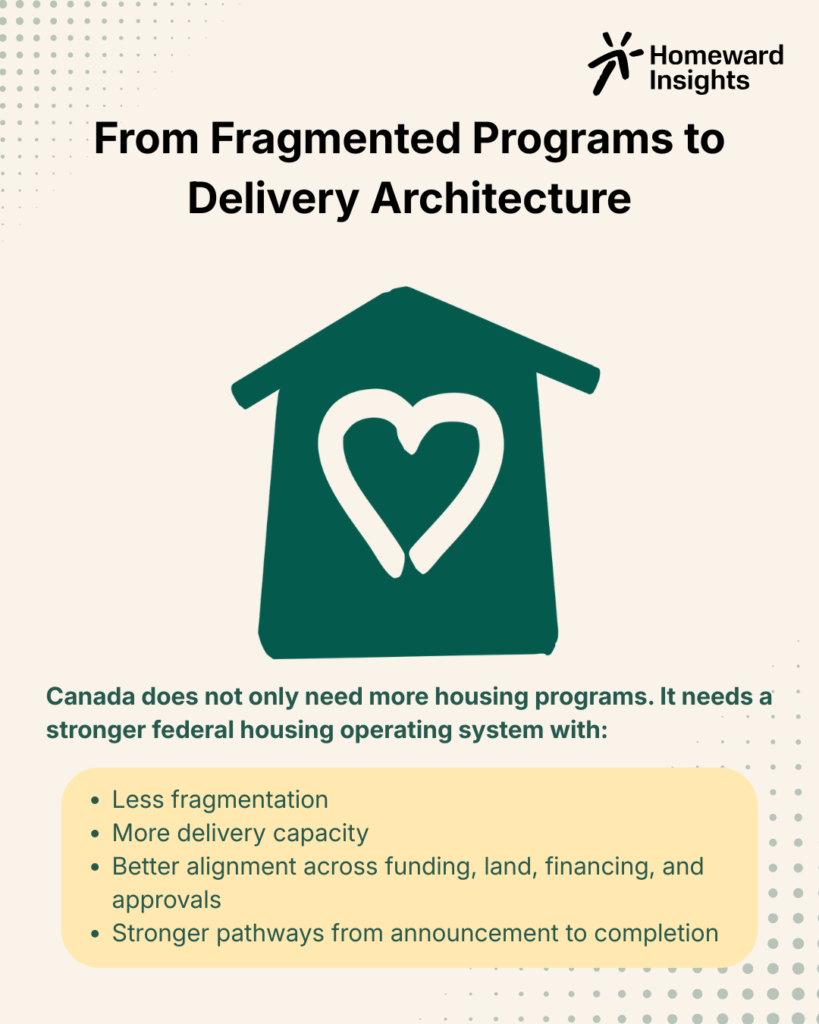
Canada does not only need more housing programs.
It needs a stronger federal housing operating system.
That is the core argument running through our submission. Over the last several years, the federal government has announced and expanded a range of housing tools, funding streams, and targeted initiatives. Some of them have absolutely mattered. But altogether, they have still not produced a sufficiently coherent delivery architecture for a housing system under this much strain. Too often, the system is strongest at the point of announcement and weakest at the point where projects encounter the realities of land access, pre-development risk, financing, approvals, construction, operating viability, and long-term stabilization.
That is why our report argues that the next phase of federal housing policy must move from fragmented programs to delivery architecture.
This is not semantics. It is the difference between a government that can announce new capital and a government that can actually turn ambition into reliable delivery.
Build Canada Homes Is Important — But It Is Not Enough
We are clear in the report that Build Canada Homes is a welcome and necessary shift. It reflects an important federal recognition that housing is not only a social policy issue, but also an economic issue, a productivity issue, and a state-capacity issue. It signals a stronger willingness to think in terms of scale, market shaping, production pipelines, procurement, and execution.
That matters.
The policy environment is already moving in this direction. Federal housing materials have increasingly emphasized modernizing homebuilding, improving productivity, and scaling modular, prefabricated, and other innovative construction approaches. Housing, Infrastructure and Communities Canada’s 2026–27 Departmental Plan says the department will advance policies and programs to “modernize homebuilding,” while departmental briefing materials explicitly reference “scaling up modern methods of construction.” (Housing Infrastructure Canada)
That is especially notable because one of our recommendations calls on the federal government to create catalytic capital tools to scale modern methods of construction and strengthen production pipelines.
At the same time, Build Canada Homes cannot, on its own, resolve the wider systemic failures that continue to constrain results. A stronger platform for financing and aggregation does not automatically fix tax friction, underwriting problems, weak pre-development pathways, rural access barriers, health-housing misalignment, or the lack of fit-for-purpose tools for smaller and repeatable housing forms.
In other words, BCH is necessary, but it is not a complete reset.
Scale without system alignment still produces bottlenecks.
What Our Strategy Found
Across the organizations that helped inform this submission, the message was remarkably consistent.
First, Canada needs to do more than fund mature projects after they are already ready to proceed. It needs to build the market and production capacity needed to scale. That means better tax treatment, more realistic financing rules, stronger underwriting for non-market delivery, catalytic capital for modern methods of construction, and stronger regionally-rooted production ecosystems.
Second, Canada needs to build a delivery system that actually works. Too many viable projects fail well before construction begins because pre-development risk is too high, land access is weak, municipal readiness is uneven, and federal pathways are poorly matched to the forms of housing and the kinds of communities that will actually matter in solving this crisis. Acquisition and preservation, low-rise multi-unit infill, ADUs, land trusts, and rural delivery models all need clearer federal pathways.
Third, Canada needs to stabilize housing outcomes by aligning housing policy more effectively with health, homelessness, and social systems. Supportive housing is an especially clear example. Our report argues that supportive housing cannot continue to be treated as a narrow sub-stream of housing policy when, in practice, it functions as part of the health and social care ecosystem and reduces pressure on far more expensive systems. That is why one of our recommendations is the creation of a Supportive Housing Health Envelope within the Canada Health Transfer.
These are not isolated asks. They are interconnected elements of a more coherent housing operating system.
This Work Is Already in Motion
One reason we felt strongly about publishing this work now is that this conversation is not hypothetical.
Since completing this coordinated strategy, we have already had the opportunity to put its core ideas in front of senior decision-makers in government. That matters not because it guarantees that every recommendation will be adopted, but because it confirms that there is real appetite for serious, practical thinking about what federal housing policy must become next.
That appetite is growing at exactly the right moment.
The Government of Canada has already released the Spring Economic Update 2026 on April 28, 2026, and the broader federal planning environment suggests increasing interest in measures that improve delivery capacity and modernize the homebuilding ecosystem. (Housing Infrastructure Canada)
While no single report can resolve the debate over the precise steps required to strengthen Canada’s housing system, we believe this is the kind of moment when serious, implementation-ready ideas can make a meaningful difference.
Why This Should Matter to Housing Organizations
This article is not only about promoting Homeward’s work. It is also a call to action.
There are housing organizations across Canada doing extraordinary work right now — building, preserving, financing, stabilizing, and supporting housing in very different contexts. Many of them are living with the consequences of a federal system that still does not fit with how delivery actually happens on the ground.
If you are one of those organizations, this is the moment to engage.
The next generation of federal housing policy is not going to shape itself.
And if the sector wants what comes next to be more coherent, more operational, and more grounded in delivery reality, then organizations working in housing need to be part of that conversation now — not after the architecture is already set.
That is one of the reasons this report was built as a coordinated effort in the first place. It reflects the insight that no one part of the housing sector can solve this alone, and that no serious federal reset should be built without the people and organizations already working at the front lines of delivery and system design.
What This Says About Homeward
At Homeward, we care deeply about helping clients navigate government effectively. But we also care about something bigger than tactical navigation alone.
We care about helping to shape policy environments so they are more coherent, more responsive, and more capable of delivering real outcomes.
That is what this submission represents.
It reflects our belief that strong government relations work is not only about access or advocacy. At its best, it is about bringing frontline insight, practical strategy, and political awareness together in a way that helps government act more intelligently.
That is the kind of work we want Homeward to be known for.
A Final Thought
Canada is entering the Build Canada Homes era. That creates real opportunity. But it also creates real responsibility.
If the federal government wants better housing outcomes, it cannot rely on capital deployment alone or assume that one new institution will solve a challenge of this scale. It needs a housing system that is coherent across the full chain of delivery — from tax and underwriting to land, production, rural capacity, supportive housing, homelessness prevention, and long-term operating stability.
That is what our strategy is trying to advance.
And if your organization wants to be a meaningful part of what comes next, this is the time to step in.
Because the next generation of federal housing policy is being shaped now.