


Many organizations begin their government relations journey with a simple thought:
“We need meetings.”
That instinct is understandable.
Meetings can matter. They can open doors, introduce your organization to people in government, and create opportunities to explain your work directly to decision-makers, staff, or officials. For organizations that have never had meaningful access before, getting in the room can feel like a major step forward.
And sometimes, it is.
But a meeting is not a strategy.
A meeting is a tactic, and like any tactic, it only matters if it is connected to a larger objective.
Good government relations is not just about filling calendars, collecting introductions, or being able to say that a certain number of offices were contacted. It is about building influence over time.
That requires clarity about what you are trying to accomplish, who actually matters, when the right windows are open, what message will resonate, and how each action moves you closer to a real outcome.
A meeting can create motion.
A strategy creates momentum.
Motion Is Not Momentum
One of the easiest mistakes in government relations is confusing activity with progress.
Motion is sending emails, booking meetings, attending events, preparing materials, and checking boxes.
Momentum is different.
Momentum means government is beginning to understand your issue. It means the right people are asking better questions. It means your organization is being seen as credible. It could also mean your ask is moving from a conversation into a briefing note, a consultation process, a funding discussion, a policy pathway, or a decision-making table.
That distinction matters because government relations can look busy without actually moving anything.
A long list of meetings does not necessarily lead to influence. A flurry of outreach is not necessarily progress. A packed advocacy calendar is not necessarily a strategy.
The real question is not, “How much have we done?”
The real question is: What has changed because of what we have done?
Has government started asking better questions? Has your issue been referred to the right officials? Has your organization been invited into a follow-up conversation? Has your ask become clearer? Has an office begun to see your work as relevant to its own priorities?
Those are signs of momentum.
The meeting itself is only one step.
What a Meeting Can — and Cannot — Do
A good government meeting can be valuable.
It can introduce your organization to people who need to understand your work. It can test whether your message resonates. It can help identify political or bureaucratic barriers. It can clarify which office, department, program, or process matters most. It can reveal whether your ask is timely, realistic, or in need of refinement.
Sometimes the immediate outcome is not a commitment. It is that your issue gets raised internally. It is that officials are asked to take a closer look. It is that your organization is added to a stakeholder list. It is that a policy advisor asks for more information. It is that a public servant connects your work to a program review, funding stream, or implementation challenge.
Those outcomes may not look dramatic from the outside.
But they do matter.
At the same time, a meeting cannot support the weight of a strategy that has not been built.
It cannot make an unclear ask clear. It cannot make a weak argument strong. It cannot overcome bad timing. It cannot substitute for preparation. It cannot replace follow-up. It cannot guarantee that government will care about an issue that has not been connected to its own priorities, pressures, or responsibilities.
This is where many organizations get frustrated.
They secure the meeting. They tell their story. The conversation is polite. The office seems interested. Everyone leaves feeling positive.
Then nothing happens.
That does not always mean the meeting was useless.
It may mean the meeting was never going to be enough on its own
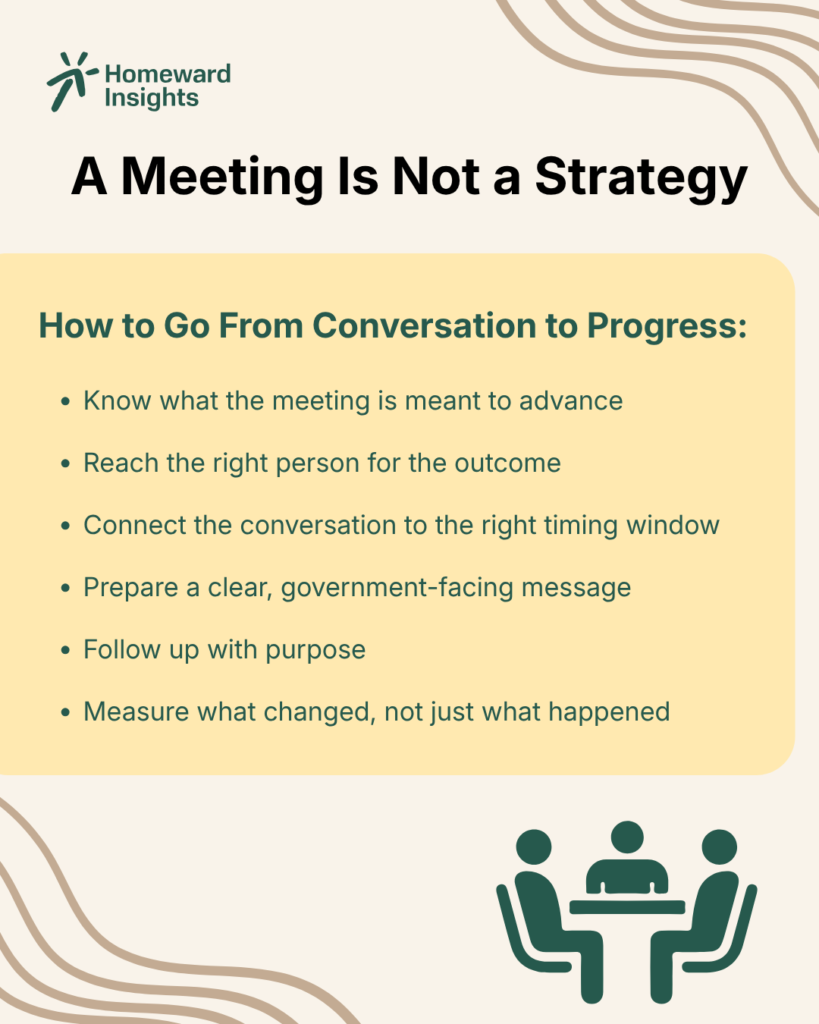
Ask Better Questions Before Asking for the Meeting
Before requesting a meeting, organizations should slow down and ask a few basic questions.
- What are we trying to accomplish?
- Who actually matters for that outcome?
- Why does this issue matter now?
- What do we want this person to think, feel, or do after the meeting?
- What are we asking for, specifically?
- What happens after the meeting?
These questions move the focus from access to purpose.
A meeting with a minister may sound impressive, but if the real issue is program design, implementation detail, or eligibility criteria, a senior public servant or policy advisor may be more important. A meeting with an elected representative may be useful for awareness, but not enough to affect a budget decision. A conversation with political staff may matter more before a fiscal window than after decisions have already narrowed.
The point is not to chase the most senior person possible.
The point is to reach the right person for the outcome you are trying to move.
Timing and Follow-Up Change Everything
The same meeting can have very different value depending on when it happens.
A meeting before a budget window is not the same as a meeting after budget decisions have largely been made. A meeting during a committee study is not the same as a meeting after the study has concluded. A meeting during a program review is not the same as a meeting after new guidelines are already published.
Timing cannot make a weak idea strong.
But poor timing can make a strong idea difficult to act on.
Government operates through windows: budgets, consultations, committee studies, legislative reviews, fiscal updates, mandate letters, cabinet shuffles, crises, and major announcements. Good government relations pays attention to those windows. It asks when the conversation is most likely to matter and what decision point it is connected to.
Follow-up matters just as much.
Good follow-up is not just a thank-you note. It reinforces the ask. It answers questions. It provides requested materials. It clarifies next steps. It gives the office something useful to circulate internally. Most importantly, it keeps the relationship alive.
Poor follow-up lets a promising conversation disappear.
Government relations is not only about getting in the room.
It is about what happens after you leave it.
Meetings Need to Fit Into a Sequence
A strong advocacy strategy is built through sequencing.
The briefing note prepares the ground for outreach. The first meeting tests the framing. The follow-up answers questions and reinforces the ask. Stakeholder validation shows broader relevance. A second conversation may move from general interest to a more specific pathway. A decision check-in may clarify whether the issue has traction.
The sequence of actions matters.
When actions are disconnected, advocacy becomes scattered. One office hears one thing. Another hears something slightly different. Meetings happen without follow-up. Materials are created but not used strategically. Outreach happens too early, too late, or too broadly.
The organization feels busy, but the pressure does not accumulate.
A good strategy does not need endless activity.
In fact, too much activity can become noise.
The strongest advocacy strategies are often not the loudest. They are the most deliberate.
What This Means for Organizations Like Yours
For organizations trying to engage government, this should be reassuring.
You do not need to do everything. You do not need to meet everyone. You do not need to send constant emails, attend every event, or chase every possible office.
You need a clear objective. You need to understand who matters. You need the right message. You need the right timing. You need disciplined follow-up. And you need to know how each action builds toward the outcome you are trying to achieve.
That is what separates motion from momentum.
It also changes how success should be measured.
Success is not only the number of meetings held. It is whether the right people are hearing the right message. It is whether your organization is becoming more credible. It is whether government is engaging more seriously. It is whether your issue is moving into internal processes, policy conversations, briefing materials, or future decisions.
A meeting can be a win.
But it is only a win if it moves the strategy forward.
How Homeward Helps
At Homeward, we do not think of meetings as the strategy.
We think of them as moments within a broader path to influence.
Our job is to help organizations make sure those moments are well chosen, well prepared, and connected to a larger objective. That means helping clients clarify what they are trying to achieve, identify who actually matters, develop the right message, choose the right timing, prepare useful materials, and follow up in a way that builds momentum.
Sometimes that means pursuing a meeting, and other times it means holding back until the ask is stronger. Sometimes it means starting with officials instead of political staff. Sometimes it means using a written submission, committee process, local validation, budget window, or stakeholder conversation before asking for higher-level engagement.
The right path depends on the objective.
The goal is not to create activity for its own sake.
The goal is to build influence that can lead to real outcomes.
For organizations that are not sure whether their current government engagement is adding up to anything, Homeward Talks is a low-barrier way to take stock, speak with an expert, and begin making sense of what a more deliberate strategy could look like.
Sometimes the most useful starting point is simply asking:
Are we creating motion, or are we building momentum?
Book a Homeward Talk: https://homewardpa.ca/talks/
A Final Thought
A meeting can open a door. It can start a relationship. It can test an idea. It can help government understand why your work matters.
But a meeting is not the strategy.
The strategy is knowing why the meeting matters, who needs to be in it, what should happen because of it, and how it fits into the larger path toward influence.
Motion is not the same as momentum.
And in government relations, momentum is what changes outcomes.