

The launch of the Canada Rental Protection Fund is a major moment for Canada’s community housing sector.
It is also more than a housing announcement.
On September 22, Build Canada Homes announced the launch of the Canada Rental Protection Fund, with the Canadian Housing Acquisition Fund selected to deploy investments from the $1.5 billion fund. The goal is to help community housing providers acquire, preserve, and renew existing affordable rental homes before they are lost from the market.
That matters on its own terms.
But it also matters because of what it signals.
For years, housing policy has been dominated by the language of building more. That remains essential. Canada needs more housing of all kinds: market, non-market, supportive, Indigenous, co-operative, deeply affordable, rental, ownership, family-sized, accessible, and everything in between.
But the federal government is now recognizing something community housing advocates have argued for decades: Canada cannot build its way out of the housing crisis while continuing to lose existing affordable homes.
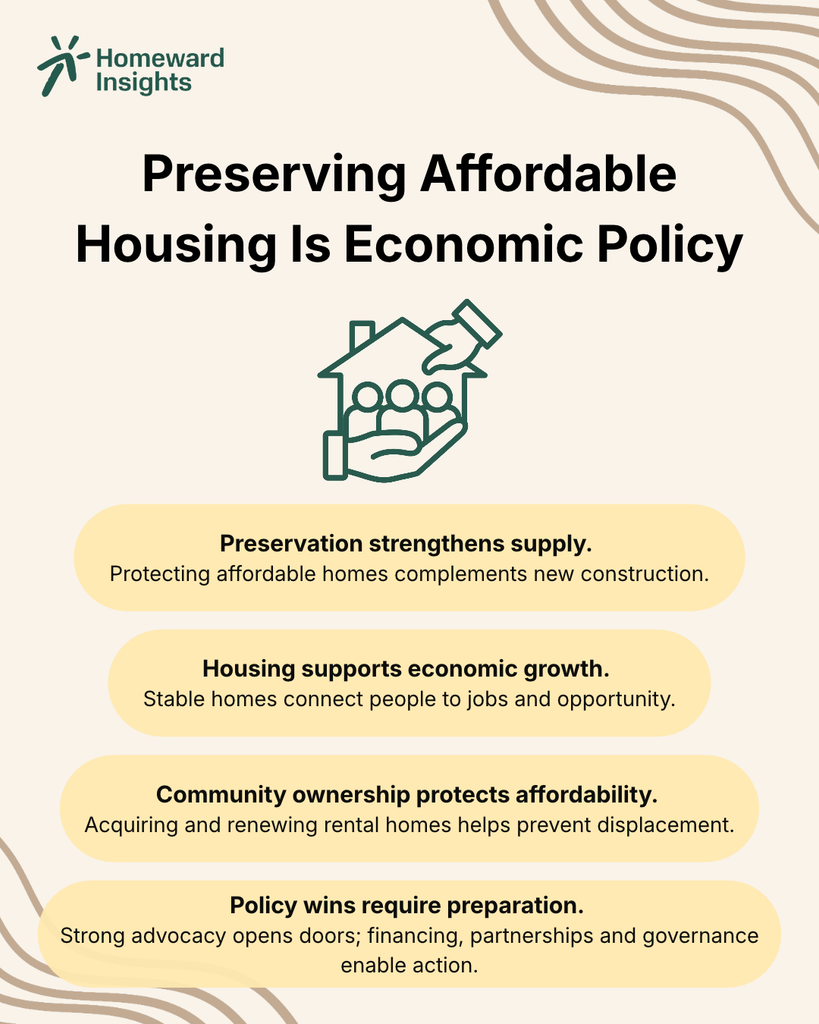
Preservation is not separate from supply.
It is part of the supply strategy.
And increasingly, it should be understood as part of Canada’s economic strategy too.
A Sector Win Years in the Making
This is a moment worth celebrating.
The Canadian Housing and Renewal Association deserves real recognition for helping keep acquisition and preservation on the national housing agenda. CHRA has long argued that Canada needs stronger tools to preserve and expand community housing, including through a national property acquisition program. That argument has now moved from advocacy into implementation.
CHRA was not alone. The Canadian Housing Acquisition Fund brings together major sector partners, including CHRA, the National Indigenous Collaborative Housing Inc., the Co-operative Housing Federation of Canada, and the BC Rental Protection Fund. Across the country, providers, advocates, tenants, co-operatives, Indigenous housing leaders, municipalities, and community housing organizations have helped make the case that preserving affordable rental housing has to be part of the national response.
For Homeward, this is not an abstract policy announcement.
It is part of a conversation we have been close to for years — through Jacob Gorenkoff’s previous work at CHRA, where he served as Director of Policy and Government Relations and was principal author of the Blueprint for Housing, and through our ongoing work with housing and homelessness organizations trying to make the case for better tools, clearer pathways, and more durable affordability.
We are not claiming this victory.
We are recognizing it for what it is: a major sector win, built through years of advocacy, persistence, coalition work, and policy development.
But the significance of this announcement goes beyond the sector itself.
The Canada Rental Protection Fund matters because it shows that affordable housing preservation is starting to be understood not only as a social-policy issue, but as an economic one.

Housing Is a Bottleneck to Growth
The current federal government is reading many of Canada’s major challenges through an economic lens.
Productivity. Investment. Workforce. Infrastructure. Trade diversification. Major projects. Affordability. Delivery. Growth.
Housing connects to all of it.
A country cannot build at scale if the people needed to build, care, teach, serve, transport, repair, innovate, and lead cannot afford to live in the communities where that work needs to happen.
A region cannot attract investment if workers cannot find attainable homes.
A major project cannot succeed if local housing systems are already strained.
A health system cannot function well if people are cycling through crisis because they do not have stable housing.
A labour market cannot reach its potential if families are forced farther from jobs, training, schools, childcare, and community supports.
Housing is not only where people live.
It is part of the infrastructure that makes economic participation possible.
That is why the Canada Rental Protection Fund matters in the context of the federal government’s broader build, invest, and deliver agenda. Preserving affordable rental homes is not a side project. It helps remove one of the constraints that makes growth harder, more expensive, and less inclusive.
The Economic Case for Community Housing Is Now Harder to Ignore
Community housing advocates have always understood the human case.
People need safe, stable, affordable homes. Families need security. Seniors need dignity. Young people need a place to start. Workers need to live near opportunity. Communities need stability. People living with complex needs need housing that works with the supports around them.
But the economic case has become sharper.
A Deloitte report commissioned by CHRA and Housing Partnership Canada found a causal connection between the proportion of community housing in the overall housing stock and gains in economic productivity. The report found that bringing Canada’s community housing stock to the OECD average by 2030 could boost productivity by 5.7% to 9.3% and increase GDP by an estimated $67 billion to $136 billion.
That is not a marginal argument.
It changes the frame.
Community housing is not only a response to vulnerability. It is not only a form of social support. It is not only something governments should do because housing insecurity is harmful, although all of that remains true.
Community housing is economic infrastructure.
It helps households stabilize. It helps workers remain connected to labour markets. It helps communities absorb growth. It reduces pressure elsewhere in public systems. It makes it easier for people to participate in the economy instead of being consumed by housing instability.
For a federal government focused on productivity, investment, and delivery, that matters.
The case for community housing is no longer only that it is compassionate.
It is also that Canada’s economy cannot function at its full potential without it.
Preservation Is Economic Discipline
Building new homes is essential.
But if Canada continues to lose existing affordable rental housing, new supply has to do two jobs at once: meet future demand and replace affordability that should never have been lost in the first place.
That is inefficient.
It is expensive.
And it is economically self-defeating.
Preservation is different.
When community housing providers acquire at-risk rental buildings, they can protect existing tenants, keep homes affordable over the long term, renew aging properties, and bring more housing into mission-driven ownership.
That can happen faster than new construction.
It can stabilize people sooner.
It can prevent displacement before it occurs.
It can preserve affordability in communities where replacing it later would be far more expensive.
In that sense, preservation is not nostalgia. It is economic discipline.
It recognizes that the most affordable home to create may be the affordable home that already exists, if government and the community housing sector can act before it is lost.
This does not reduce the need to build.
It makes building more effective.
A serious housing strategy has to both expand supply and stop preventable loss. Otherwise, Canada is trying to fill a bathtub while the drain is open.
Why Now?
The obvious question is why this is happening now.
Community housing advocates have been making the preservation argument for decades. The need is not new. The risk of losing affordable rental housing is not new. The logic of acquisition is not new.
So what changed?
First, the housing crisis has become too severe to treat as a narrow social issue. Housing affordability is now central to discussions about inflation, labour mobility, productivity, family formation, workforce recruitment, regional growth, and Canada’s ability to deliver major projects.
Second, the sector has built a stronger economic case. The Deloitte productivity research helped translate a long-standing housing argument into language that matters to a government focused on economic performance.
Third, the sector helped develop a delivery mechanism. The Canadian Housing Acquisition Fund gave government something concrete to work with. It showed that advocates were not only saying, “This problem matters.” They were saying, “Here is how this can be delivered.”
That is a critical advocacy lesson.
Government is more likely to move when the sector can define the problem, build alignment, demonstrate the model, and show how implementation could happen.
Fourth, British Columbia helped prove the concept. The BC Rental Protection Fund provided a live example of acquisition as a practical preservation tool, giving federal policymakers a model to build from rather than a theory to imagine.
Finally, Build Canada Homes has changed the federal housing context. The Canada Rental Protection Fund is now being launched under a federal housing delivery structure explicitly designed to move capital, land, construction, preservation, and affordability through more active federal machinery.
In other words, this moment reflects the convergence of advocacy, evidence, delivery design, and political timing.
That is how major policy change often happens.
Slowly, then suddenly.
What This Means for the Sector
The launch of the Canada Rental Protection Fund creates opportunity.
It also creates a readiness test.
Acquisition requires speed. The private market does not pause while non-profits arrange governance approvals, assemble capital stacks, complete due diligence, negotiate partnerships, and confirm financing.
Community housing providers will need to be ready before the right building comes onto the market.
That means understanding local acquisition opportunities. Building relationships with municipalities, lenders, tenants, brokers, funders, and community partners. Developing governance processes that can move quickly while still managing risk. Strengthening asset management, legal, financial, development, and operational capacity. Understanding how acquisition fits into long-term mission, stewardship, and portfolio strategy.
The fund creates a pathway.
It does not automatically create readiness.
That distinction matters.
The organizations best positioned to use this tool will be those that understand not only the policy opportunity, but the practical conditions required to act.
What It Means for Government
The Canada Rental Protection Fund should also shape how governments think about housing policy more broadly.
First, preservation should remain a permanent part of the toolkit. A one-time fund can make a meaningful difference, but the underlying market dynamics will not disappear. Affordable rental homes will continue to be at risk. Community housing providers will continue to need tools that allow them to act quickly.
Second, preservation should be understood as part of the economic agenda. The more Canada talks about productivity, workforce, investment, and growth, the more it needs to talk about the housing systems that allow people and communities to participate in that growth.
Third, acquisition has to be paired with renewal. Preserving affordability also means ensuring homes remain safe, accessible, energy-efficient, healthy, and dignified over time.
Fourth, governments should continue learning from sector-led delivery. The community housing sector understands stewardship, affordability, tenancy stability, and the operational realities of preserving homes over the long term. Policy will be stronger when it is designed with that expertise at the table.
Finally, housing policy should be integrated with the rest of the federal agenda. Build Canada Homes, infrastructure, workforce, major projects, Indigenous economic participation, and regional development are not separate conversations. They are increasingly part of the same conversation.
Housing is the platform on which much of the rest depends.
The Advocacy Lesson
From the outside, a federal announcement can look like a single moment.
It rarely is.
The launch of the Canada Rental Protection Fund reflects years of advocacy, research, relationship-building, coalition work, policy design, delivery modelling, and persistence. It reflects the work of people and organizations that kept making the case even when the pathway was not obvious.
It also shows what strong advocacy can do.
Strong advocacy does not only describe the problem.
It builds the case. It gathers evidence. It aligns partners. It develops a model. It learns from other jurisdictions. It speaks to the government’s priorities without losing sight of the human stakes.
That is exactly what happened here.
The housing sector made the human case for preservation.
It also built the economic case.
And now, in a federal environment focused on productivity, growth, and delivery, that argument is landing in a new way.

What Organizations Should Be Thinking About Now
For housing organizations, the question now is not only whether the Canada Rental Protection Fund exists.
It is what this shift makes possible.
- Are there at-risk rental properties in your community that should be preserved?
- Do you have the partnerships needed to identify and act on acquisition opportunities?
- Are you ready to move quickly if the right property becomes available?
- Do you understand the financing, governance, legal, operational, and asset-management requirements?
- Are municipal, provincial, Indigenous, philanthropic, and financial partners aligned?
- How does acquisition fit with your broader housing strategy?
- Are you visible to the partners, funders, and decision-makers shaping the next phase of housing policy?
For organizations outside the housing sector, there is also a lesson.
The federal government is looking for solutions that connect human need to economic performance, system capacity, and delivery. If your organization can help remove a bottleneck to growth, improve participation, reduce pressure on public systems, or make government priorities easier to implement, there may be a public policy case to build.
But it has to be built.
How Homeward Helps
At Homeward, we work with mission-driven organizations trying to move from good ideas to public policy action.
That includes housing providers, homelessness organizations, community service organizations, Indigenous communities, social enterprises, and others trying to shape government decisions in complex environments.
We help organizations clarify the problem, build the public policy case, identify the right decision-makers, prepare evidence, develop advocacy strategies, and position their work in a way government can understand and act on.
The launch of the Canada Rental Protection Fund is a reminder of what disciplined advocacy can achieve over time.
It is also a reminder that once a policy window opens, organizations need to be ready.
For organizations trying to understand where they fit in the next phase of housing policy — including acquisition, preservation, Build Canada Homes, infrastructure, supportive housing, or broader housing system reform — Homeward Talks is a practical place to start. It is a low-pressure way to speak with an expert, assess the landscape, and understand whether there is a pathway, opportunity, or risk worth paying attention to.
Book a Homeward Talks session to get clearer about your role in what comes next.
A Final Thought
The Canada Rental Protection Fund is a major win for Canada’s community housing sector.
It is also a signal that the housing conversation is changing.
Preserving affordable housing is not separate from solving the housing crisis. It is one of the ways we solve it.
And preserving affordable housing is not separate from Canada’s economic agenda. It is one of the ways we make that agenda possible.
Because a productive country needs people to be housed.
It needs workers to live near opportunity.
It needs communities that can absorb growth.
It needs stable households, resilient neighbourhoods, and housing systems that do not lose affordability faster than governments can replace it.
Canada still needs to build.
But it also needs to preserve.
The Canada Rental Protection Fund recognizes that both are part of the same project: building a more affordable, productive, and resilient country.