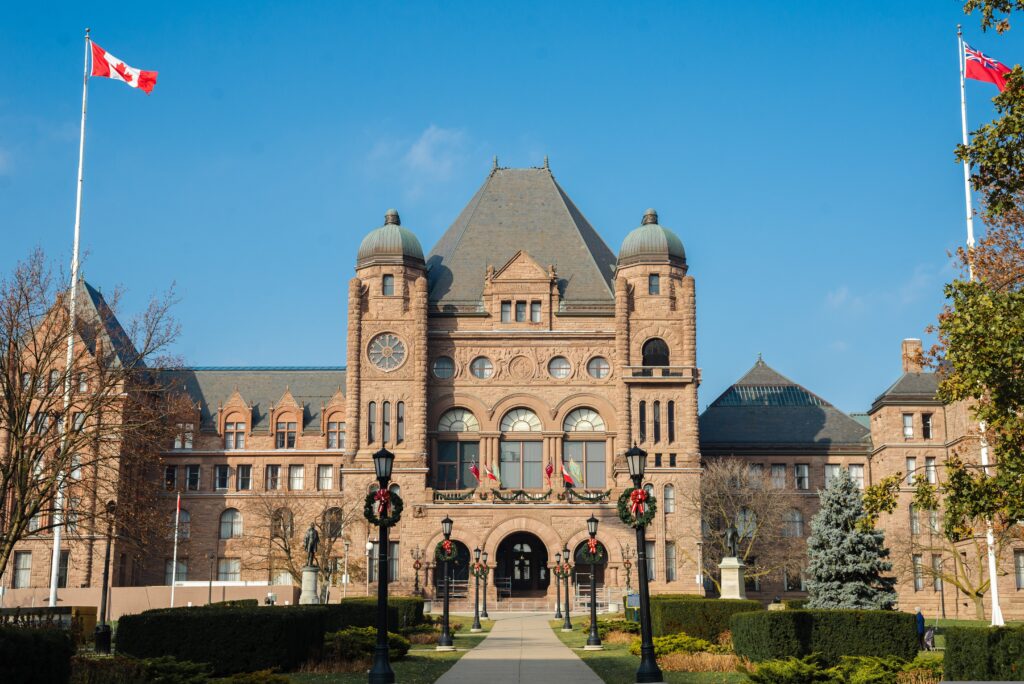


Over the past several weeks, the federal government has started to show much more clearly where it wants to take the country.
On September 15, the Prime Minister convened the first Canada Investment Summit in Toronto, announcing nearly $500 billion in new investment commitments and making the case that Canada is trying to attract major private and institutional capital into infrastructure, energy, critical minerals, AI, defence, digital capacity, housing, and strategic industries.
On September 17, the Prime Minister addressed the European Parliament in Strasbourg, framing deeper Canada-Europe cooperation around critical minerals, defence industrial capacity, AI and compute, energy security, space, digital trade, research, youth mobility, and economic resilience.
On September 21, the federal government introduced the Building Canada Strong Act, designed to create faster and more predictable reviews for major infrastructure and resource projects, strengthen trade corridors and ports, and support the workers who will build them.
On September 22, Build Canada Homes announced the launch of the Canada Rental Protection Fund, with the Canadian Housing Acquisition Fund selected to deploy investments from the $1.5 billion fund to help community housing providers acquire, preserve, and renew existing affordable rental housing.
And sitting behind all of this is a broader policy architecture that has been developing through Budget 2025 and the Spring Economic Update, including the Major Projects Office, the Build Communities Strong Fund, Team Canada Strong, trade diversification, workforce investments, and a more active federal role in housing and infrastructure.
Taken together, these are not small signals.
They suggest that the federal government is trying to organize its agenda around a few big questions: how Canada builds faster, attracts investment, protects affordability, strengthens economic resilience, diversifies trade, and delivers visible results in communities.
For many organizations, that can feel both encouraging and overwhelming.
There is movement on housing. Movement on major projects. Movement on infrastructure. Movement on workforce. Movement on investment attraction. Movement on trade diversification, industrial strategy, defence, critical minerals, AI, and economic resilience.
But announcements are not self-explanatory.
A press release is not a strategy. A new fund is not automatically an opportunity. A summit is not the same thing as a grant program. A government priority does not matter to every organization in the same way.
The real question is not simply, “What did government announce?”
The better question is: “What does this tell us about where government is going, and where does our organization fit?”
That is the question mission-driven organizations should be asking now.
The Pattern: Build, Invest, Deliver
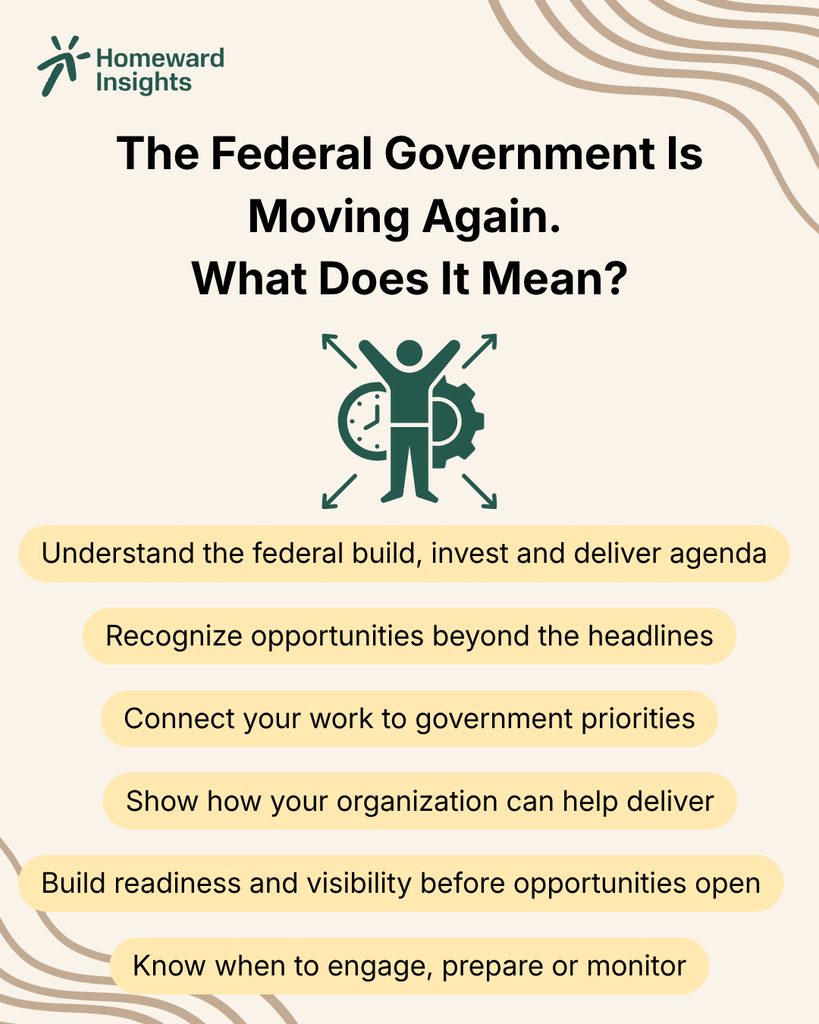
The pattern is becoming clearer.
Canada is trying to build more. Attract more investment. Move major projects faster. Protect and expand housing supply. Strengthen infrastructure. Train the workforce needed to deliver. Diversify trade. Increase productivity. And position the country as more resilient in a volatile global environment.
This is not just a collection of disconnected announcements.
It is an attempt to reorganize federal policy around a build, invest, and deliver agenda.
That matters because governments do not only create opportunity through traditional grants and contributions. They create opportunity through priorities, institutions, procurement, partnerships, program design, regulation, convening power, and the signals they send to other levels of government, investors, sectors, and communities.
For nonprofits, Indigenous communities, social enterprises, housing providers, workforce organizations, community infrastructure leaders, and mission-driven businesses, the opportunity is not always obvious at first glance.
But it may be real.
The task is to understand where the machinery is moving.
The Canada Investment Summit Was Not Just About Investors
The Canada Investment Summit attracted attention because of the scale of the investment commitments announced.
That is understandable. Nearly $500 billion is a significant figure.
But for many mission-driven organizations, the immediate reaction may have been: “That sounds important, but is it relevant to us?”
In many cases, the answer is yes — but not because organizations should expect a direct funding envelope to appear from the summit itself.
The summit matters because it tells us where government wants capital, attention, and delivery capacity to flow.
The federal government is trying to mobilize private and institutional investment into areas it sees as nationally significant: infrastructure, energy, critical minerals, AI, digital capacity, defence, housing, productivity, and strategic industries.
That creates secondary and enabling opportunities.
Major investment does not happen in isolation. It requires workers. Housing. Community infrastructure. Indigenous partnerships. Local services. Social licence. Training systems. Transportation. Environmental planning. Community benefits. Regional coordination. Public trust.
For organizations working in those areas, the question should not be, “Can we apply to the Canada Investment Summit?”
The question should be, “What does this investment agenda need in order to succeed, and do we have a role in delivering it?”
That is a very different conversation.
Housing Policy Is Becoming More Active and More Complex
Housing remains one of the clearest areas where federal policy is shifting from announcement to machinery.
Build Canada Homes is one part of that shift. The launch of the Canada Rental Protection Fund is another.
That matters because it shows that federal housing policy is not only about new construction.
It is also about acquisition, preservation, community ownership, long-term affordability, and protecting existing rental homes before they are lost.
For community housing providers, Indigenous housing organizations, land trusts, municipalities, mission-driven developers, and social finance partners, this is significant.
Acquisition-based housing policy requires readiness. Organizations need to understand eligibility, financing, governance, acquisition pipelines, local market conditions, affordability requirements, partnerships, and timelines. They need to be able to move quickly when opportunities arise, because the private market does not wait for slow internal decision-making.
The broader point is that housing policy is becoming more delivery-focused.
Government is not only asking, “How do we announce more housing?”
It is asking, “Who can actually deliver housing, preserve affordability, use capital well, and keep homes affordable over the long term?”
That creates opportunity for organizations that are ready.
It also creates risk for organizations that are aligned with the agenda but not yet visible, prepared, or positioned.

Major Projects Need More Than Permits
The federal government’s major projects agenda is often discussed through the lens of approvals, regulatory timelines, and national-interest infrastructure.
That is understandable.
The Building Canada Strong Act and the Major Projects Office both point toward a government that wants more speed, coordination, predictability, and investor confidence around large projects.
But major projects need more than permits.
They need communities that can absorb growth. They need workers who can build and operate them. They need housing close enough to support labour supply. They need Indigenous participation and consent-based partnership. They need training systems. They need transportation and social infrastructure. They need local health and community services that can handle population and economic change.
That means the major projects agenda should matter to more than industry proponents.
It should matter to Indigenous communities, municipalities, workforce organizations, colleges and training providers, housing organizations, environmental and land-based organizations, and regional economic development actors.
The federal government is trying to move faster on projects it views as nationally significant.
The question for many organizations is whether they understand how those projects will land in communities — and whether they have something useful to contribute before decisions are fully shaped.
Infrastructure Is Becoming Social Policy Again
Infrastructure policy is also broadening.
The Build Communities Strong Fund, launched earlier this year, is not only about roads, bridges, water, and transit, although those matter enormously. It also includes housing-enabling infrastructure, health infrastructure, post-secondary infrastructure, community facilities, broadband, climate adaptation, and regionally significant projects.
This is important because infrastructure is not separate from social policy.
A community cannot build housing without water and wastewater capacity. A health system cannot improve access without physical and digital infrastructure. A rural or northern community cannot participate fully in the economy without transportation and broadband. A growing region cannot attract workers without schools, recreation, transit, and community services.
For organizations that do not think of themselves as “infrastructure organizations,” this may still matter.
A housing provider may need to understand municipal infrastructure constraints. A health organization may need to understand capital planning. A community agency may need to connect its work to social infrastructure. A post-secondary institution may need to think about training infrastructure and regional development. An Indigenous government may need to align community priorities with federal and provincial infrastructure streams.
The word “infrastructure” can sound technical.
But the consequences are deeply human.
Infrastructure shapes whether people can live, work, move, learn, access care, and participate in community life.
Canada’s Build Agenda Has a Workforce Problem
The federal government’s workforce agenda is also increasingly tied to its broader economic strategy.
Team Canada Strong, with its focus on recruiting, training, and hiring new skilled trades workers, reflects a basic reality: Canada cannot build what it does not have the workforce to deliver.
Housing, infrastructure, resource development, defence, energy, and major projects all depend on people.
That creates an obvious role for colleges, unions, employers, Indigenous skills and training organizations, youth employment organizations, newcomer-serving agencies, workforce intermediaries, and regional economic development bodies.
But the issue goes beyond training seats.
Workers need pathways. Employers need confidence. Communities need housing. Young people need exposure to careers. Underrepresented groups need supports that make participation possible. Indigenous communities need equitable access to training, ownership, and employment. Regions need systems that connect people to opportunity.
A workforce announcement is not just a labour-market announcement.
It is part of the implementation plan for the entire build agenda.
Organizations that understand this connection will be better positioned than those that treat workforce as a separate file.
Canada’s International Agenda Is Becoming More Strategic
The federal government is also signalling a more deliberate approach to Canada’s international economic relationships.
The Canada-Europe conversation is not only about trade in the traditional sense. It is about strategic capabilities: critical minerals, defence industrial capacity, AI, compute, energy security, space, payments, digital trade, research, standards, and talent.
That matters because Canada’s domestic policy agenda is increasingly connected to global positioning.
The government is not only asking how Canada can build more at home. It is asking how Canada can become more resilient, less dependent on any single partner, more attractive to global capital, and more capable of participating in strategic supply chains.
For companies, post-secondary institutions, research organizations, workforce bodies, Indigenous economic development organizations, and mission-driven businesses, this creates another layer of opportunity.
The relevant question may not be, “Is there a federal grant for us?”
It may be, “Does our work connect to the capabilities Canada is trying to build?”
What This Means for Mission-Driven Organizations
For mission-driven organizations, the federal government’s renewed activity creates both opportunity and confusion.
The opportunity is that government is clearly trying to move.
It is looking for delivery partners, evidence, models, capacity, community legitimacy, implementation insight, and practical solutions. It is trying to connect public investment, private capital, infrastructure, housing, workforce, and strategic sectors into a more coherent growth agenda.
The confusion is that not every announcement creates a direct opening.
Some developments matter immediately. Others are signals. Some require direct advocacy. Others require preparation. Some are relevant only if your organization can connect its work to implementation. Others may be interesting but not strategically important.
This is where judgment matters.
Organizations should not chase everything.
But they should not ignore the pattern either.
The federal government is telling the country what it is trying to build. The question is whether your organization can explain how its work helps make that possible.
How Organizations Should Think About Engaging
The first step is not to respond to every announcement.
The first step is to sort the announcements into categories.
Some are immediate opportunities. A fund opens. An intake launches. Eligibility criteria are published. A consultation is live. A proposal window exists. In those cases, organizations need to assess fit quickly and decide whether they are ready to move.
Some are policy signals. Government may not yet be asking for applications or submissions, but it is showing where priorities are going. These signals matter because they help organizations prepare, build relationships, gather evidence, and shape their positioning before formal opportunities appear.
Some are implementation openings. A major project, infrastructure investment, or workforce strategy may create needs around housing, training, community services, Indigenous partnership, local planning, health capacity, or public trust. Organizations may have a role even if they are not the direct project proponent.
Some are long-term positioning opportunities. Canada’s Europe pivot, trade diversification agenda, critical minerals strategy, or defence industrial strategy may not produce an immediate next step for every organization. But for those with relevant expertise, partnerships, or delivery capacity, they may point to where government attention is heading.
And some announcements are simply not relevant.
That is important too.
Good government relations is not about chasing everything. It is about knowing what matters, what might matter later, and what should be ignored.
Questions Organizations Should Be Asking Now
A practical starting point is to ask a few disciplined questions.
- Where does our work connect to the federal build, invest, and deliver agenda?
- Are we affected by changes in housing, infrastructure, workforce, major projects, investment attraction, trade diversification, or economic resilience?
- Are there new federal institutions, funds, or processes we need to understand?
- Do we have evidence, delivery experience, community relationships, or implementation insight government may need?
- Are there risks if government designs programs or policies without hearing from organizations like ours?
- Are we visible to the right offices, departments, officials, or partners?
- Do we know what our ask is?
- Do we know whether this is a moment to engage, prepare, monitor, or wait?
These questions help move an organization from passive observation to strategic positioning.
That matters because the organizations best positioned in a changing environment are rarely the ones that simply react to announcements.
They are the ones that understand where government is going before the window fully opens.

How Homeward Helps
At Homeward, we help mission-driven organizations make sense of exactly this kind of policy environment.
We help clients understand what government is doing, what it means, where the real opportunities are, and how their work can be positioned in a way decision-makers understand.
Sometimes that means pursuing a specific funding opportunity. Sometimes it means preparing for a policy window. Sometimes it means helping an organization understand that a headline announcement is not yet a real opportunity, but could become one. Sometimes it means building visibility now so that when government starts looking for delivery partners, the organization is already known.
Our approach is policy advocacy, made human.
That means connecting real community needs, lived experience, operational expertise, and human consequences to the machinery of government: budgets, programs, legislation, regulation, procurement, implementation, and relationships.
The current federal agenda is moving quickly.
Organizations do not need to understand every announcement in detail.
But they do need to understand where they fit.
For organizations trying to make sense of what these federal developments mean for their work, Homeward Talks is a practical place to start. It is a low-pressure way to speak with an expert, assess the landscape, and understand whether there is a risk, opportunity, or pathway worth paying attention to.
Book a Homeward Talks session to get clearer about where your organization fits in the agenda now taking shape.
A Final Thought
The federal government is moving again.
That does not mean every organization has an immediate opportunity.
It does mean the policy landscape is changing.
Housing policy is becoming more active. Infrastructure is being tied to community strength and economic growth. Major projects are being accelerated. Workforce is becoming central to delivery. Investment attraction is shaping the national agenda. Canada’s international economic strategy is becoming more deliberate.
Government is trying to build, invest, and deliver at the same time.
For mission-driven organizations, the choice is not between chasing every announcement and ignoring the movement altogether.
The choice is whether to understand the pattern, identify where your work fits, and become visible before the next window opens.
Because when government starts moving, the organizations that are clear, credible, and prepared are the ones most likely to be invited into what comes next.