

A good government meeting can feel like progress.
The conversation goes well. The decision-maker understands the issue. Staff ask thoughtful questions. Officials seem engaged. Everyone agrees the work matters. There is a promise to stay in touch.
Then the meeting ends.
And that is where many advocacy efforts begin to lose momentum.
Not because the meeting was bad. Not because government was insincere. Not because the organization failed to make its case.
But because a meeting is only one moment in a longer process.
What happens after the meeting often matters as much as the meeting itself.
Follow-up is not administrative housekeeping. It is not simply sending a thank-you note and hoping someone remembers the conversation. Done well, follow-up is one of the most important disciplines in government relations.
It is how interest becomes movement.
A Meeting Is Not the Finish Line
Many organizations treat a government meeting as the main event.
That is understandable. It can take weeks or months to secure the right meeting. Preparing for it takes time. The conversation may involve senior staff, elected officials, public servants, board members, or organizational leaders. When the meeting finally happens, it can feel like a major milestone.
And sometimes it is.
But a meeting is rarely the end of the advocacy process.
More often, it is the beginning of the next stage.
After a meeting, government may need more information. Staff may need to brief a minister. Officials may need to validate a claim. A political office may need to speak with a department. A department may need to assess whether a program pathway exists. Someone may need to understand cost, timing, authority, risk, implementation, or public value.
A positive meeting creates a chance for the file to move.
Follow-up is what helps it move.
Polite Follow-Up Is Not Enough
Most organizations know they should send a thank-you email after a meeting.
That is a good habit.
But polite follow-up is not the same thing as strategic follow-up.
A thank-you note may acknowledge the conversation, but it does not necessarily advance the objective. It may preserve goodwill, but it may not clarify next steps. It may be courteous, but it may not help the issue travel inside government.
Strategic follow-up does more.
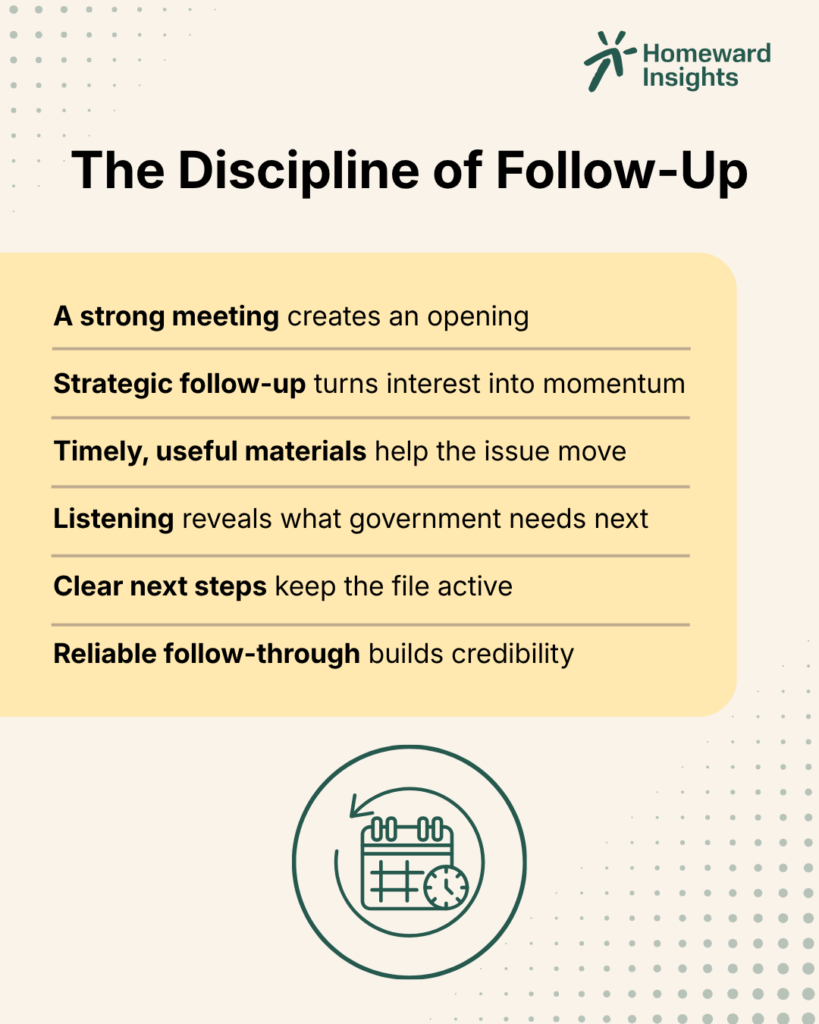
It restates the core issue clearly. It answers questions raised in the meeting. It provides materials that can be forwarded internally. It confirms any commitments made. It suggests a practical next step. It helps the person you met explain the issue to someone else.
That last point is critical.
Most advocacy does not move because one person heard a good pitch.
It moves because that person can carry the issue forward.
Your follow-up should make that easier.
The File Has to Travel
Government is not one person.
Even when a meeting goes well, the person you meet may not control the outcome. A ministerial staffer may need to brief the minister. A minister may need advice from officials. Officials may need direction from political staff. A department may need approval from a central agency. A local representative may need to connect the issue to a minister’s office. A program team may need to assess fit. Finance may need to understand the fiscal logic.
That means your issue has to travel.
It has to move from a conversation into a note, from a note into an internal discussion, from an internal discussion into a process, and from a process into a decision.
Follow-up helps create the materials, clarity, and momentum required for that movement.
A strong follow-up package might include a short briefing note, a clear one-page summary, answers to specific questions, supporting data, examples from the community, proposed language, or a concise explanation of the decision being requested.
The goal is not to overwhelm.
The goal is to make the next internal conversation easier.
Timing Matters After the Meeting Too
Follow-up should be timely.
That does not mean rushing out a generic email five minutes after the meeting ends. It means responding while the conversation is still fresh and before the file loses energy.
A good follow-up often arrives within a day or two. It is specific enough to show that the organization listened, but concise enough to be useful.
Timing also matters over the weeks that follow.
Some files need a quick second touch. Others need space. Some require a reminder before a budget deadline, consultation close, committee hearing, cabinet process, program intake, or implementation decision. Some need a quiet check-in after government has had time to process the issue.
Follow-up is not one email.
It is a sequence.
The discipline is knowing when to re-engage, what to provide, and how to avoid becoming either invisible or irritating.
Follow-Up Should Clarify the Ask
A meeting can surface ambiguity.
That is not always a bad thing. Sometimes the conversation reveals that the original ask needs to change. Government may point to a different pathway. Officials may identify a barrier. Political staff may signal that the timing is wrong, but another process is coming. A decision-maker may agree with the problem but need a more specific recommendation.
Follow-up is the opportunity to sharpen the ask.
That might mean clarifying the exact decision required. It might mean narrowing the request. It might mean reframing the issue around a different public priority. It might mean separating a short-term action from a longer-term objective.
Good advocacy adapts.
The point is not to repeat the same message forever. The point is to learn from each interaction and make the next one stronger.
Follow-Up Builds Credibility
Government notices how organizations follow up.
A disciplined organization that sends clear materials, answers questions quickly, respects timelines, and keeps its message consistent becomes easier to work with.
That matters.
Credibility is not built only through a strong mission or a compelling story. It is also built through professionalism, reliability, judgment, and follow-through.
When an organization follows up well, it signals that it understands the seriousness of the process. It shows that it can be trusted with details. It demonstrates that it is not only passionate, but prepared.
That credibility can shape how government sees the organization in future conversations.
In a crowded environment, being easy to understand and easy to work with is a real advantage.
Follow-Up Is Also How You Listen
Follow-up is not only about pushing your message.
It is also about listening carefully to what government has told you.
A good meeting often contains signals. A staffer may ask repeated questions about cost. An official may focus on implementation risk. A minister may respond most strongly to a local example. A department may point toward a program review. Someone may use language that reveals how they are framing the issue internally.
Those signals matter.
Follow-up should reflect them.
When organizations ignore what they heard and simply send the same materials they had planned to send anyway, they miss an opportunity. When they adjust their follow-up to the conversation that actually happened, they show judgment.
That is part of what we mean at Homeward when we talk about policy advocacy, made human.
The work is substantive and strategic, but it is also relational. It requires understanding people, listening to concerns, respecting constraints, and helping decision-makers see a practical path forward.
When Follow-Up Reveals There Is No Path
Sometimes follow-up shows that the opportunity is not real, or not ready.
That is useful too.
A lack of response, a vague answer, a repeated deflection, or a shift to a different process may indicate that the file needs more work, a different audience, stronger evidence, better timing, or a more realistic ask.
That can be frustrating.
But it is better to know.
Government relations is not only about getting to yes. It is also about understanding where things stand. Follow-up helps reveal whether a file is moving, stalled, premature, or misdirected.
That information allows organizations to make better choices about where to spend time and energy next.
What Strong Follow-Up Looks Like
Strong follow-up is clear, useful, and connected to the objective.
It usually does a few things well.
- It thanks the person for the conversation without spending too much space on pleasantries.
- It restates the issue in simple terms.
- It reflects back what was discussed.
- It provides the specific information requested.
- It attaches or links to materials that can be used internally.
- It confirms the ask or next step.
- It makes it easy for the recipient to respond, forward, or act.
Most importantly, it keeps the file alive without pretending that one email can do all the work.
The best follow-up is not long.
It is useful.
How Homeward Helps
Homeward helps mission-driven organizations treat follow-up as part of the strategy, not an afterthought.
We help clients prepare for meetings, listen for signals, clarify next steps, develop materials government can actually use, and sequence engagement so that conversations build on each other instead of disappearing into the void.
Sometimes that means drafting a concise note after a ministerial meeting. Sometimes it means preparing a briefing package for officials. Sometimes it means identifying a new decision-maker, adjusting the ask, or recognizing that the file needs more evidence before it can move.
The work is not simply to get in the room.
The work is to make the room matter.
For organizations that have had good conversations with government but are not sure what to do next, Homeward Talks is a practical place to start. It is a low-pressure way to assess where the file stands, what follow-up may be needed, and how to turn interest into a clearer path forward.
Book a Homeward Talks session to get clearer about your next step.
A Final Thought
Follow-up is where advocacy proves whether it is disciplined.
A good meeting can open a door. A thoughtful conversation can create interest. A strong story can make people care.
But follow-up is what helps the issue move.
It carries the message forward. It answers questions. It clarifies the ask. It builds credibility. It helps government understand what to do next.
In government relations, momentum rarely happens by accident.
It is built through disciplined follow-up.