


In government relations, everyone wants the big win.
A budget commitment. A policy change. A new funding stream. A regulatory fix. A pilot project. A ministerial announcement. A long-standing issue finally recognized as a government priority.
That makes sense.
Organizations do not engage government because they want symbolic progress. They engage government because they want substantive change.
But one of the biggest mistakes organizations can make is assuming that anything short of the final outcome does not matter.
In government relations, small wins are not distractions from the real objective.
Often, they are the signals that the strategy is working.
Big Wins Usually Have a Long Runway
Government rarely moves from first meeting to final decision in one step.
Before an issue becomes a budget item, it often has to become visible to the right offices. Before a policy change happens, officials usually need to understand the problem, test options, assess risk, and determine whether the recommendation is politically and administratively workable. Before a new program or pilot is launched, government needs confidence that the issue is real, the proposed solution is credible, and the organization or sector behind it can deliver.
That takes time.
It also takes sequencing.
A big win may be the outcome the strategy is designed to unlock, but it is rarely the first sign that progress is happening.
The earlier signs are usually quieter.
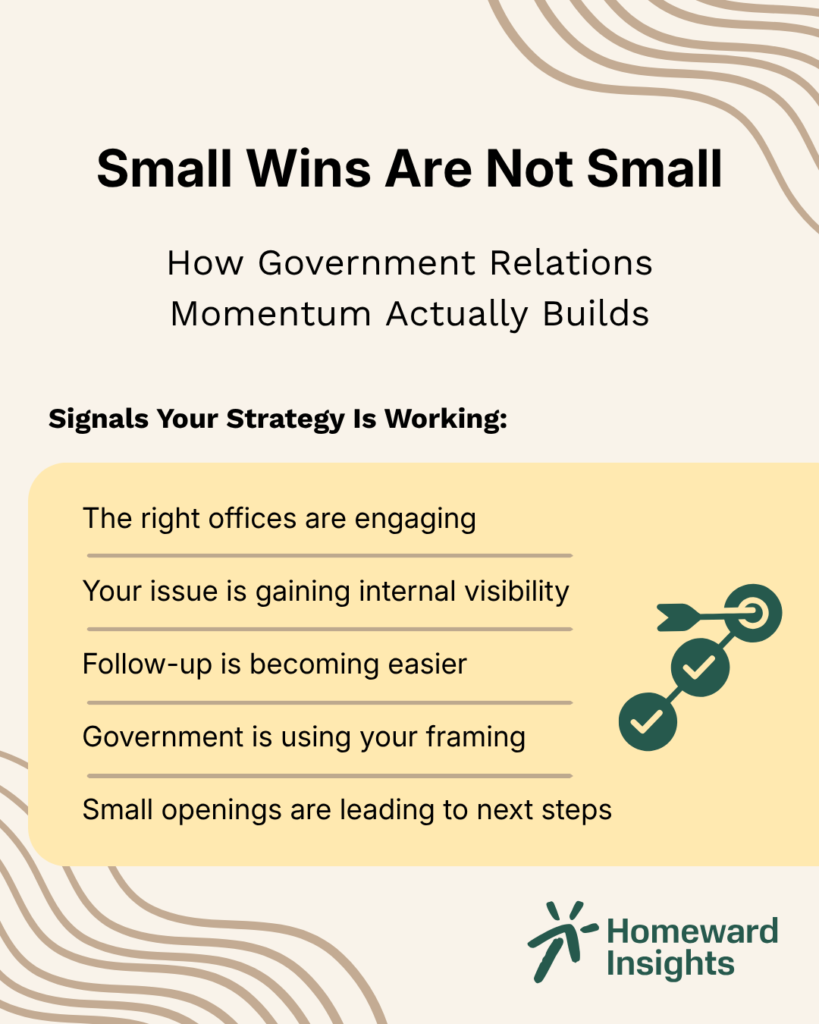
A minister’s office agrees to meet. A policy advisor asks for more information. A public servant connects your issue to a program review. Your organization is added to a stakeholder list. Your recommendation is reflected in a briefing note. You are invited into a consultation. An office that was hard to reach becomes easier to schedule with the second time.
None of these are the final outcome.
But none of them is meaningless either.
They show that your issue is moving from outside government’s attention into its internal field of view.
That is momentum.
Small Wins Are Signals
A small win is not just something nice that happens along the way.
It is a signal.
It may signal that your framing is landing. It may signal that you have reached the right audience. It may signal that government sees your organization as credible. It may signal that your ask is becoming more realistic. It may signal that the timing is improving. It may signal that your issue has moved from “interesting” to “actionable.”
Those signals matter because government relations is often ambiguous.
Most of the time, government does not tell you exactly where your issue stands. You may not know whether your recommendation is being discussed internally, whether an office is testing your idea with officials, or whether your ask is being considered for a future window.
Small wins help you read the landscape.
They do not guarantee success. But they can indicate whether the strategy is creating movement, whether the message needs to be sharpened, or whether the path needs to be adjusted.
That is why they should be taken seriously.
Not exaggerated. Not over-sold. But understood.
This Is Not About Lowering Expectations
Recognizing small wins does not mean lowering expectations.
It does not mean telling organizations to be satisfied with polite meetings, vague encouragement, or endless process. It does not mean accepting activity as a substitute for results.
The point is that serious government relations requires both ambition and realism.
An organization should know the big objective. It should be clear about the change it ultimately wants to see. But it should also understand what intermediate progress looks like, because without that understanding, every advocacy effort can feel like either total victory or total failure.
That is not how government usually works.
A strong strategy should be able to answer three questions at once:
- What is the long-term objective?
- What mid-term shifts would show we are getting closer?
- What short-term wins would tell us the strategy is working?
A short-term win might be securing a meeting with senior political staff, being consulted informally on a policy design question, or getting your issue included in a briefing note. A mid-term shift might be inclusion in a formal consultation, a change to program criteria, or government adopting your framing publicly. A long-term objective might be a new funding stream, legislative change, or the institutionalization of your issue as a standing government priority.
Each level matters.
But they are not the same.
Small Wins Build Trust
Government relations is not only about persuasion.
It is also about trust.
Government needs to know that an organization is credible, constructive, prepared, and realistic. That trust is rarely built all at once. It develops through repeated interactions that show an organization understands the policy environment, respects government’s constraints, and can contribute usefully to solving a public problem.
Small wins often reflect that trust beginning to form.
An office asks for your perspective. A staffer wants a follow-up conversation. Officials ask how a program is working on the ground. A parliamentarian repeats your framing in a speech or committee question. A department begins to treat your organization as a source of practical delivery insight.
These moments matter because they change the relationship.
Your organization is no longer just asking government for something.
It is becoming part of how government understands the issue.
That is a meaningful shift.
But Activity Is Not the Same as Progress
There is an important caution here.
Not every activity is a small win.
A meeting is not automatically a win. A letter sent is not automatically a win. An event attended is not automatically a win. A conversation that feels positive is not automatically a win.
A real small win changes something.
It deepens a relationship. It clarifies a path. It generates follow-up. It moves an issue into a process. It gets the right person asking the right question. It creates a stronger opening for the next step.
That distinction matters because organizations can easily confuse activity with progress.
The goal is not to collect small wins for their own sake.
The goal is to use them as evidence that the strategy is building toward something larger.
What This Means for Organizations Like Yours
For organizations engaging government, the lesson is not to think smaller.
It is to think more clearly.
You should have a big objective. You should know what you ultimately want government to do. But you should also define the steps that would show the strategy is gaining traction.
What would be a meaningful short-term win?
What would show that your issue is being taken seriously?
What would suggest your framing is working?
What would indicate that the right people are starting to engage?
What would make the next conversation easier than the last one?
These questions make advocacy more disciplined. They also make it easier for boards, executives, staff, and partners to understand what progress actually looks like.
That matters because government relations can be slow, and without clear markers, even good strategies can feel uncertain.
How Homeward Helps
At Homeward, we help organizations pursue big outcomes without losing sight of the steps required to get there.
That means helping clients define what success looks like at different stages: short-term wins, mid-term shifts, and long-term objectives. It means helping them understand which signals matter, which ones do not, and how to adjust the strategy as government responds.
Sometimes progress looks like access. Sometimes it looks like a better question from the right office. Sometimes it looks like a recommendation showing up in a process that matters. Sometimes it looks like government beginning to use your language.
The work is to understand what those moments mean, and how to build from them.
For organizations trying to figure out whether their advocacy is gaining traction, Homeward Talks is a practical place to start. It can help clarify what progress should look like, what signals to watch for, and how to think about the next step.
A Final Thought
Big wins matter.
They are often the reason organizations engage government in the first place.
But big wins usually do not appear out of nowhere. They are built through credibility, timing, trust, persistence, and a series of smaller moments that move an issue closer to action.
Small wins are not small when they change the trajectory of a file.
They are how momentum becomes visible.
And in government relations, momentum is often what makes the big win possible.