Every year, there comes a point when organizations across Canada start paying closer attention to the federal budget.
They watch for signals. They listen for announcements. They try to gauge where things are going.
But by the time most people are focused on the budget, a great deal of the real work has already happened.
The budget may be unveiled on one day, but the real work of shaping it begins months earlier.
That is especially true right now.
The federal budget has always been the government’s main annual spending blueprint. What has changed is the timing. Instead of landing in the spring, the federal government has shifted to a fall budget cycle.
That matters because it changes the practical window for influence.
If your organization has a priority that needs federal support, now is the time to act.
Budget Day Gets Attention. The Shaping Happens Earlier.
One of the biggest misconceptions about the federal budget process is that influence happens during the formal public consultation phase.
Those consultations matter. They are part of the process. But they are not where the real contest for influence begins.
By the time the public process is fully visible, officials and political offices often already have a much clearer sense of the direction they want to go in. Options have already been narrowed. Ideas have been pressure-tested. Priorities have begun to take shape.
Real influence lives in a legitimate and transparent part of the budget-making process: the period before formal consultation, when government is still sorting through what belongs in the budget and what does not.
That is why the period from May through mid-summer is so important. This is often one of the best windows to get ideas in front of government early enough to matter — before the process becomes more crowded, more formalized, and more constrained.
Organizations that understand that rhythm give themselves a much better chance of helping shape the conversation.
Organizations that move too late usually end up responding to a process they could have helped influence.
Why This Matters Even More Now
This timing matters in any year. It matters even more in this one.
As we wrote in our first Homeward Insights piece, we are watching government redesign itself in real time, especially at the federal level. Under Prime Minister Mark Carney, the government has been explicit about productivity, fiscal discipline, delivery, and stronger economic resilience. In his May 2025 mandate letter, the Prime Minister directed government to become “much more productive,” shifting focus on results over spending, and using scarce public dollars to catalyze more private investment.
That is not just a messaging exercise. It is a signal about how this government intends to govern.
In practice, that means ideas are not just competing for money. They are competing for fiscal room, political attention, and implementation capacity in a more disciplined environment.
Budget 2025 itself reinforced this broader orientation toward resilience, affordability, productivity, and a more effective state.
In this kind of environment, a good idea is not enough on its own. Timing, alignment, and positioning matter enormously.
At a High Level, How Does the Budget Process Work?
At its simplest, the federal budget process is a competition among priorities.
Organizations, sectors, communities, businesses, and institutions all bring forward ideas they believe deserve support. Some are proposing new initiatives. Others are seeking renewals, pilots, expansions, infrastructure support, or policy changes that carry a fiscal cost.
Government then has to determine which of those ideas align with its political objectives, fiscal reality, and broader direction.
Some priorities rise because they solve an urgent problem. Some because they are timely. Some because they align naturally with a larger government objective already taking shape.
Others do not break through, even when the underlying idea is strong.
The budget process is not just about whether your idea is worthy. It is about whether it is framed and advanced in a way that fits government priorities and decision-making reality.
That is why early strategy matters.
By the time a budget is tabled, the public sees the final product. What they do not see is the long period beforehand when ideas are being sorted, refined, challenged, combined, deferred, or quietly dropped.
That is the period organizations need to be thinking about now.
What Kinds of Ideas Tend to Gain Traction?
There is no single formula. But in our experience, ideas tend to break through when they do a few things well.
First, they solve a clearly defined public problem.
Second, they align with where government is already moving.
Third, they show practical value and credible delivery potential.
Fourth, they connect to a broader objective that extends beyond one organization’s internal needs.
The strongest budget asks are rarely framed as “support us because our work matters.” They are framed as “here is a real problem facing Canada, here is how this solution helps address it, and here is why now is the moment to act.”
That distinction is crucial.
Many organizations are doing extraordinary work. But if that work is not connected to the government’s direction, to a broader public outcome, and to a timely fiscal narrative, it becomes much harder to land.
Where Is the Government Likely to Be Focused?
No one outside government knows every final budget decision in advance.
But the directional signals are often fairly clear.
Housing is one obvious example. The federal government has made housing a central priority, including through Build Canada Homes, a new federal agency intended to support affordable housing at scale and a more active federal role in housing delivery.
Health is another area worth watching. Honourable Marjorie Michel currently serves as Minister of Health, and there are strong reasons to expect health, including mental health, to remain an important part of the government’s broader agenda.
We also expect continued opportunity around workforce development, labour, defence, infrastructure, productivity, and economic resilience. These themes are prominent in both the government’s messaging and the framing of its broader agenda.
That does not mean every ask in those areas will succeed. It does mean organizations should not be pitching into a vacuum.
The more clearly you understand where government is already heading, the better positioned you are to make your case in a way that resonates.
What This Means for Organizations Right Now
At a high level, it means five things.
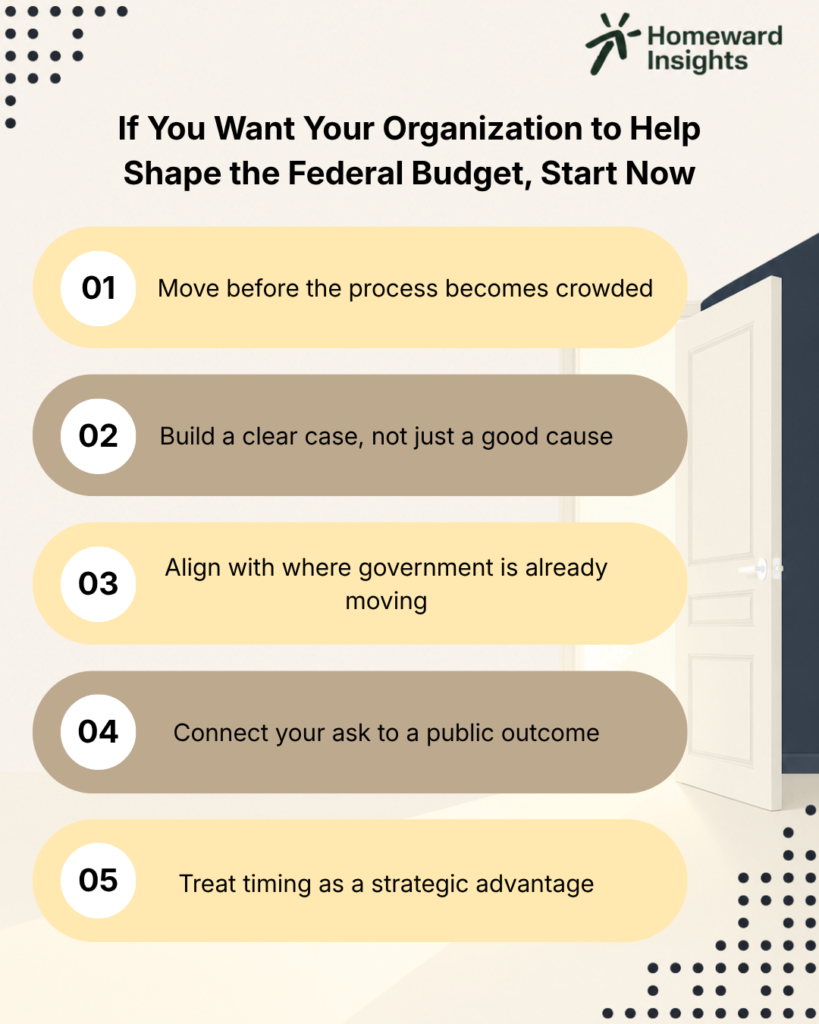
First, if your priority belongs in the budget, start now. Not later. Not once the process is obvious to everyone. Not once the public conversation is already underway.
Second, you need more than a good cause. You need a clear case, driven by economic sense. Worthiness alone does not determine what gets prioritized.
Third, timing and positioning matter as much as substance. A strong idea introduced too late can miss the window. A strong idea framed too narrowly can fail to connect.
Fourth, do not wait for perfect certainty. By the time everything feels obvious, much of the meaningful room to influence has already narrowed.
Finally, treat clarity as a strategic advantage. Organizations that understand how the budget window works are in a much stronger position than those reacting after the fact.
That does not guarantee success. But it can dramatically improve your odds of being heard at the right time, in the right way.
How Homeward Helps
At Homeward, we help organizations understand where these windows of opportunity exist, clarify what they want to advance, and position their ideas in ways that align with government direction and timing.
That does not mean reducing complex work to a slogan. It means helping mission-driven organizations tell the right story, to the right people, at the right moment.
Our role is not just to watch government. It is to help our clients move with it.
A Final Thought
If your organization has priorities that need to be in front of government this year, this is the moment to move.
And if you know this moment matters but are not sure what your next step should be, Homeward Talks is new platform, launching June 2nd, designed to help. It is a low-barrier way to speak with an expert, clarify your priorities, and begin mapping a plan.
Sometimes the most important step is simply getting the right conversation started.